 Pradnya Ganorkar
Written by Pradnya Ganorkar · Updated 27 October 2026
Protein in Chicken Breast
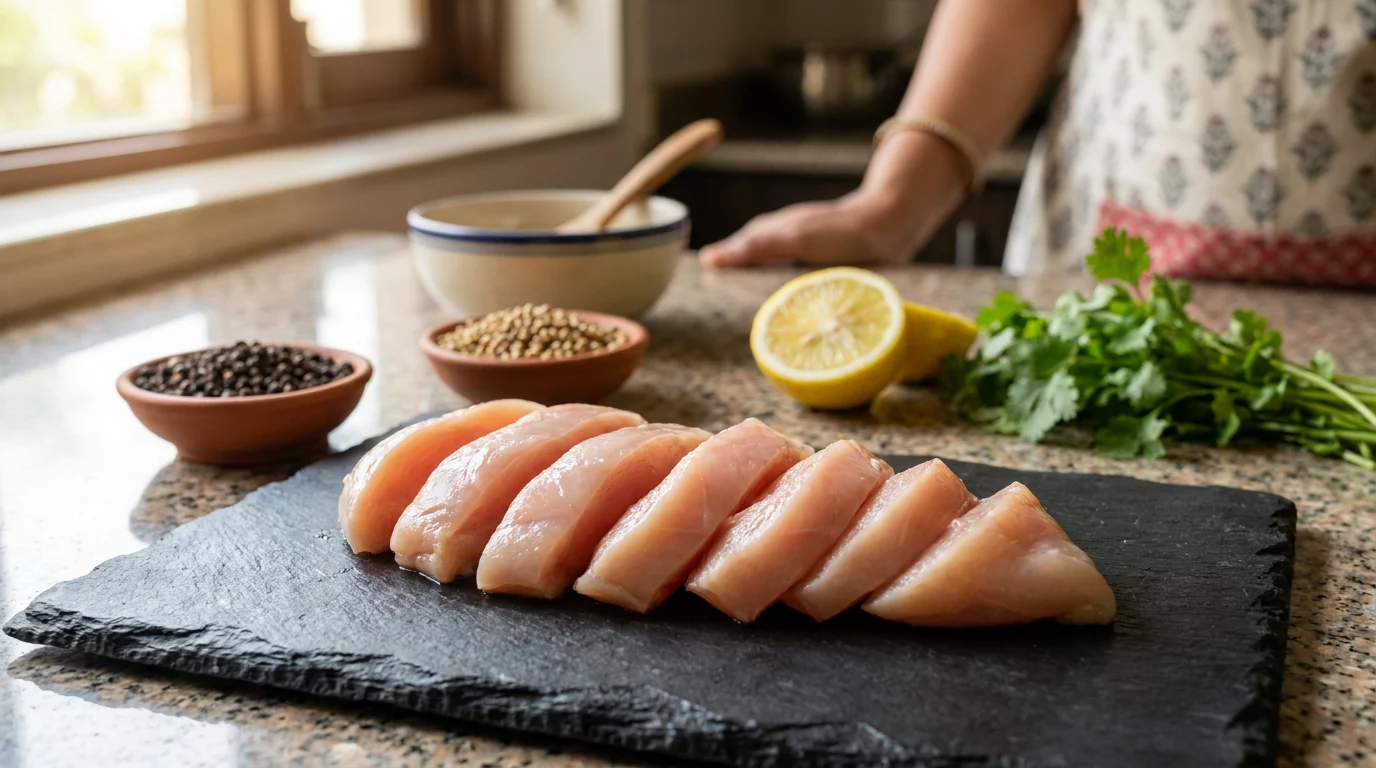
100 g of raw, skinless chicken breast has 21.81 g of protein. It also has 168 kcal of energy and 9.00 g of total fat. These values come from the Indian Food Composition Tables 2017 by the ICMR-National Institute of Nutrition, and they are for the raw, edible portion.
If you weigh your chicken before cooking, these are the numbers to log against. Below you will find the full table, a comparison with other chicken cuts and some practical notes from the Nutrimate Wellness team.
The full breakdown
Here is every value in the tables for chicken breast, per 100 g of raw, skinless, edible portion.
| Nutrient | Per 100 g |
|---|---|
| Energy | 168 kcal (704 kJ) |
| Protein | 21.81 g |
| Total fat | 9.00 g |
| Calcium | 12.91 mg |
| Iron | 0.83 mg |
| Potassium | 295 mg |
| Sodium | 36.70 mg |
| Magnesium | 20.20 mg |
| Zinc | 0.78 mg |
| Folate | 10.44 µg |
| Thiamine (B1) | 0.10 mg |
| Riboflavin (B2) | 0.06 mg |
| Niacin (B3) | 8.06 mg |
| Vitamin B6 | 0.53 mg |
Source of the values: Values from the Indian Food Composition Tables 2017 (ICMR-National Institute of Nutrition, Hyderabad), food code N003: Chicken, poultry, breast, skinless, mean of samples from 5 regions of India, per 100 g edible portion. The full tables are in the IFCT 2017 publication.
How Chicken Breast compares
These are similar rows from the same tables, all per 100 g.
| Food | Energy | Protein | Total fat | Iron |
|---|---|---|---|---|
| Chicken breast, skinless | 168 kcal | 21.81 g | 9.00 g | 0.83 mg |
| Chicken leg | 384 kcal | 19.44 g | 12.64 g | 1.27 mg |
| Chicken liver | 124 kcal | 21.57 g | 4.08 g | 9.92 mg |
| Chicken gizzard | 92 kcal | 18.22 g | 2.07 g | 3.19 mg |
Chicken breast has the most protein of the four at 21.81 g, with liver close behind at 21.57 g. Leg has the highest energy and total fat in this table. Liver stands out for iron, at 9.92 mg against 0.83 mg in breast.
Good to know
The values on this page are for raw chicken. This source gives no cooked figure for this cut, so match your log to the raw weight. They are also the mean of samples from 5 regions of India, so one piece on your plate can differ a little.
Pradnya Ganorkar, who answers these questions for Nutrimate Wellness users, sees one mistake again and again:
> "The biggest mistake is logging cooked weight against a raw value, or the other way round. Chicken loses water when it cooks, so 100 g of cooked breast has noticeably more protein than 100 g of raw breast. We tell people to weigh it in one state, usually raw before cooking, and log it as that same state every time," says Pradnya Ganorkar.
She also advises against leaning on one big chicken meal:
> "We suggest spreading protein across the day instead of relying on one big chicken meal. Pair a chicken meal with dal, curd, paneer, eggs or chana at other meals," says Pradnya Ganorkar.
Questions people ask
How much protein is in 100 g of chicken breast?
100 g of raw, skinless chicken breast has 21.81 g of protein. This is the mean of samples from 5 regions of India in the ICMR-National Institute of Nutrition tables.
How many calories and how much fat are in 100 g of chicken breast?
Per 100 g of raw, skinless chicken breast, the tables give 168 kcal (704 kJ) of energy and 9.00 g of total fat. Protein in the same 100 g is 21.81 g.
Does chicken breast or chicken leg have more protein?
Per 100 g, chicken breast has 21.81 g of protein and chicken leg has 19.44 g. Leg has more energy, 384 kcal against 168 kcal, and more total fat, 12.64 g against 9.00 g.
How much chicken do I need to eat to reach my protein for the day?
In our experience, this is the question we hear most. Many people think one piece of chicken in a curry covers it, but a home serving is often smaller than they assume, and the gravy adds calories without adding much protein. Your own needs are best assessed by a registered dietitian.
With Nutrimate Wellness
Nutrimate AI Nutrition and Fitness Tracking helps you track Indian food nutrition information, including calorie and protein tracking, with AI-assisted food logging and WhatsApp-based food logging. Nutrimate also provides free calorie tracking and nutrition guidance. Try the calorie calculator, read about everyday Indian foods rich in protein, or see the Nutrimate app.
Sources
Values are per 100 g of the edible part of the food, from the Indian Food Composition Tables 2017 (ICMR-National Institute of Nutrition). Actual values vary with variety, season, cooking and portion size.
This article is general information, not medical advice. Speak to a doctor or registered dietitian about your own needs.
Related on our website
More on this subject from us:
- 100 Gram Namkeen Calories: Complete Comparison of Popular Indian Snacks – Nutrimate
- Namkeen Calories: Nutritionist Guide to Indian Snack
- Protein in Atta: 10.57 g per 100 g (IFCT 2017)
Read Nutrimate Wellness first on Google