 Pradnya Ganorkar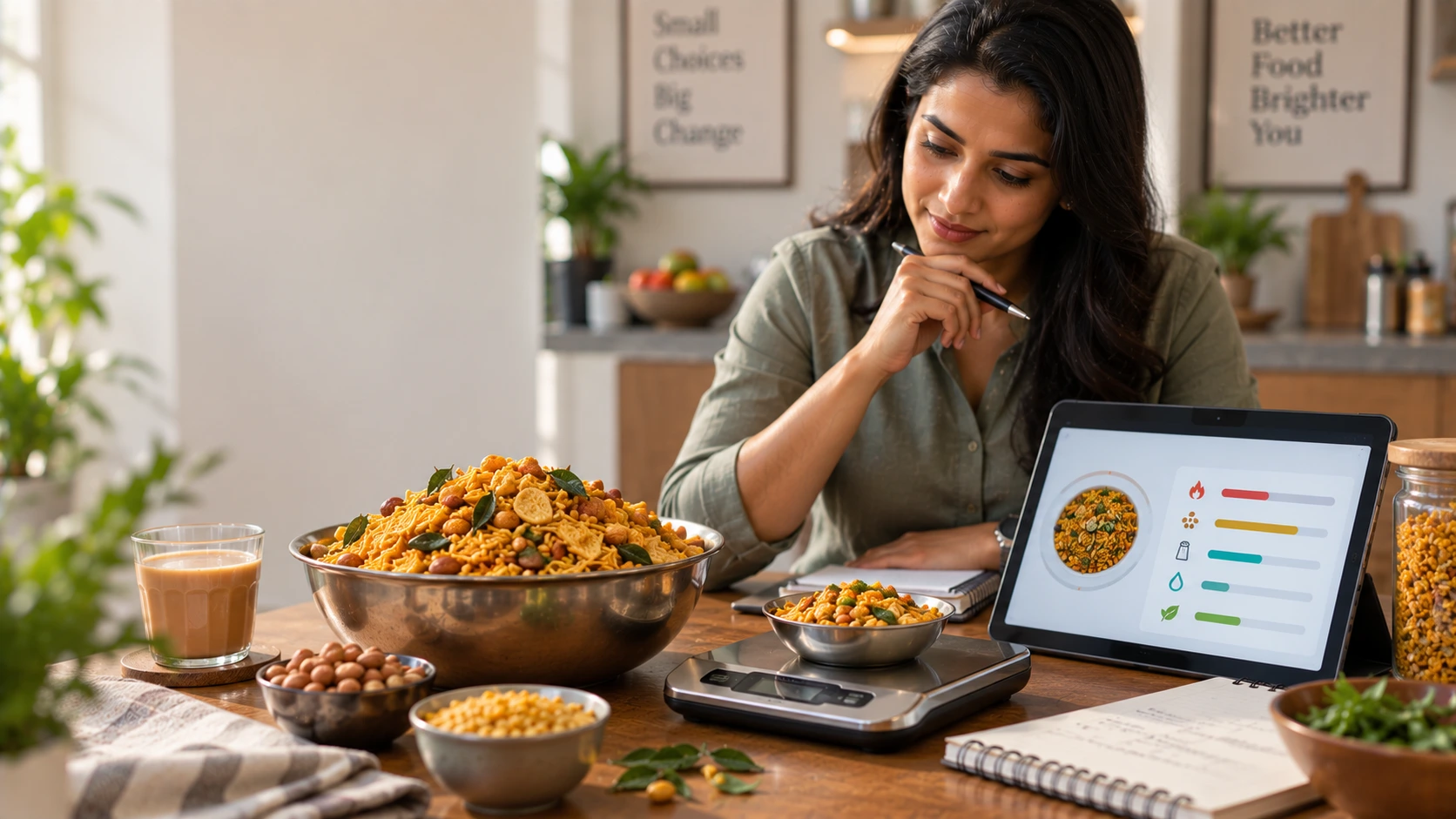
For many Indian diets, snacks are where calorie awareness quietly breaks down. A person may carefully manage breakfast, lunch, and dinner but still underestimate calories in namkeen because it is commonly treated as a light evening snack. Understanding 100 gm namkeen calories and 1 katori namkeen calories is therefore important for nutrition counselling, weight management, and everyday Indian snack nutrition.
Namkeen is not automatically unhealthy, but its calorie density, fat content, and sodium can make portion size particularly important. For nutrition professionals and consumers, the goal is not to eliminate familiar foods. It is to understand what a realistic portion contributes to the overall diet.
Why Indian Snacking Is the Biggest Blind Spot in Diet Counselling
Indian snacking often happens outside structured meals. A handful of namkeen with evening tea, a bowl while watching television, or an unmeasured serving during family gatherings may not feel significant.
The problem is that repeated small portions can become a meaningful part of daily energy intake.
This is especially relevant for people trying to manage weight. Someone may accurately estimate meals but overlook two or three servings of snacks during the day.
The issue is not simply calories. Commercial namkeen can also contribute substantial amounts of sodium and fat. The ICMR-NIN Dietary Guidelines for Indians specifically identify namkeen and other savoury snacks among foods that can be high in salt.
A useful counselling principle is:
Do not ask only, “Do you eat namkeen?” Ask, “How much, how often, and from which type?”
That shifts the conversation from food labelling to actual behaviour.
Calories in 100 gm Namkeen: The Numbers Across Common Types
The calories in 100 gm namkeen vary considerably according to ingredients, preparation method, oil absorption, and formulation.
Approximate values from the provided nutrition framework include:
| Namkeen type | Approximate calories per 100 g |
| Bhunja mixture | 450 to 480 kcal |
| Aloo bhujia | 540 to 560 kcal |
| Chivda | 400 to 430 kcal |
| Fried moong dal namkeen | Around 570 kcal |
This means 100 gram namkeen calories can represent a substantial amount of energy for a snack.
For someone trying to reduce calorie intake, the difference between 30 g and 100 g matters considerably. A snack that starts as a small handful can become several hundred calories without the person consciously deciding to eat a full meal’s worth of energy.
This is why nutrition education should focus on portion awareness, rather than simply labelling namkeen as good or bad.
A practical comparison
Consider two snack patterns:
- 25 to 30 g namkeen with tea
- A large bowl eaten directly from an open packet
The food is the same, but the behavioural context is completely different.
Pre-portioning the snack into a small bowl makes intake visible. Eating directly from the packet removes that visual stopping point.
For clients who struggle with weight management, this simple environmental change can be more useful than telling them to “avoid snacks.”
What 1 Katori Namkeen Actually Contains
The question of 1 katori namkeen calories is particularly relevant because “one bowl” is how many people describe their serving.
A standard katori of approximately 60 to 70 g of mixed namkeen can provide around 300 to 380 calories, depending on the product and composition.
That is considerably more than many people assume when they describe the portion as “just a little namkeen.”
The practical lesson is that household measures should be translated into approximate weights whenever accuracy matters.
For nutrition professionals, asking clients to photograph their actual bowl can also reveal a useful behavioural pattern. Two people may both report “one katori,” while their serving sizes are very different.
What to check on the package
When assessing 100 gram namkeen calories, look at:
- Energy per 100 g
- Energy per serving
- Serving size
- Total fat
- Saturated fat
- Sodium
- Protein
- Ingredients
This is especially important when comparing different brands. A smaller-looking packet is not necessarily a lower-calorie option.
Sodium Content: The Overlooked Problem in Namkeen
Calories receive most of the attention during weight-management conversations, but sodium deserves equal consideration for people who regularly consume packaged savoury snacks.
The provided figures indicate that popular namkeen products can contain approximately 600 to 900 mg of sodium per 100 g.
That becomes important when someone regularly consumes namkeen alongside other salty foods such as pickles, papads, packaged snacks, sauces, or processed foods.
The WHO recommends that adults consume less than 2,000 mg of sodium per day, equivalent to less than 5 g of salt.
Therefore, snack counselling should not focus exclusively on calories.
A useful three-question framework is:
- How many calories does this portion provide?
- How much sodium does it contribute?
- Does it provide enough protein or fibre to justify its place in the meal pattern?
This creates a more complete picture of snack quality.
For individuals managing hypertension or kidney-related conditions, sodium intake should be discussed according to their clinician’s recommendations rather than treated as a generic dietary target.
Healthier Snack Alternatives With Similar Satisfaction
The goal of improving snacking behaviour is not to remove enjoyment. It is to find options that provide better nutritional value and are easier to portion.
Practical alternatives include:
- Roasted chana
- Makhana
- Plain poha
- Sprouts with curd
These options can provide different combinations of protein, fibre, carbohydrates, and micronutrients while still satisfying the desire for something savoury or crunchy.
For example, roasted chana can work well when someone wants a crunchy snack but also needs a more substantial source of protein and fibre.
Makhana can be useful as a lighter snack when prepared with controlled amounts of fat and salt.
Sprouts with curd can create a more balanced snack by combining plant foods with a protein-rich dairy component.
The right choice still depends on the individual’s overall diet, energy requirements, health status, and preferences.
The objective is not to create a “perfect snack.” It is to make everyday choices easier to manage.
Using Digital Tools to Teach Snack Calorie Awareness
Nutrition education often fails when information remains theoretical.
Telling a person that namkeen is calorie-dense is less powerful than showing them what their actual serving contributes to their daily intake.
An indian calorie counter app or nutrition tracking app can make this process more practical when it contains relevant Indian food information.
Instead of searching through generic food databases, users can record the actual snack they consumed and compare it with their broader daily pattern.
For Indian users, the quality of the underlying indian food database matters because familiar foods and branded packaged products need to be represented accurately enough to support useful tracking.
This is where technology should remain an enabler, not the centre of the nutrition strategy.
The objective is simple:
Awareness → better portion decisions → greater consistency.
Nutrimate supports this approach through Indian food tracking and WhatsApp-based meal logging, allowing users to record everyday foods without making nutrition tracking another complicated task.
The positioning is particularly useful for people who want simple meal tracking without spending several minutes entering every ingredient manually.
For professionals working with fitness clients, FitVia by Nutrimate extends this ecosystem into structured coaching, combining Indian nutrition tracking with trainer dashboards and client engagement tools.
Building Snack Awareness Into Patient Counselling Sessions
Snack counselling becomes more effective when it is specific.
Rather than telling a patient to “reduce junk food,” a nutrition professional can ask:
What snack do you usually eat?
Then establish:
- Typical portion
- Frequency
- Brand or preparation
- Approximate calorie contribution
- Sodium contribution
- What triggers the snack
- What could replace or reduce the portion
For example, if a patient consumes a large bowl of namkeen every evening while working, the intervention may not need to be complete elimination.
A more sustainable strategy could be:
Large bowl → measured portion → lower-sodium alternative → occasional larger serving
This approach recognises real Indian routines instead of assuming that people will permanently remove familiar foods.
Digital tracking can reinforce the lesson. Nutrimate can be used to log branded Indian snacks through WhatsApp, helping users build awareness around the foods they actually eat rather than relying on generic diet examples.
As part of Nutrimate’s broader positioning, the platform also includes India’s #1 whatsapp meal logging feature and Unique Caregiver feature, designed around reducing friction in everyday health tracking.
The most useful nutrition intervention is often the one a person can repeat.
A simple snack-awareness framework
For patients, trainers, and wellness professionals, use this four-step process:
1. Identify
Record the actual snack and brand.
2. Measure
Estimate the realistic portion rather than relying on “one handful” or “one bowl.”
3. Compare
Look at calories, sodium, protein, and fibre.
4. Adjust
Reduce the portion, change the frequency, or choose a more nutrient-dense alternative.
This makes calories in namkeen a practical nutrition lesson rather than another abstract number.
References
- ICMR-NIN Dietary Guidelines for Indians
- WHO Sodium Reduction Guidance
FAQs
Calories in 100 gm namkeen range from 400 to 570 depending on the type. Fried varieties like aloo bhujia are on the higher end, while baked or roasted variants are lower.
A standard katori of 60 to 70 grams of mixed namkeen contains approximately 300 to 380 calories along with significant fat and sodium.
Most commercial namkeen is calorie-dense, high in sodium, and low in protein and fibre, making it a poor choice for weight management. Portion-controlled roasted alternatives are better options.
Popular namkeen brands contain 600 to 900mg of sodium per 100g, a significant concern for patients managing hypertension or kidney conditions.