 Pradnya Ganorkar
Written by Pradnya Ganorkar · Updated 26 November 2026
Calories in Guava
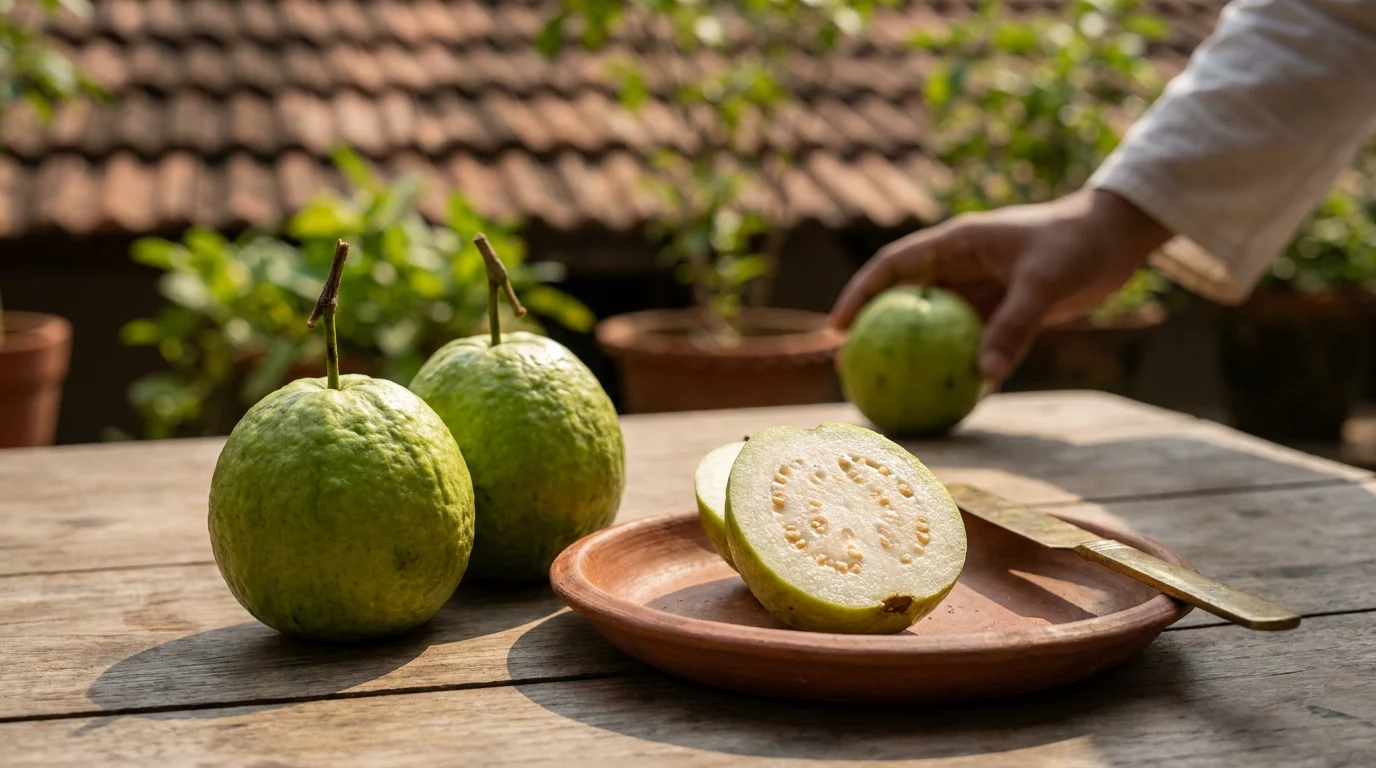
Guava has 32 kcal (135 kJ) of energy per 100 g of edible portion, according to the Indian Food Composition Tables 2017. These tables give values by weight, not for one whole fruit, so the calories in your guava depend on how much it weighs. In India, guava is also called Amrud, Peru, Aamba and Amrodh.
The full breakdown
Values are from the Indian Food Composition Tables 2017 (ICMR-National Institute of Nutrition, Hyderabad), food code E028: Guava, white flesh, mean of samples from 5 regions of India, per 100 g edible portion. These are published food composition values, not measurements made by Nutrimate Wellness.
| Nutrient | Per 100 g edible portion |
|---|---|
| Energy | 32 kcal (135 kJ) |
| Protein | 1.44 g |
| Carbohydrate (available) | 5.13 g |
| Total fat | 0.32 g |
| Dietary fibre | 8.59 g |
| Total sugars | 4.10 g |
| Calcium | 18.52 mg |
| Iron | 0.32 mg |
| Potassium | 283 mg |
| Sodium | 2.87 mg |
| Magnesium | 15.26 mg |
| Zinc | 0.23 mg |
| Vitamin C | 214 mg |
| Folate | 29.76 µg |
The energy value is low for the amount of fibre. Most of the weight of a guava is not fat or protein, so the numbers above are small except for fibre, potassium and vitamin C.
How guava compares
Here are similar rows from the same Indian tables, side by side, all per 100 g.
| Food | Energy | Protein | Carbohydrate (available) | Total fat | Dietary fibre | Total sugars |
|---|---|---|---|---|---|---|
| Guava | 32 kcal | 1.44 g | 5.13 g | 0.32 g | 8.59 g | 4.10 g |
| Amla | 24 kcal | 0.34 g | 4.39 g | 0.16 g | 7.75 g | 3.39 g |
| Apple | 62 kcal | 0.29 g | 13.11 g | 0.64 g | 2.59 g | 9.53 g |
| Avocado | 144 kcal | 2.95 g | 1.75 g | 13.86 g | 6.69 g | 1.65 g |
Guava has fewer calories than apple and avocado, and more than amla. Its dietary fibre is higher than all three of the others in this table.
Good to know
Guava is exceptionally rich in vitamin C and has a high fibre content for a fruit. The Indian tables list 214 mg of vitamin C and 8.59 g of dietary fibre in 100 g.
Be careful when you compare numbers from different websites. One database, nutritionfactlabel.com, lists one common guava (55 g edible portion) at 37 calories. That source uses different data, so its figures differ from the Indian tables. Pick one source, and use it consistently when you log your food.
If you want a calorie count for your own guava, weigh the edible part and use the per 100 g values above.
Questions people ask
How many calories are in a whole guava?
The Indian Food Composition Tables 2017 give guava as 32 kcal per 100 g edible portion, with no weight for a whole fruit, so the count depends on the size of your guava. A different database, nutritionfactlabel.com, lists one common guava (55 g edible portion) at 37 calories. Its figures differ from the Indian tables, so do not mix the two.
How many calories are in 100 grams of guava?
Guava has 32 kcal (135 kJ) per 100 g edible portion, according to the Indian Food Composition Tables 2017 (food code E028, white flesh). The same 100 g has 1.44 g protein, 5.13 g available carbohydrate, 0.32 g fat and 8.59 g dietary fibre.
Is guava a protein or carbohydrate?
Guava is mainly a carbohydrate source rather than a protein source. In the Indian tables, 100 g of guava has 5.13 g available carbohydrate and 1.44 g protein. If you are tracking protein, treat guava as a fruit that adds fibre and vitamin C, not protein.
Are fresh guavas good for you?
Guava is exceptionally rich in vitamin C and has a high fibre content for a fruit. The Indian tables list 214 mg vitamin C and 8.59 g dietary fibre per 100 g. Whether it suits your own needs depends on your health, so speak to a doctor or registered dietitian.
With Nutrimate Wellness
Nutrimate AI Nutrition and Fitness Tracking offers AI-assisted food logging, Indian food nutrition information, calorie and protein tracking, and WhatsApp-based food logging. If you log fruit such as guava often, a consistent source and a consistent portion make your daily totals easier to trust. You can also use our calorie calculator or read how to calculate daily calories in India.
Sources
Values are per 100 g of the edible part of the food, from the Indian Food Composition Tables 2017 (ICMR-National Institute of Nutrition). Actual values vary with variety, season, cooking and portion size.
This article is general information, not medical advice. Speak to a doctor or registered dietitian about your own needs.
Related on our website
More on this subject from us:
- 100 Gram Namkeen Calories: Complete Comparison of Popular Indian Snacks – Nutrimate
- Protein in Chicken Breast per 100 g: Full Nutrition Table
- Namkeen Calories: Nutritionist Guide to Indian Snack
Read Nutrimate Wellness first on Google