 Pradnya Ganorkar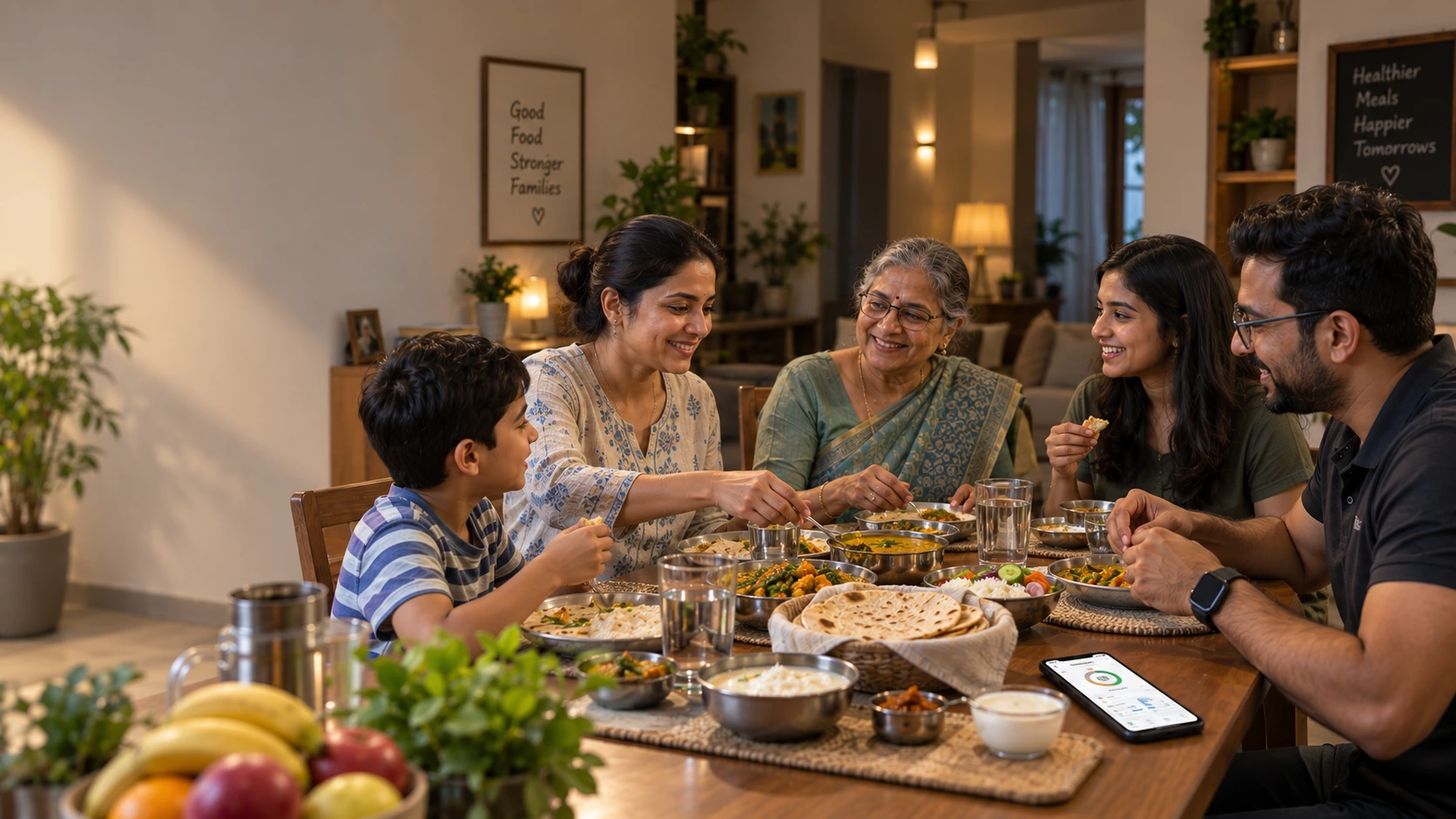
When people search for lifestyle diseases India, they often think about individual choices: exercising more, reducing sugar, losing Weight loss, or following a better Indian diet.
But many everyday health behaviours are not individual decisions. They are family routines.
What appears on the dinner table, how meals are prepared, whether the family eats together, how often packaged snacks are bought, and whether older parents stay physically active can shape family health over many years.
This is why prevention needs to move beyond individual discipline. It needs to become part of everyday family life.
The World Health Organization identifies unhealthy diet and insufficient physical activity among the major behavioural risk factors associated with noncommunicable diseases.
The practical question is not whether every family can follow a perfect diet.
It is whether a family can build healthy Indian eating habits that are realistic enough to continue.
Why Health Habits Are Learned at Home, Not in a Clinic
A consultation can provide information. A family environment determines how easily that information becomes a habit.
A child who regularly sees vegetables, dal, fruit and balanced portions on the family table develops a different food environment from someone whose routine revolves around fried snacks, sugary drinks and irregular meals.
The same applies to adults.
A working professional may know that regular meals and physical activity matter, but busy lifestyles in india can make healthy choices difficult. Long commutes, late meetings, school schedules and family responsibilities often push health decisions to the bottom of the priority list.
This is why why staying healthy is hard is not always a motivation problem.
Sometimes the environment itself makes unhealthy behaviour easier.
The family can change that environment.
A parent preparing a balanced breakfast, a spouse choosing a home-cooked evening meal, or children joining a short post-dinner walk can turn health habits into something shared rather than imposed.
The ICMR-NIN Dietary Guidelines for Indians 2024 specifically frame healthy eating as a practical concern for individuals, families and communities, with an emphasis on food choices and variety rather than complicated nutrient calculations.
How Family Meal Patterns Shape Lifelong Habits
Family meals create repetition.
Repetition creates familiarity.
Familiarity can influence preference and behaviour.
Consider a typical Indian household where breakfast may rotate between poha, idli, dosa, paratha or bread. Lunch may include rice or roti with dal, vegetables and curd. Evening tea may come with biscuits or namkeen calories, while dinner varies according to work schedules.
There is nothing inherently wrong with Indian food.
The problem often comes from portions, preparation methods, frequency and the overall pattern.
For example, someone may search for protein in average indian meal because their meals contain plenty of carbohydrates but not enough protein-rich foods. Another person may regularly snack without realising how much energy comes from foods such as namkeen.
The better question is not “Is this food healthy?”
It is:
How does this food fit into the family’s overall eating pattern?
A family can make small improvements without creating separate meals for every person.
For example:
- Add dal, legumes, curd, eggs or other suitable protein sources to regular meals.
- Include vegetables more consistently.
- Keep highly processed snacks as occasional foods rather than automatic evening habits.
- Make water the default beverage.
- Keep portions realistic instead of treating traditional foods as forbidden.
- Build regular meal timings where the household schedule allows.
This approach supports Indian food and health without turning dinner into a calorie-counting exercise.
Breaking Cycles of Unhealthy Habits Across Generations
Generational habits can be surprisingly powerful.
A child may learn that every evening requires a packaged snack because that is what the family has always done.
An adult may continue eating oversized portions because that was normal at home.
Parents may become less active with age while younger family members gradually adopt the same sedentary routine.
These patterns do not mean that families are destined to repeat unhealthy behaviours.
They mean that prevention often starts with identifying the pattern.
For example, if a household notices frequent evening snacking, the solution does not have to be eliminating snacks altogether.
The family could change what is available, reduce frequency, introduce more filling options, or simply become more conscious of the habit.
This is the foundation of sustainable health habits for Indians.
The goal is not a dramatic 30-day transformation.
It is to make the healthier behaviour easier to repeat.
The same principle applies to activity. A family does not need everyone to become a gym member. A short walk after dinner, taking stairs when practical, active weekend outings or household movement can all contribute to a more active routine.
For families supporting older adults, parents health also deserves attention. Changes in food habits, activity, weight or energy should not be treated casually when someone has an existing medical condition. Appropriate screening and professional guidance remain important.
Simple Changes at the Dinner Table That Compound Over Time
Prevention becomes more realistic when families stop trying to change everything at once.
A useful starting point is the three-part dinner table check:
1. What is already working?
Do not remove familiar foods simply because they are traditional.
Roti, rice, dal, vegetables, curd and regional dishes can all be part of a balanced eating pattern.
This also helps challenge the roti rice weight gain myth. Weight change is influenced by overall energy intake, activity and individual circumstances, not by declaring one staple food automatically responsible.
2. What is missing?
Look at the meal as a whole.
Is there a useful protein source?
Are vegetables regularly included?
Are portions appropriate?
Are snacks or sugary drinks becoming routine?
For people asking about protein for indian vegetarians, the practical answer is to look across the entire day’s food pattern rather than expecting one meal to solve the problem.
3. What can become easier?
If tracking meals is difficult, choose the simplest possible method.
For a family already comfortable with smartphones, easy way to track meals may be more sustainable than maintaining a detailed handwritten diary.
A simple meal tracker app can help families observe recurring patterns without turning every meal into a mathematical exercise.
Nutrimate approaches this problem through Indian-first, WhatsApp-first meal logging, making everyday tracking simpler for individuals and families. Its India’s #1 whatsapp meal logging feature and Unique Caregiver feature also reflects an important reality: family health often involves helping parents or other family members stay consistent with everyday health habits.
The purpose of tracking is not perfection.
It is visibility.
Once a family can see a recurring pattern, it becomes easier to decide what needs changing.
Making Prevention a Family Value, Not an Individual Chore
One of the biggest reasons why diets fail long term is that they are often treated as temporary individual projects.
One person starts a diet.
The rest of the family continues eating normally.
The person eventually gets tired of preparing separate meals, resisting familiar foods or following rules that do not fit everyday life.
A family approach is different.
Instead of asking one person to “eat healthy”, the household can make small changes together.
That creates a more practical lifestyle change.
It also reduces the feeling that healthy living means giving up normal Indian food.
For example, a family can decide to:
- Cook with more awareness of oil and portion sizes.
- Include a protein source in regular meals.
- Keep fruit or other practical options available.
- Reduce routine consumption of heavily processed snacks.
- Walk together when possible.
- Support older family members in staying active according to their abilities.
- Review recurring food habits rather than obsessing over individual meals.
For families managing multiple generations, a family health tracking app can also provide a practical way to notice patterns.
Similarly, health tracking for parents can help caregivers stay organised around everyday information, particularly when family members live in different households.
The technology should remain in the background.
The family habit is what matters.
A Family Dinner Table Checklist
Use this simple checklist once or twice a week:
Food
- Does the meal include a useful protein source?
- Are vegetables or other nutrient-rich foods included?
- Are portions appropriate for the household’s needs?
- Are packaged snacks becoming an everyday habit?
Family routine
- Are meals regularly skipped because of work or school?
- Does everyone eat at completely different times?
- Are children learning healthy food habits from the adults around them?
Parents and older family members
- Are their food and activity routines changing?
- Does anyone need additional support with health tracking for parents?
- Are existing health conditions being managed with appropriate professional guidance?
Behaviour
- What one habit is working well?
- What one habit repeatedly causes problems?
- What is the smallest change the family can maintain?
The goal is not to make the dinner table another place for health anxiety.
It is to make it a place where healthier choices become normal.
Prevention does not always begin with a strict diet, an expensive membership or a complicated tracking system.
Sometimes it begins with what the family cooks, what everyone eats, what children observe, and what parents continue doing year after year.
That is how family health can become part of everyday life rather than another individual responsibility.
FAQs
Family habits can support prevention by making healthier eating, regular physical activity and consistent routines easier to maintain. They cannot eliminate disease risk completely, but they can influence several modifiable behaviours associated with lifestyle diseases India.
Repeated meal patterns influence what people regularly eat, portion habits, food preferences and the overall household food environment. Consistent healthy Indian eating habits can make balanced eating easier to maintain across generations.
Start with practical changes such as including a protein source, adding vegetables, becoming more aware of portions, reducing routine processed snacks and avoiding unnecessary separate meals for different family members. The best change is one the household can repeat consistently.
Read Nutrimate Wellness first on Google