 Pradnya Ganorkar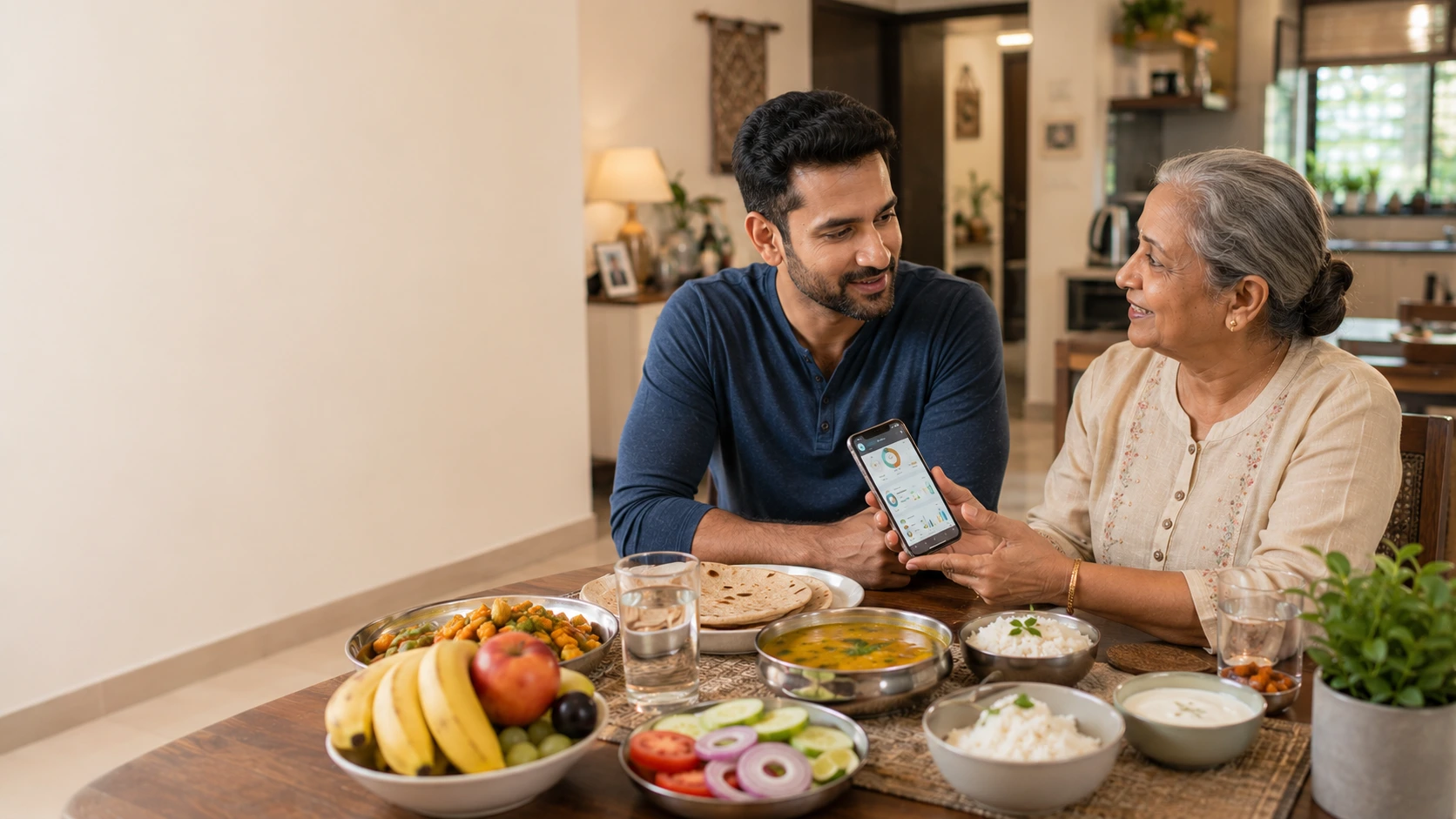
Health tracking for parents can be useful when it helps families stay informed, support better routines and notice changes early. But tracking a parent’s meals is not simply a technology question. It is a question of consent, trust and family boundaries.
For a working professional living in another city, knowing whether an ageing parent is maintaining agreed healthy Indian eating habits can provide reassurance. For a caregiver, shared information can also make everyday coordination easier.
The important distinction is this: tracking should support a parent, not control them.
Why This Question Comes Up More Often Than People Admit
Many Indian families are becoming geographically separated.
A son may work in Bengaluru while his parents live in Pune. A daughter may be based in Mumbai while her parents remain in their hometown. Regular phone calls can help, but they do not always provide a clear picture of everyday routines.
The questions are familiar:
“Did you eat?”
“Did you follow your diet?”
“Are you taking care of yourself?”
These questions usually come from concern. But repeated questioning can eventually feel like pressure, particularly when an adult parent feels that their independence is being questioned.
This is where health tracking for parents can be useful if approached correctly.
Instead of repeatedly asking for updates, families can agree on a simple system where the parent records relevant information and chooses what should be visible to family members.
The purpose is not to create a digital record of every decision.
It is to reduce uncertainty while keeping the parent in control.
This becomes particularly relevant for families concerned about lifestyle diseases India faces and the everyday habits that can influence long-term health. However, tracking should complement professional healthcare, not replace it.
The Difference Between Support and Surveillance
The technology may look similar, but the intention and consent process are completely different.
Support looks like:
- A parent knowingly agrees to share selected information.
- The family discusses what should be visible.
- The parent can change their mind.
- Family members use the information to offer help rather than criticism.
- Health professionals remain responsible for medical advice and treatment.
Surveillance looks like:
- Tracking someone without their knowledge.
- Expecting access to every meal or activity.
- Using information to question or discipline the person.
- Treating every deviation from a routine as a problem.
- Removing the parent’s ability to decide what remains private.
The National Health Authority’s digital health framework places strong emphasis on consent-based processing and individual control over health information. It also highlights the importance of collecting only relevant information and limiting access according to need.
That principle translates well to family technology.
A parent should not have to surrender privacy simply because their children are worried about them.
Having the Conversation With Your Parents First
The most important step happens before downloading an app.
Have a normal conversation.
Do not begin with:
“We need to track what you eat.”
Instead, explain the reason behind the idea.
For example:
“I live away from you, and sometimes I worry that I don’t know how your routine is going. Would you be comfortable sharing some basic meal or health information with me so I can stay involved?”
Then listen.
Your parent may agree immediately. They may want to share only certain information. They may not want tracking at all.
All three responses should be respected.
A useful conversation can establish:
- What will be tracked?
- Why is it being tracked?
- Who can see it?
- How frequently will it be reviewed?
- What happens if the parent stops sharing?
This makes the arrangement collaborative rather than imposed.
For example, a parent may be comfortable sharing meal activity but not weight information. Another may prefer to share only a weekly summary.
There is no single correct level of visibility.
What Respectful, Opt-In Tracking Looks Like
A respectful family health system should make the parent an active participant.
A simple model is:
Parent records information → Parent chooses what to share → Family sees agreed information → Family offers support when appropriate
This is very different from:
Child accesses information → Child monitors parent → Parent is questioned about deviations
The first model protects independence while improving communication.
A practical family health tracking app should therefore provide clear controls around shared information.
Useful capabilities can include:
Individual profiles
Each family member should have their own information rather than placing the entire household into one generic health profile.
Selective sharing
The parent should be able to decide what family members can see.
Caregiver visibility
A caregiver may need useful context, particularly when living in another city, but visibility should be limited to what the family has agreed is relevant.
Simple meal tracking
Indian meals vary considerably across households. A practical system should make it easy to record foods such as dal, roti, rice, sabzi, curd, poha, dosa and homemade snacks without turning every meal into an administrative exercise.
Easy withdrawal
Consent should not be treated as permanent.
If a parent becomes uncomfortable with sharing, they should be able to reduce or stop access.
Nutrimate’s family and caregiver approach is built around this principle of shared visibility rather than one-sided monitoring. The objective is to make family collaboration easier while respecting individual control.
Signs You Might Be Overstepping
Even well-intentioned family members can cross the line.
Watch for these signals:
You are commenting on every meal
If every shared meal produces a correction, the system has stopped being supportive.
Your parent feels watched
If they start changing what they log because they are worried about your reaction, trust is being lost.
You expect perfect compliance
Health routines are not identical every day.
A samosa at a family gathering or an occasional dessert does not automatically mean someone has failed.
You are using tracking to replace conversation
Technology should make communication easier, not eliminate it.
Sometimes the most useful response to a change in routine is simply:
“Is everything okay?”
You want access to more information than you actually need
Ask yourself whether you need the information to provide meaningful support.
If the answer is no, it probably does not need to be shared.
You are making medical conclusions from lifestyle data
Meal or activity tracking can reveal patterns, but it does not diagnose medical conditions.
If something appears concerning, encourage the parent to speak with an appropriate healthcare professional.
The goal of tracking should be awareness, not self-diagnosis.
A Respectful Family Tracking Checklist
Before setting up health tracking for parents, use this checklist:
- Have we discussed tracking openly?
- Has the parent given clear consent?
- Does the parent understand what will be shared?
- Can the parent decide who has access?
- Are we tracking only information that is genuinely useful?
- Can access be changed or withdrawn?
- Are we using information to support rather than criticise?
- Are we respecting existing family boundaries?
- Are we still having normal conversations instead of relying entirely on the app?
- Are we avoiding unnecessary health anxiety?
- Are medical questions being directed to qualified healthcare professionals?
- Does the system make caregiving simpler rather than creating another responsibility?
The strongest family health technology should make people feel more connected, not more watched.
For families living across cities, a consent-based approach can provide useful visibility without turning everyday meals into a performance review. The parent remains in control, while children and caregivers can stay meaningfully involved.
That balance is the real purpose of respectful family health tracking.
FAQs
Yes, when an adult parent knowingly agrees to it and understands what information will be shared, with whom and for what purpose. Tracking should be voluntary and supportive. It should never become covert monitoring or a way to control everyday food choices.
Start with your concern rather than the technology. Explain that you want to stay involved because you live away or cannot always be present. Ask what information they would be comfortable sharing and let them decide the boundaries.
Caregiving support is transparent, consent-based and focused on helping. Surveillance involves monitoring someone without their knowledge or using their information to control their behaviour. A respectful system allows the parent to remain in control of their own information.
Read Nutrimate Wellness first on Google