 Pradnya Ganorkar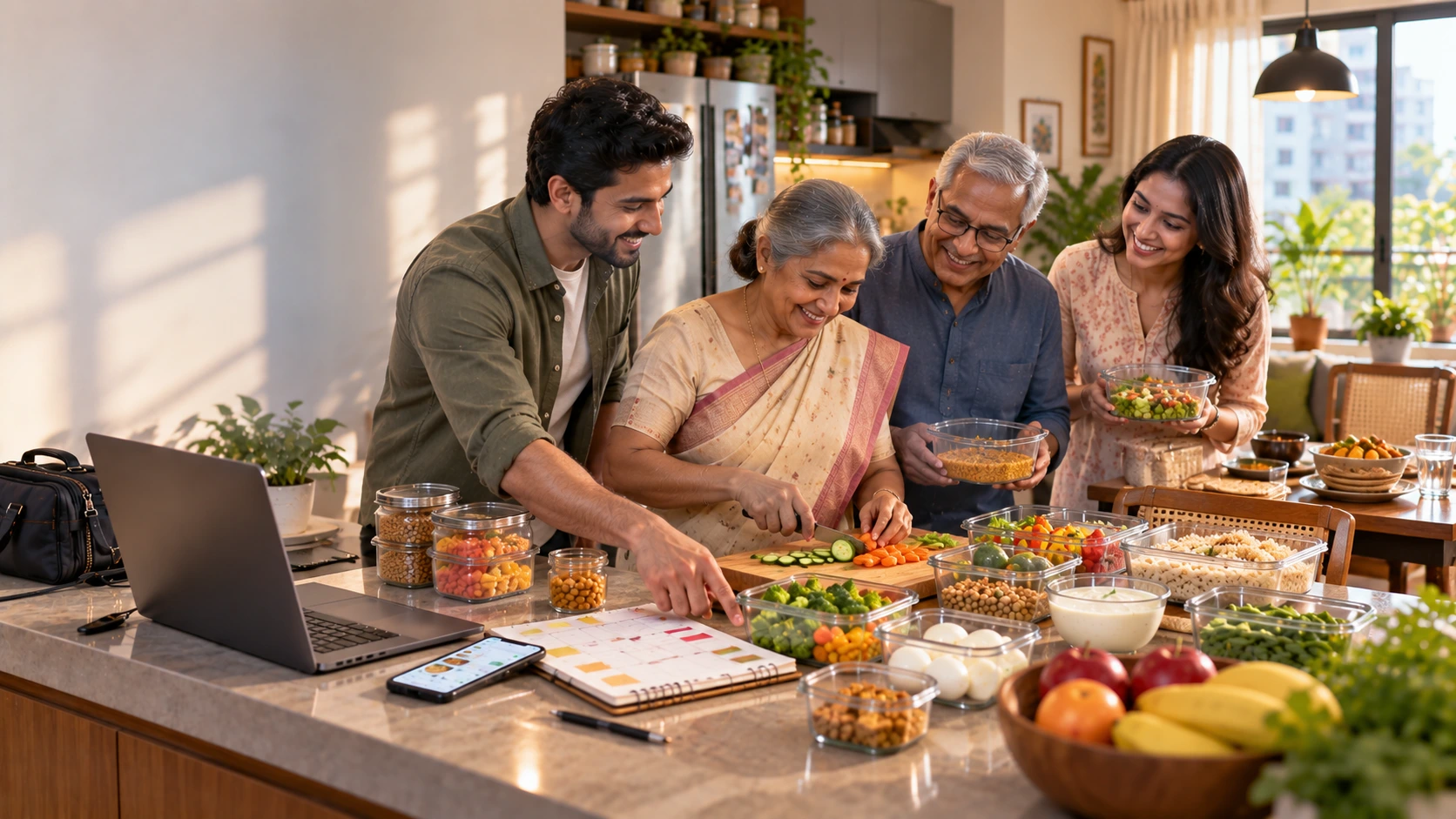
Managing family health through food sounds straightforward until Monday morning arrives. One parent is rushing to work, children need breakfast and lunch boxes, someone wants poha, another wants eggs, and dinner decisions are still pending. By Wednesday, the carefully planned meals often give way to takeout, biscuits, namkeen, or whatever is quickest.
The problem is rarely a lack of nutrition knowledge. It is the absence of a realistic system.
For Indian households, effective indian meal planning does not mean preparing seven different meals or spending an entire weekend in the kitchen. It means creating a flexible structure that works around school timings, office schedules, preferences, budgets, and the reality of cooking Indian food every day.
Why Indian Families Eat Well on Sundays and Poorly on Wednesdays
Sunday creates the illusion of control. There is more time to shop, cook, prepare vegetables, and think about the week ahead.
Wednesday exposes whether that plan was actually practical.
This is where family health often gets affected. A family may intend to eat dal, vegetables, fruit and homemade meals, but when preparation becomes difficult, convenience wins. Working parents may skip breakfast, children may rely on packaged snacks, and dinner may become carbohydrate-heavy because rice or roti is easier to prepare than a complete meal.
The goal is not perfection. It is reducing the number of decisions a family has to make when everyone is tired.
A practical weekly system should answer three questions:
- What are our basic meals for the week?
- Which ingredients can be prepared in advance?
- What can we do when the original plan fails?
This is also why stress free living should be part of a nutrition strategy. A meal plan that creates more stress will eventually be abandoned.
The Meal Planning Problem Specific to Indian Households
Indian households often have one kitchen serving people with very different nutritional requirements.
A parent may want to reduce weight. A teenager may need more energy for sports and growth. A child may be selective with vegetables. A working professional may eat lunch outside the home. An older parent may need more attention to regular meals and dietary quality.
Trying to create a separate menu for everyone makes meal planning unnecessarily complicated.
A better approach is a shared food base with individual adjustments.
For example:
Common family meal: dal + seasonal sabzi + roti + curd
Adult trying to manage weight: moderate roti portion and more vegetables
Teenager who is physically active: additional roti or rice and an appropriate protein serving
Child: same family meal, with portions and presentation adjusted to age and preference
This approach supports indian family wellness because the household eats together without requiring identical portions.
The ICMR-National Institute of Nutrition’s Dietary Guidelines for Indians also emphasize variety across food groups, including cereals and millets, pulses, vegetables, fruits, nuts and seeds, and milk or curd.
The practical lesson is simple: build the family menu around nutritious foods that people will actually eat.
A Weekly Meal Architecture That Works for Indian Families
A useful family food plan india does not need a new recipe every day. Instead, create a weekly architecture with repeatable meal components.
A simple structure can look like this:
| Meal component | Weekly approach |
| Breakfast | Rotate 4 to 5 options such as poha, upma, idli, dosa, eggs or paratha with curd |
| Lunch | Dal or legumes + vegetable + roti/rice + curd |
| Evening snack | Fruit, roasted chana, nuts, homemade snack or another planned option |
| Dinner | Repeat the same balanced structure with different vegetables or protein |
| Fruit | Keep 2 to 3 seasonal options available |
| Protein | Rotate dal, legumes, eggs, paneer, curd and other family-appropriate sources |
The purpose is not to make the menu exciting every day. It is to make healthy eating easier on busy days.
For indian diet for busy professionals, the same principle works outside the home. Instead of trying to follow a completely separate diet, identify reliable options at the office cafeteria, nearby restaurant, or tiffin service.
A sustainable routine is one that survives a busy Tuesday, not just a relaxed Sunday.
Simple Meal Prep Strategies That Save Time Without Sacrificing Nutrition
Weekly meal prep india becomes useful when it prepares ingredients rather than entire meals.
A two-hour Sunday session can focus on high-use components such as:
- Preparing dal or legumes for quick cooking
- Boiling eggs for the next few days
- Soaking or cooking legumes in batches
- Washing and cutting selected vegetables
- Preparing basic chutneys or accompaniments
- Portioning nuts and simple snacks
- Keeping curd, fruit and other regular foods easily accessible
The objective is to bring weekday cooking closer to 30 minutes rather than trying to cook everything in advance.
For example, if dal is already prepared, vegetables are washed, and eggs are boiled, dinner can become a simple combination of dal, sabzi, roti and curd rather than a fresh cooking project from scratch.
This also helps address one of the biggest barriers to healthy eating: friction.
WHO guidance emphasizes dietary variety, including vegetables, fruits, legumes, whole grains and appropriate protein sources, while recommending limits on excessive salt, free sugars and unhealthy fats.
The goal is therefore not complicated recipes. It is making nutritious ingredients the easiest ingredients to reach.
How to Involve Children in Family Meal Planning
Children should not experience healthy eating as something imposed entirely by adults.
Involving them in small decisions can make family meals easier to maintain.
For example, ask a child to choose:
- One fruit for the week
- One vegetable they want included
- One breakfast from two available options
- One healthy snack they would like prepared
- One meal they can help assemble
This supports children nutrition india in a practical way because children become familiar with different foods rather than simply being told what they cannot eat.
Parents can also create a simple “family food rule”: everyone eats the shared family meal, but portions and additions can be adjusted according to age, activity and individual needs.
For parents managing several household members, health tracking for parents can also become useful. Instead of relying entirely on memory, families can observe whether meals are regular, whether certain foods are consistently missing, and whether children or older family members are developing recurring eating patterns.
The objective is awareness, not surveillance.
Managing Food Budgets While Maintaining Nutritional Quality
A nutritious family diet does not have to depend on expensive health foods.
One of the most practical advantages of Indian food is the availability of relatively affordable staples such as dal, chana, rajma, seasonal vegetables, rice, wheat, eggs, curd, peanuts and locally available fruits.
A sensible family cooking routine can reduce both food waste and unnecessary spending.
Try these principles:
- Buy seasonal produce instead of building the menu around expensive out-of-season foods.
- Plan meals around ingredients already available at home.
- Use the same core ingredients across multiple meals.
- Keep inexpensive protein sources available.
- Avoid buying large quantities of snacks simply because they are convenient.
- Prepare realistic quantities so leftovers are actually eaten.
Budget planning also becomes easier when families stop treating healthy food as a collection of speciality products.
A household can build a nutritious routine using familiar Indian foods without following expensive diet trends.
When Meal Tracking Replaces Meal Planning
Meal planning answers: What should we eat?
Meal tracking answers: What did we actually eat?
That difference matters.
A family may plan dal and vegetables for dinner but end up ordering food because someone worked late. A parent may plan fruit as an evening snack but discover that the family repeatedly chooses packaged snacks instead. These patterns are difficult to identify from a plan alone.
This is where a family health tracking app can complement planning.
Instead of tracking food simply to count calories, families can use meal tracking to understand patterns: skipped meals, frequent snacks, low protein intake, inconsistent vegetables, or repeated reliance on convenience foods.
Nutrimate takes this approach by combining planning and tracking around Indian meals and everyday routines. Its Indian-first, WhatsApp-first approach is designed to make logging less disruptive to daily life, including India’s #1 whatsapp meal logging feature and Unique Caregiver feature for households that need greater visibility across family wellness.
The broader principle is more important than the technology: track reality, not intention.
A useful system looks like this:
Plan loosely → eat normally → track consistently → identify gaps → adjust the next week.
That creates a feedback loop instead of another restrictive diet.
For busy households, this can be more sustainable than trying to follow a perfect meal plan every day. It also makes preventive family health more practical because small patterns can be noticed before they become deeply established habits.
Reference:
- ICMR-NIN Dietary Guidelines for Indians
- WHO Healthy Diet Guidance
FAQs
A two-hour Sunday session that prepares key protein components like dal, boiled eggs, and soaked legumes reduces daily cooking time to under 30 minutes. Rotate four to five simple base meals through the week for variety without full daily cooking.
A plan that includes dal or legumes at lunch and dinner, one egg or paneer serving, seasonal vegetables, roti or rice in moderate portions, curd daily, and seasonal fruit covers the essential nutritional requirements for most family members.
Build meals around a shared base that is accepted by everyone, then customise protein additions. Children and adults often share the same dal and sabzi while protein portions and carbohydrate quantities vary by individual need.
For some families yes. Daily tracking of what is actually eaten reveals patterns and gaps more accurately than planning what should be eaten. Many families find tracking and planning work together.