 Pradnya Ganorkar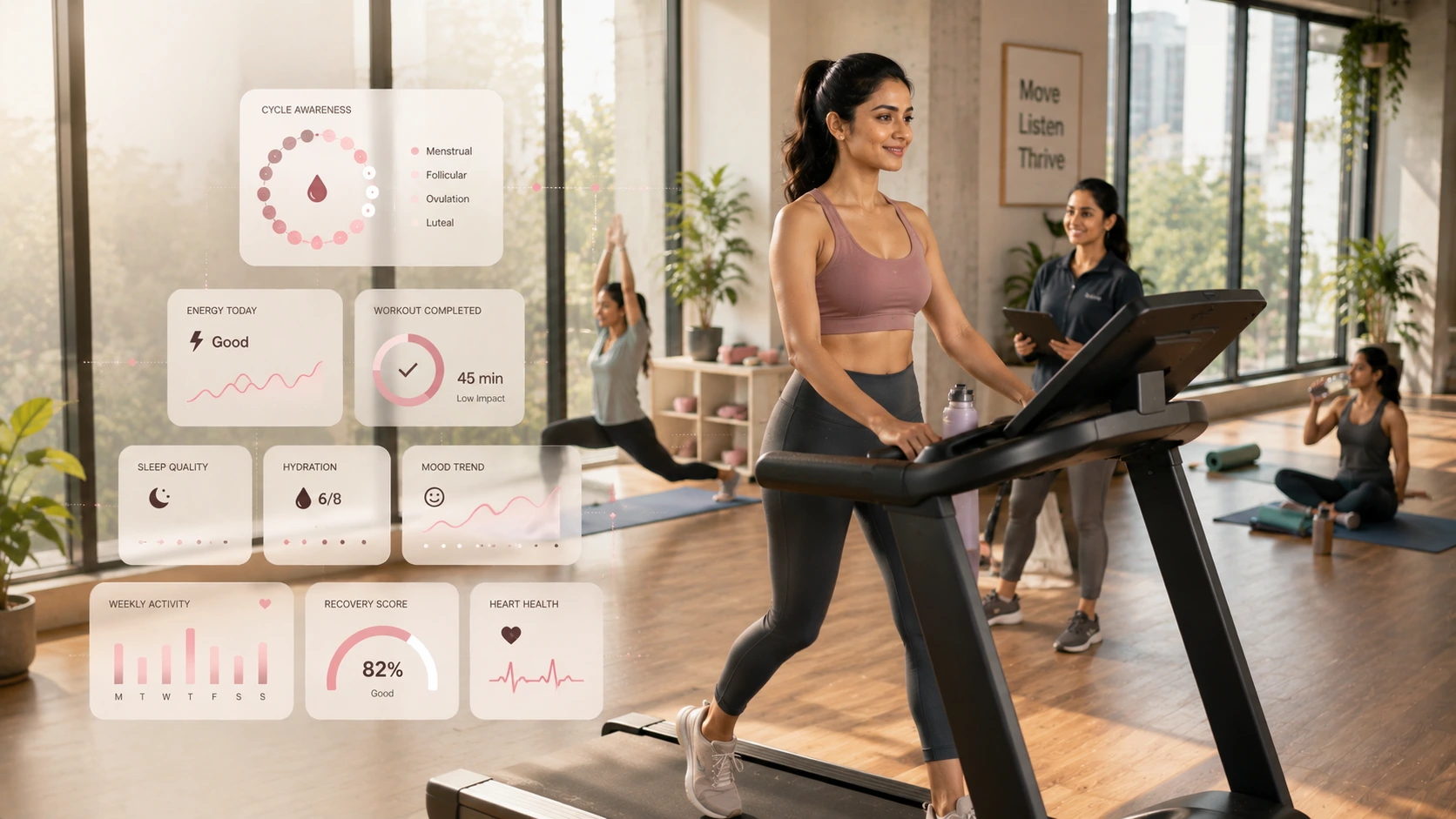
Quick answer: Yes, exercising during your period is safe and often reduces cramps and
improves mood. Listen to your body on heavy-flow days — lighter movement counts. As for
“cycle syncing” workout plans: research shows hormonal phases have at most small, highly
individual effects on performance, so your own tracked pattern matters more than any
generic phase chart.
Myth 1: “Don’t exercise during periods”
False, and the opposite of what evidence suggests. Light-to-moderate exercise — walking,
yoga, moderate gym work — is associated with reduced menstrual cramp severity and
better mood. There is no medical reason for healthy women to skip movement during
periods. Adjust intensity to comfort: heavy-flow day 1–2 might be a walk-and-stretch day;
that still counts.
Myth 2: “You must train according to your cycle phase”
This one is popular on Instagram, so here is the honest version. A 2020 systematic review and meta-analysis in Sports Medicine examining exercise performance across menstrual cycle phases concluded that effects are trivial to small and vary enormously between individuals [1]. Elite athletes compete and set records in every phase.
What IS real:
- Symptoms are real even if performance effects are small. Cramps, luteal-phase fatigue, disturbed sleep before periods — these affect how training feels and how consistently you show up.
- Individual patterns are real. Some women reliably feel strongest mid-cycle and sluggish pre-period; others notice nothing. The only way to know your pattern is to track it.
So the evidence-based approach is not a rigid phase chart — it is tracking your own cycle
alongside your workouts for 2–3 months and adjusting to your own data.
A practical (honest) template
Use this as a starting hypothesis to test against your own tracking, not a rulebook:
- Period days (heavy flow): move by comfort — walking, stretching, light weights. Skip nothing on principle; scale by feel.
- Post-period to mid-cycle: many women subjectively report the best energy here — a reasonable window for pushing progressive overload or attempting PRs.
- Pre-period week: if you consistently log fatigue/poor sleep here, plan maintenance sessions instead of max attempts, and protect sleep.
- Any phase: iron status matters more than phase (see our anaemia guide) — persistent unusual fatigue during training deserves a blood test, not a motivation lecture.
Red flags — when exercise + periods need a doctor
- Periods stopped after increasing training (with or without dieting) — this signals under fuelling (low energy availability) and needs attention, not celebration
- Pain severe enough to prevent normal activity every cycle
- Very heavy bleeding that makes any activity difficult
FAQs
Yes. Adjust intensity by comfort. Many women find movement reduces cramps.
Regular exercise is associated with improved cycle symptoms overall; extreme training with under-eating can make periods lighter or stop them — which is a warning sign.
Whatever you tolerate comfortably: walking, yoga, swimming, moderate weights. There is no forbidden list for healthy women.
Current evidence shows small, individual effects at most [1]. Tracking your own cycle and energy is more useful than any generic phase plan.
References
1. McNulty KL, et al. The Effects of Menstrual Cycle Phase on Exercise Performance in Eumenorrheic Women: A Systematic Review and Meta-Analysis. Sports Medicine. 2020.
https://pubmed.ncbi.nlm.nih.gov/32661839
General wellness information, not medical advice