 Pradnya Ganorkar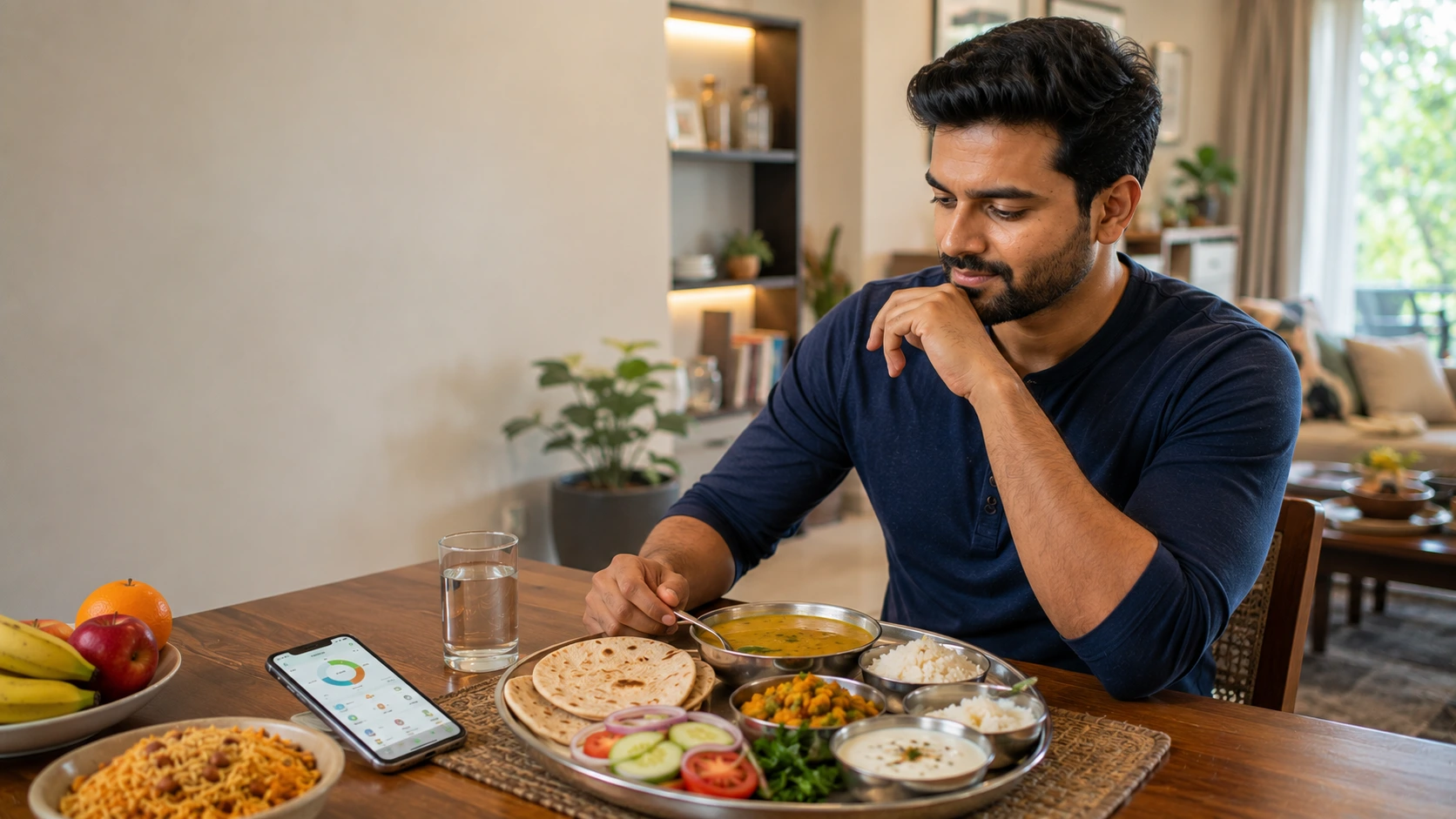
For many Indians, downloading an indian calorie counter app feels like the logical first step toward better eating. But after a few days of entering every roti, spoon of dal, cup of chai and handful of namkeen, the process can become exhausting.
That raises a useful question: do you actually need to count every calorie to build healthy Indian eating habits?
The short answer is no, not everyone needs detailed calorie counting. Calorie tracking can be useful for specific goals, but meal awareness, portions, food quality and consistency can also create a practical foundation for healthier eating.
This article explains where calorie counting helps, where it can become difficult to sustain, and how an awareness-first approach can work for people who want better nutrition without turning every meal into a calculation.
Why Calorie Counting Feels Exhausting for Many Indians
The challenge is not that calories are irrelevant. The challenge is that Indian meals are often difficult to reduce to a single database entry.
A home-cooked meal could include:
- Two rotis
- Dal
- Seasonal sabzi
- Curd
- Salad
- A spoon of pickle
- Cooking oil used across the preparation
Then there are snacks, office chai, weekend restaurant meals and family occasions.
For someone already managing a demanding job, commute and family responsibilities, manually recording every ingredient can become another daily task.
This is where calorie counting fatigue can become a practical barrier.
The problem is particularly relevant to busy lifestyles in India, where a system that requires perfect tracking may be difficult to maintain.
ICMR-NIN’s dietary guidance takes a broader approach to healthy eating, emphasising variety across food groups, vegetables, whole grains, pulses or beans, fruits and other nutrient-rich foods rather than focusing only on calories.
The lesson is important: nutrition is bigger than one number.
What Calorie Counting Gets Right (and Where It Falls Short)
Calorie counting has a genuine advantage.
It creates numerical awareness.
Someone who believes a particular snack is “small” may discover that frequent portions contribute substantially to their overall intake. Understanding 100 gm namkeen calories, for example, can make portion size more visible than simply thinking of namkeen as an occasional snack.
Similarly, understanding calories in namkeen can help someone recognise how a few unplanned servings may add up.
Calorie tracking can be particularly useful when:
- You have a specific weight-management target
- You are working with a qualified professional
- You need greater precision for a particular fitness goal
- You want to understand your current eating pattern
- You are comfortable maintaining the habit
But there are limitations.
Calories do not tell the complete story of food quality, satiety, protein, fibre or micronutrient variety. Two meals with similar calorie values can have very different nutritional compositions.
ICMR-NIN’s Dietary Guidelines describe a balanced diet as one that provides adequate calories, protein, vitamins, minerals and fibre through a variety of foods.
So calorie awareness can be useful, but it should not become the only definition of healthy eating.
Meal Awareness as an Alternative Approach
Food tracking without calorie counting focuses on understanding what you eat without requiring precise numerical calculations for every meal.
Instead of asking:
“Exactly how many calories did this contain?”
you might ask:
“What did I eat, how much did I eat, and how balanced was the meal?”
For an Indian household, that could mean noticing whether your lunch usually contains:
- A protein source such as dal, curd, paneer or beans
- Vegetables
- A sensible portion of rice or roti
- Adequate variety
- Excessive fried or sugary additions
This approach can make meal awareness easier to maintain.
Example
Imagine an office worker who regularly eats:
Breakfast: Poha and chai
Lunch: Rice, dal and sabzi
Evening: Biscuits with sweetened chai
Dinner: Roti, paneer and vegetables
Instead of calculating every ingredient immediately, the person can first identify patterns:
- Which meals provide meaningful protein?
- Where are snacks becoming automatic?
- Are vegetables appearing consistently?
- Are portions larger on weekends?
- Is hunger driving evening snacking?
That information can lead to practical changes without requiring perfect numerical tracking.
For someone who has repeatedly downloaded and abandoned calorie apps, this can be a more approachable starting point.
When Calorie Counting Genuinely Helps
There are situations where detailed tracking makes sense.
For example, someone preparing for a specific fitness objective may benefit from understanding their energy intake more precisely.
Similarly, a person working with a dietitian may be asked to track specific quantities to help evaluate their dietary pattern.
In these situations, a calorie counter can provide useful structure.
The key is to treat tracking as a tool, not a test of discipline.
A practical approach can look like this:
| Situation | Potentially useful approach |
| General healthy eating | Meal awareness |
| Understanding portions | Occasional calorie checking |
| Specific weight-management goal | More structured tracking |
| Fitness goal requiring precision | Detailed tracking may help |
| Tracking feels stressful | Simplify the process |
| Working with a dietitian | Follow the professional’s tracking approach |
The goal should be a method you can realistically continue.
Choosing the Approach That Fits Your Life
There is no universal requirement to use one tracking method.
Consider three levels of awareness.
Level 1: Basic awareness
Notice what you eat, when you eat and how often you snack.
This may be enough for someone who simply wants to improve everyday food choices.
Level 2: Structured meal awareness
Record meals and look for patterns across several days.
This is useful when you want more visibility without calculating everything.
Level 3: Detailed calorie tracking
Track quantities and calories more precisely.
This can be appropriate when you have a specific objective that benefits from numerical accuracy.
The important point is that you can move between levels.
Someone may begin with simple meal tracking, discover that evening snacks are frequent, and then use detailed calorie information for selected foods rather than calculating every homemade meal.
Technology can support this process.
Nutrimate’s approach focuses on making everyday Indian meal awareness simpler, particularly for people who find manual calorie entry difficult to sustain. Instead of making perfect calorie calculation the objective, the emphasis is on seeing eating patterns and building consistency.
For Indian users, this distinction matters because the easiest system to maintain is often more useful than the most detailed system that gets abandoned.
A Simple Awareness-First Checklist
Before deciding that you need to count every calorie, start with these questions:
- Do I know what I am eating most days?
- Am I aware of my usual portions?
- Do my main meals contain a reasonable mix of food groups?
- Do I regularly include protein sources?
- Are snacks planned or mostly automatic?
- How often do I drink sugary beverages?
- Do weekends look significantly different from weekdays?
- Am I eating because I am hungry or simply because food is available?
- Can I maintain detailed tracking without feeling overwhelmed?
- Would simpler sustainable health habits be more realistic for me?
If you want more precision, you can always move toward detailed calorie tracking later.
For many people, however, the first step is simply becoming more aware of their meals.
A useful nutrition system should make that awareness easier, not turn eating into an accounting exercise.
FAQs
No. Calorie awareness can be useful for weight management, but it is not the only approach. Portion awareness, food quality, physical activity and sustainable eating habits also matter. People with specific goals may benefit from structured calorie tracking, particularly when guided by a qualified professional.
Yes. You can build healthier eating patterns by focusing on balanced meals, appropriate portions, food variety, protein sources, vegetables, fruits and limiting excess added sugar, salt and highly processed foods. ICMR-NIN’s dietary guidance supports a varied, balanced approach to nutrition.
Meal awareness tracking means recording or reviewing what you eat to identify patterns without necessarily calculating the exact calories in every meal. It can help you understand portions, food choices, snacking habits and consistency while keeping the tracking process simpler.
Read Nutrimate Wellness first on Google