 Pradnya Ganorkar
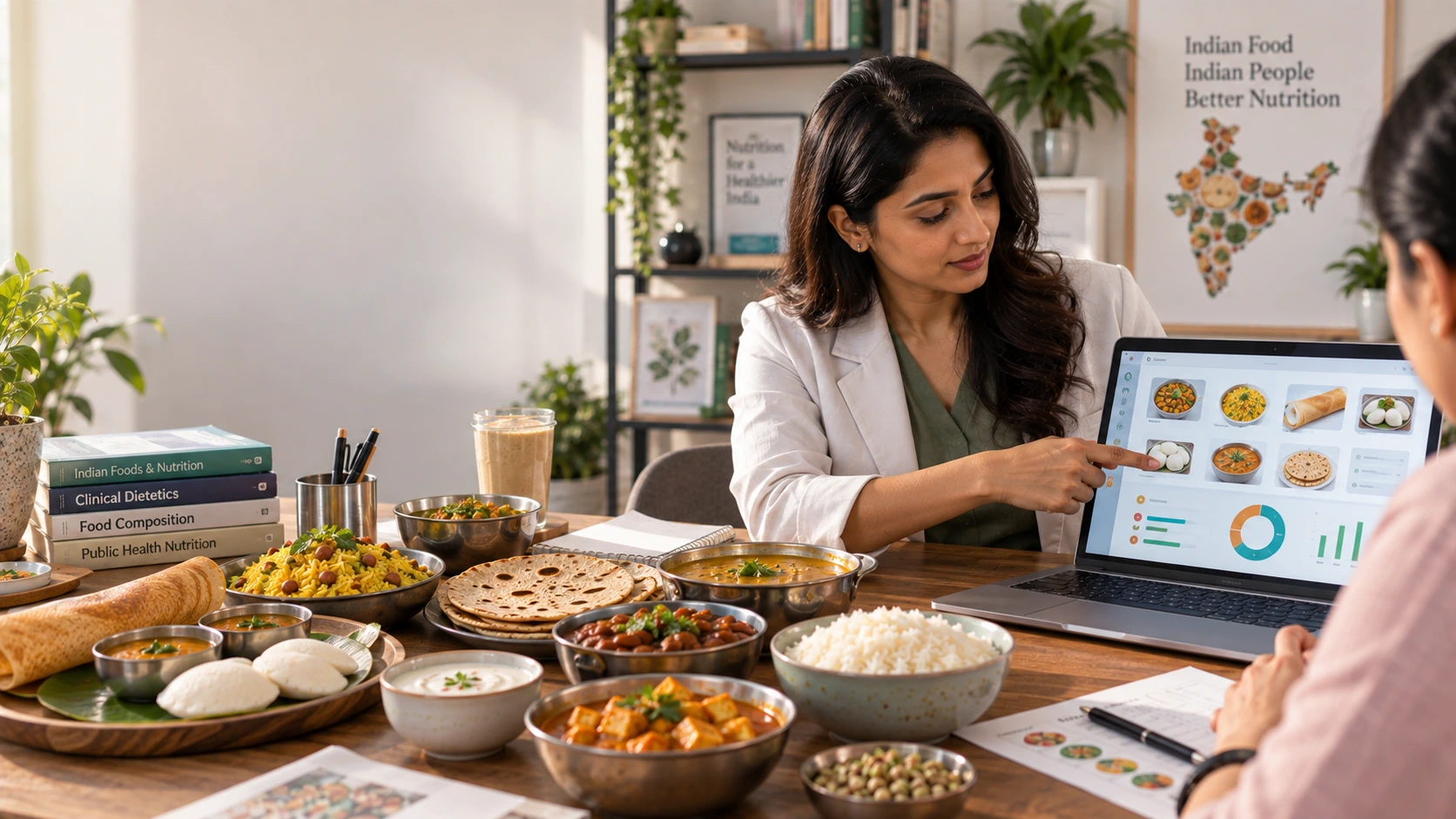
Clinical nutrition in India has one fundamental challenge that generic nutrition software often overlooks: Indian food is highly diverse. A reliable indian food database needs to reflect regional recipes, preparation methods, branded foods, household portions, and culturally familiar meals.
For nutritionists, dietitians, doctors, trainers, and wellness professionals, accurate nutrition tracking app data is not simply a convenience. It determines whether a patient’s food record provides useful information or creates another layer of estimation.
This is especially important when using nutrition app india solutions for patient nutrition tracking. The quality of the underlying food data matters as much as the interface used to record it.
Why Generic Food Databases Fail Indian Clinical Nutrition
A patient may log idli sambar, dal baati churma, sattu paratha, poha, biryani, or a regional fish curry. These foods cannot always be represented accurately by selecting a generic Western equivalent.
The problem becomes more significant when a professional is assessing protein, carbohydrates, fats, fibre, sodium, or total energy intake.
For example, “rice with curry” is not a nutritionally precise description of every Indian meal. A Bengali meal involving rice and maacher jhol has different ingredients and preparation characteristics from a Tamil meal involving rice and sambar.
A useful database therefore needs to answer questions such as:
- What food was actually consumed?
- Which regional preparation was used?
- Was it raw, boiled, fried, roasted, or cooked with additional ingredients?
- What portion was consumed?
- Is the entry a household recipe or a packaged product?
- Which nutrient values can be traced back to a credible source?
The ICMR-National Institute of Nutrition’s food composition work specifically includes nutritional databases for cooked foods and laboratory-based determination of nutrients, highlighting why preparation and composition matter in Indian nutrition data.
What a Clinically Reliable Indian Food Database Must Contain
A useful indian food database should go beyond a long list of food names.
At minimum, professionals should look for five layers of information:
1. Standardised Indian food composition data
IFCT 2017 provides an important Indian reference for food composition. The published tables were developed by the National Institute of Nutrition and contain nutrient information for Indian foods. ICMR-NIN describes the tables as covering key foods sampled from across the country using statistically valid sampling methods.
2. Regional foods
The database should recognise foods from different parts of India rather than assuming one standard Indian diet.
Examples include:
- Dal baati
- Sattu
- Idli and dosa
- Poha
- Rajma
- Regional fish preparations
- Parathas
- Local snacks and sweets
3. Cooking methods
The same base ingredient can produce substantially different nutritional profiles depending on preparation.
Boiled, fried, roasted, steamed, and cooked-with-oil versions should not automatically be treated as interchangeable.
4. Branded and packaged foods
Patients increasingly consume packaged snacks, breakfast products, beverages, and ready-to-eat foods. A clinically useful system should therefore distinguish standard food composition data from branded product information.
5. Practical portion sizes
Patients rarely describe meals in grams.
They say:
- One katori dal
- Two rotis
- One glass chaas
- Half a plate poha
- One bowl curd
Digital nutrition systems need a practical way to translate everyday portions into meaningful nutritional information.
Regional Diversity and Why One Database Rarely Covers It
India’s food culture changes significantly across states, communities, and households.
A nutrition professional working with patients in Maharashtra may frequently encounter poha, bhakri, usal, misal, varan bhaat, and regional snacks. A professional working with patients in Punjab may see different staples, while a clinician in Tamil Nadu may work with idli, dosa, sambar, rasam, and rice-based meals much more frequently.
This creates an important principle:
An Indian food database should be broad enough to represent regional diversity but structured enough to maintain nutritional consistency.
ICMR-NIN’s ongoing work on nutrition and health mapping also recognises geographical, socioeconomic, and cultural differences in food consumption patterns across India.
For clinical teams, this means the most useful database is not necessarily the one with the most entries. It is the one that represents the foods their patients actually eat with credible nutritional values.
How to Evaluate a Nutrition App for Indian Food Database Quality
Before recommending a nutrition tracking app, professionals should test it against real patient behaviour.
A simple evaluation framework is to select 10 regional dishes commonly consumed by your patient population.
Then check:
- Does the exact food exist?
- Are regional variations recognised?
- Are cooking methods differentiated?
- Can patients select realistic portions?
- Are packaged products distinguishable from generic foods?
- Can nutrient values be traced to a credible source?
- Does the system avoid presenting generic Western food as an Indian equivalent?
The same approach applies when evaluating an indian calorie counter app.
A polished interface does not compensate for weak food data. If a patient repeatedly receives inaccurate estimates for familiar foods, the resulting tracking can create false confidence.
For professionals evaluating a patient nutrition tracking platform, food accuracy should therefore be treated as a core product criterion rather than a secondary feature.
Integrating Digital Food Databases Into Clinical Workflow
The biggest benefit of digital food data is not simply faster calorie calculation. It is reducing the friction between what a patient eats and what a professional can actually review.
Traditional food diaries often depend on patients remembering meals, estimating quantities, and manually recording ingredients.
A simpler workflow can be:
Eat → Log → Analyse → Identify gap → Adjust → Repeat
For example, a patient may consistently record meals containing rice, dal, vegetables, and curd. Over several days, the nutrition professional can identify whether protein, fibre, total energy, or another nutrient consistently falls short of the individual’s plan.
This makes patient nutrition tracking more useful because the professional can focus consultation time on behaviour and decisions rather than reconstructing every meal manually.
Nutrimate applies this principle through Indian food intelligence and simple WhatsApp-based meal logging. The technology remains in the background while the primary objective stays focused on making everyday nutrition easier to record and understand.
AI-Powered Indian Food Recognition: Where It Is Heading
AI can make Indian nutrition tracking easier, but recognition alone does not guarantee nutritional accuracy.
Identifying a photograph as “dal rice” is only the first step. A useful system also needs to understand the food composition, approximate portion, preparation, and relevant nutritional values.
That distinction is important.
Recognition answers: “What does this look like?”
Food intelligence answers: “What food is this, how was it prepared, what quantity was consumed, and what does that mean nutritionally?”
For clinical applications, the second question matters more.
AI-powered systems should therefore be connected to validated food composition data rather than functioning as independent sources of nutritional truth.
For professionals, the ideal direction is a combination of:
- Indian food recognition
- Standardised composition data
- Regional food understanding
- Portion estimation
- Patient-specific nutrition targets
- Longitudinal meal records
The Future of Indian Food Intelligence in Clinical Nutrition
The future of clinical nutrition india will increasingly depend on making accurate nutrition information usable outside the consultation room.
A dietitian may spend one hour with a patient, but the patient eats several times every day. Digital tools can help bridge that gap by turning everyday meals into structured information that can be reviewed over time.
This is also where consumer and professional wellness ecosystems can complement each other.
For example, FitVia by Nutrimate extends Indian nutrition tracking into the fitness ecosystem, giving gym owners, trainers, influencers, and dietitians access to tools such as trainer dashboards, nutrition tracking, progress monitoring, and Indian food data.
The broader opportunity is not to make patients track more information. It is to make the information they already generate through everyday eating more useful.
A strong local food database, credible Indian composition reference, simple logging experience, and professional review workflow can together create a more practical model of nutrition care.
For India, food intelligence needs to begin with Indian food, Indian preparation methods, and Indian eating behaviour. The technology should make that information easier to use, not replace professional judgement.
FAQs
The IFCT 2017 from the National Institute of Nutrition is the gold standard. Digital platforms integrating this database with regional variations are the most practical clinical tools.
They lack regional Indian dish data, have inaccurate entries for common Indian foods, and do not account for Indian cooking methods.
Test it with 10 regional dishes your patients commonly eat and cross-reference values against IFCT 2017.
Summary data is accessible through the National Institute of Nutrition. Full integration into clinical tools requires licensed database partnerships.