 Pradnya Ganorkar
Written by Pradnya Ganorkar · Updated 21 November 2026
To track calories for Indian food accurately, weigh or measure what you eat, log it against a food database that covers Indian dishes, and record cooking oil and ghee separately. The national reference for this is IFCT 2017, India's reference database of what foods contain. An app built around Indian food, such as Nutrimate, makes the habit easier to keep.
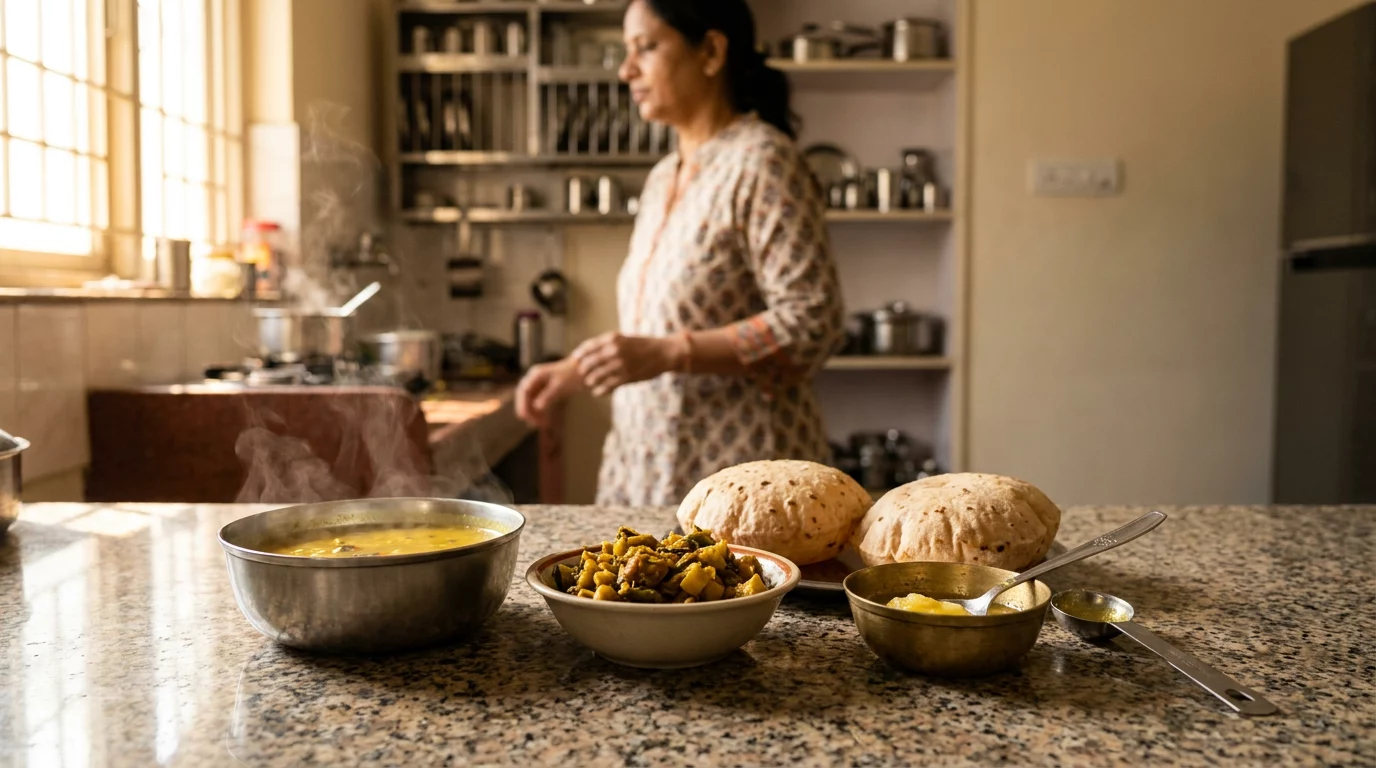
This guide is about everyday home cooking: dal, sabzi and roti on a normal weekday. It explains where calorie numbers come from, how to handle the parts of a thali that are hard to measure, and where WhatsApp logging fits in. It is general information and does not tell you how much you should eat.
Why is tracking Indian food calories harder than it looks?
Packaged food has a label. A home-cooked meal does not. The same dal can weigh and taste very differently from one kitchen to the next, because one family finishes it with a spoon of ghee and another keeps it plain.
Indian meals add other difficulties. A thali is several small dishes eaten together. A katori at your home may be smaller or larger than a katori at a friend's home. Sabzi is often cooked in more oil than people remember, and a roti can be thin or thick depending on who rolled it.
None of this puts accurate tracking out of reach. It means you need a few fixed habits, so that your records stay consistent from day to day. Consistent records are more useful than perfect ones that you give up on after a few days.
Where do calorie numbers for Indian foods come from?
The most trusted starting point is IFCT 2017. It serves as India's main reference database for the nutritional content of foods. Scientists at ICMR-NIN, Hyderabad, collected samples of foods from across India, analysed them in the laboratory and reported average values for energy, protein and fat. Dietitians, researchers and food laboratories in India rely on it as their standard reference for laboratory-analysed nutrient values of Indian foods.
Two things follow from this. First, it makes sense to prefer a tracker that offers Indian food nutrition information, and to check which data an app uses before you trust its numbers. Second, database values are averages. Your dal, with your amount of oil, will not match the average exactly. Treat the figure as a close starting point and adjust for what you actually added.
How many calories are in different types of Indian food?
There is no single honest number for dal, sabzi or roti, and we do not quote one here. The calories depend on the recipe, the oil or ghee used, the size of the portion and how the dish was cooked. A figure copied from a random website may describe a different recipe from yours.
A better method works for almost any dish:
- Look up the dish in a database that covers Indian foods.
- Pick the entry closest to what you cooked.
- Change the portion to match what you ate.
- Add the extras separately: tadka, ghee on roti, cream, sugar in your chai.
If you want to see how much foods in the same category can differ, our namkeen calories comparison is a good example. For a staple, see our page on protein in atta.
How do you track home-cooked dal, sabzi and roti?
The idea is simple. Measure the raw ingredients, share the total across the portions that were eaten, and add oil on top. Here is how that works for each part of the meal.
Dal
- Note the dry dal you used, and weigh it if you can.
- Record the oil or ghee in the tadka as its own entry, because it is the easiest thing to forget.
- When the pot is ready, decide how many katoris it made, or measure your serving with the same katori every time.
- Log your serving as a share of the whole pot.
Sabzi
- Weigh the vegetables before cooking, not after, since cooking changes their weight.
- Add the oil, and any coconut, peanut powder, cream or gravy base you used.
- Share the total across the servings, the same way as for dal.
Roti
- Weigh the atta you used for the dough and count how many rotis you made.
- Each roti is then an equal share of that flour, so a thicker roti should count as more than one share.
- If you apply ghee or butter, log it separately.
- For stuffed parathas, log the filling as its own entry.
Rice, curd and the small extras
Measure rice cooked with the same katori each time. Curd, salad, pickle and papad look small, but they add up across a day, so log them as well.
When you cook in batches
Batch cooking is where most errors creep in. Write down everything that went into the pot, weigh the finished dish if you have a scale, then weigh your own serving. Your serving is the same fraction of the total ingredients as it is of the total dish. This takes a minute once you have done it a few times, and it is the closest you can get to a true figure for a home recipe.
When you cannot weigh anything
At a relative's home, a wedding or a restaurant, choose the closest entry, estimate the portion honestly and move on. An approximate entry is more useful than a missing one.
Which free calorie tracking app suits Indian food?
Many people search for a free app. Before you install one, look at what it actually does for Indian meals. These are sensible things to check:
- Does it have Indian dishes, and do the entries match how you cook?
- Can you change portions in katoris, rotis or spoons, not only in grams?
- Can you log a meal quickly, so that you keep doing it?
- Does it show protein as well as calories?
- Are the plan details clear, and does free access come with limits?
Nutrimate AI Nutrition and Fitness Tracking, from Nutrimate Wellness, offers AI-assisted food logging, Indian food nutrition information, calorie and protein tracking, and WhatsApp-based food logging. It is offered as a personalised consumer plan. Please check the current plan details on the Nutrimate website, because this article does not state a price.
If you are comparing tools, our honest comparison of calorie tracker apps in India sets out how they differ. Test any app for a few days with your own home meals before you decide.
How does WhatsApp meal logging help?
Most people who stop tracking do so because logging feels like extra work. WhatsApp meal logging is one of the things Nutrimate lists as its own differentiator. The idea is that you log food in an app you already open many times a day, so there is less to remember.
This article does not set out the exact steps for sending a home-cooked dal, sabzi and roti meal, because we want to describe it only as the Nutrimate team confirms it. To learn how to send your first meal, use the contact page. You can also read more under our WhatsApp meal logging tag.
Which habits keep your tracking accurate?
- Use the same katori, spoon and plate every time, so portions stay comparable.
- Log the meal when you eat it, not at night from memory.
- Always record oil, ghee, butter and sugar, because they are the most commonly missed items.
- Save your usual home recipes, so a repeat meal takes seconds.
- Look at your weekly pattern instead of worrying about a single day.
To understand what your own daily energy need might look like, you can use our calorie calculator or read how to calculate daily calories in India. Those tools give a general estimate only. A doctor or registered dietitian can advise on your personal needs. If you want to understand why tracking Indian meals often goes wrong, read Indian food isn't unhealthy, we just track it wrong.
What if you are a trainer, dietitian or gym owner?
Clients tend to keep better food records when the tool fits Indian food and is simple to use. FitVia, from Nutrimate Wellness, helps fitness businesses deliver a more connected member experience through their own branded mobile app, trainer dashboards, structured workout programmes, Indian-food-based nutrition tracking and member engagement tools. You can read more on the FitVia page.
Frequently asked questions
How can I track calories in food?
Log what you eat as you eat it, measure portions with the same katori, spoon or scale each time, and use a database that covers the foods you cook. For Indian food, IFCT 2017 is the national reference database of what foods contain. Remember to record oil and ghee separately.
How do you track home-cooked meals like dal, sabzi and roti?
Measure the raw ingredients, add the oil or ghee as its own entry, then log your serving as a share of the whole dish. For roti, weigh the atta used and count how many rotis you made. Use the same katori for dal and rice.
Sources
This article is general information, not medical advice. Speak to a doctor or registered dietitian about your own needs.
Related on our website
More on this subject from us:
Read Nutrimate Wellness first on Google