 Pradnya Ganorkar
Written by Pradnya Ganorkar · Updated 31 October 2026
Protein in almond
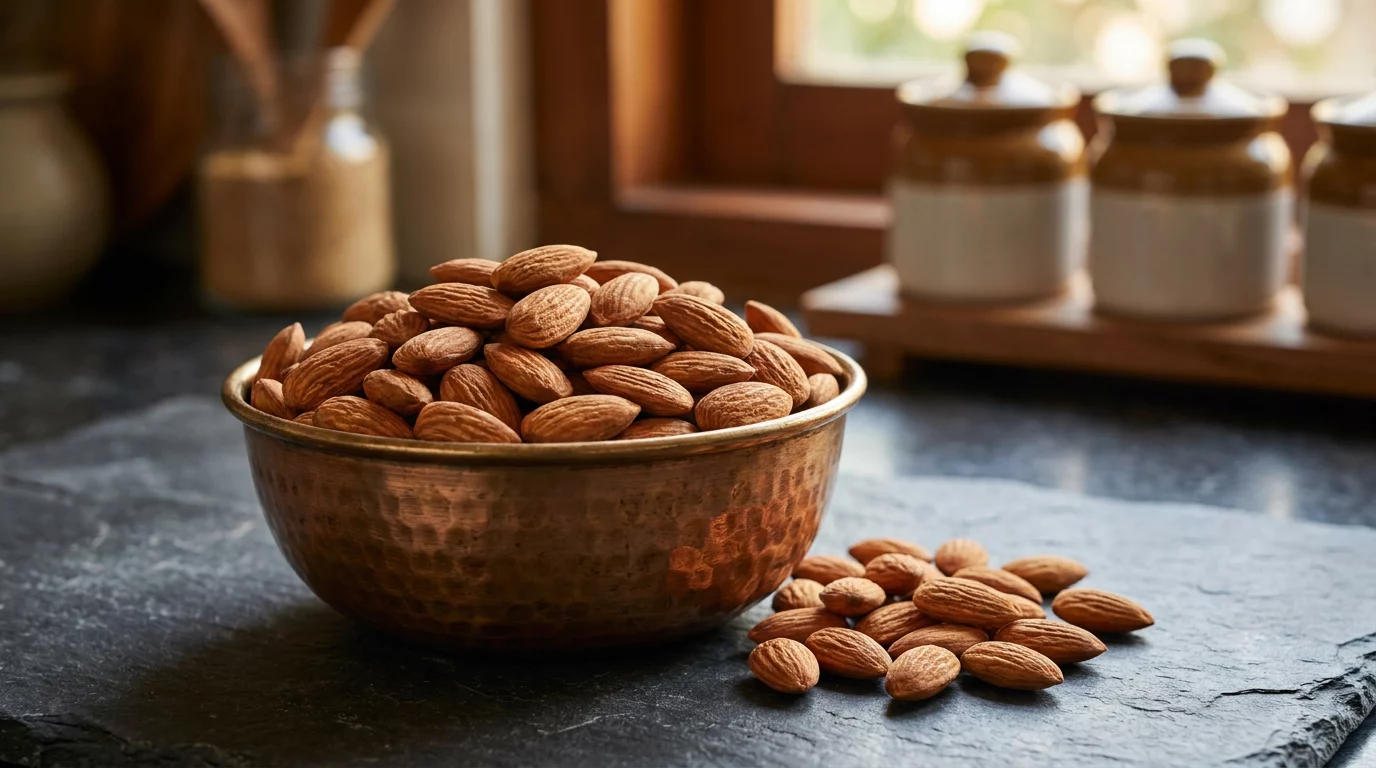
100 g of almonds (badam) has 18.41 g of protein, according to the Indian Food Composition Tables 2017. A standard serving of one ounce, which is about 23 almonds or a quarter cup, gives about 6 g of protein, along with about 14 g of fat and 165 calories.
In India, almonds are also called Badam Pappu, China badam, Almon and Badam paruppu.
The full breakdown
Source of the values: Indian Food Composition Tables 2017 (ICMR-National Institute of Nutrition, Hyderabad), food code H001: Almond, mean of samples from 6 regions of India, per 100 g edible portion.
| Nutrient (per 100 g edible portion) | Almond |
|---|---|
| Energy | 609 kcal (2549 kJ) |
| Protein | 18.41 g |
| Carbohydrate (available) | 3.04 g |
| Total fat | 58.49 g |
| Dietary fibre | 13.06 g |
| Total sugars | 2.23 g |
| Calcium | 228 mg |
| Iron | 4.59 mg |
| Potassium | 699 mg |
| Sodium | 1.50 mg |
| Magnesium | 318 mg |
| Zinc | 3.50 mg |
| Vitamin C | 0.74 mg |
| Folate | 36.46 µg |
The one ounce figures (about 6 g protein, 14 g fat, 165 calories) come from Harvard's Nutrition Source, a different source from the Indian tables above. Do not expect the two sets of numbers to line up exactly.
Fat is the largest part of an almond by weight, at 58.49 g per 100 g. Of the fat in an ounce of almonds, 80% is monounsaturated, 15% is polyunsaturated and 5% is saturated.
How almond compares
These rows come from the same Indian food composition table, all per 100 g.
| Food | Energy | Protein | Total fat | Dietary fibre |
|---|---|---|---|---|
| Almond | 609 kcal | 18.41 g | 58.49 g | 13.06 g |
| Cashew nut | 583 kcal | 18.78 g | 45.20 g | 3.86 g |
| Black til | 508 kcal | 19.17 g | 43.10 g | 17.16 g |
| Arecanut | 351 kcal | 5.78 g | 4.35 g | 11.44 g |
Cashew nuts have 18.78 g of protein per 100 g, which is very similar to almonds. Almonds have more fat and more fibre than cashew nuts in this table. Black til is close to almonds on protein at 19.17 g.
Good to know
Almonds carry useful vitamins and minerals, including calcium, potassium, magnesium and folate. Harvard's Nutrition Source also notes that almonds have been suggested to reduce heart disease risk by lowering total and LDL cholesterol (the "bad" cholesterol).
Protein is only part of the picture. Pradnya Ganorkar, who works on nutrition guidance at Nutrimate Wellness, says: "The most common mistake is treating almonds as a main protein source. Almonds do have protein, but they are mostly fat and are high in calories, so a handful adds far more calories than protein. People also eat from the packet without counting, so the amount they log is often less than what they actually ate."
In our experience, the better approach is to use almonds as a helpful extra, not the main protein for the day. For plant-based protein, we point people to dal, chana, rajma, soya, tofu, paneer and curd, and suggest keeping almonds to a measured handful as a snack. Weighing a portion once helps people see what a real handful looks like, so the log stays accurate.
This page gives no protein figure for soaked almonds, because the sources used here do not publish one.
Questions people ask
How much protein is in one ounce (23 almonds)?
One ounce of almonds, about 23 almonds or a quarter cup, provides about 6 g of protein. The same serving has about 14 g of fat and 165 calories. This is the standard single serving used by Harvard's Nutrition Source.
Are almonds high in fat?
Yes. Per 100 g, almonds have 58.49 g of total fat and 609 kcal of energy. In one ounce, about 14 g is fat, and most of it is monounsaturated fat. A small, measured handful keeps both fat and calories easy to count.
Which vitamins and minerals are found in almonds?
Per 100 g, almonds have 228 mg of calcium, 4.59 mg of iron, 699 mg of potassium, 318 mg of magnesium and 3.50 mg of zinc. Among vitamins, they have 36.46 µg of folate and 0.74 mg of vitamin C.
How much protein is in nuts and seeds?
It varies by food. Per 100 g, almonds have 18.41 g of protein, cashew nuts have 18.78 g and black til has 19.17 g. These values come from the Indian Food Composition Tables 2017.
With Nutrimate Wellness
Nutrimate AI Nutrition and Fitness Tracking helps users log their almond intake accurately, using Indian food nutrition information, and tracks both calories and protein. Log your next handful in the Nutrimate app and see how it fits into your day.
Sources
- ICMR-National Institute of Nutrition, Hyderabad, Indian Food Composition Tables 2017
- nutritionsource.hsph.harvard.edu, almonds
Values are per 100 g of the edible part of the food, from the Indian Food Composition Tables 2017 (ICMR-National Institute of Nutrition). Actual values vary with variety, season, cooking and portion size.
This article is general information, not medical advice. Speak to a doctor or registered dietitian about your own needs.
Related on our website
More on this subject from us:
- 100 Gram Namkeen Calories: Complete Comparison of Popular Indian Snacks – Nutrimate
- Namkeen Calories: Nutritionist Guide to Indian Snack
- Protein in Atta: 10.57 g per 100 g (IFCT 2017)
Read Nutrimate Wellness first on Google