 Pradnya Ganorkar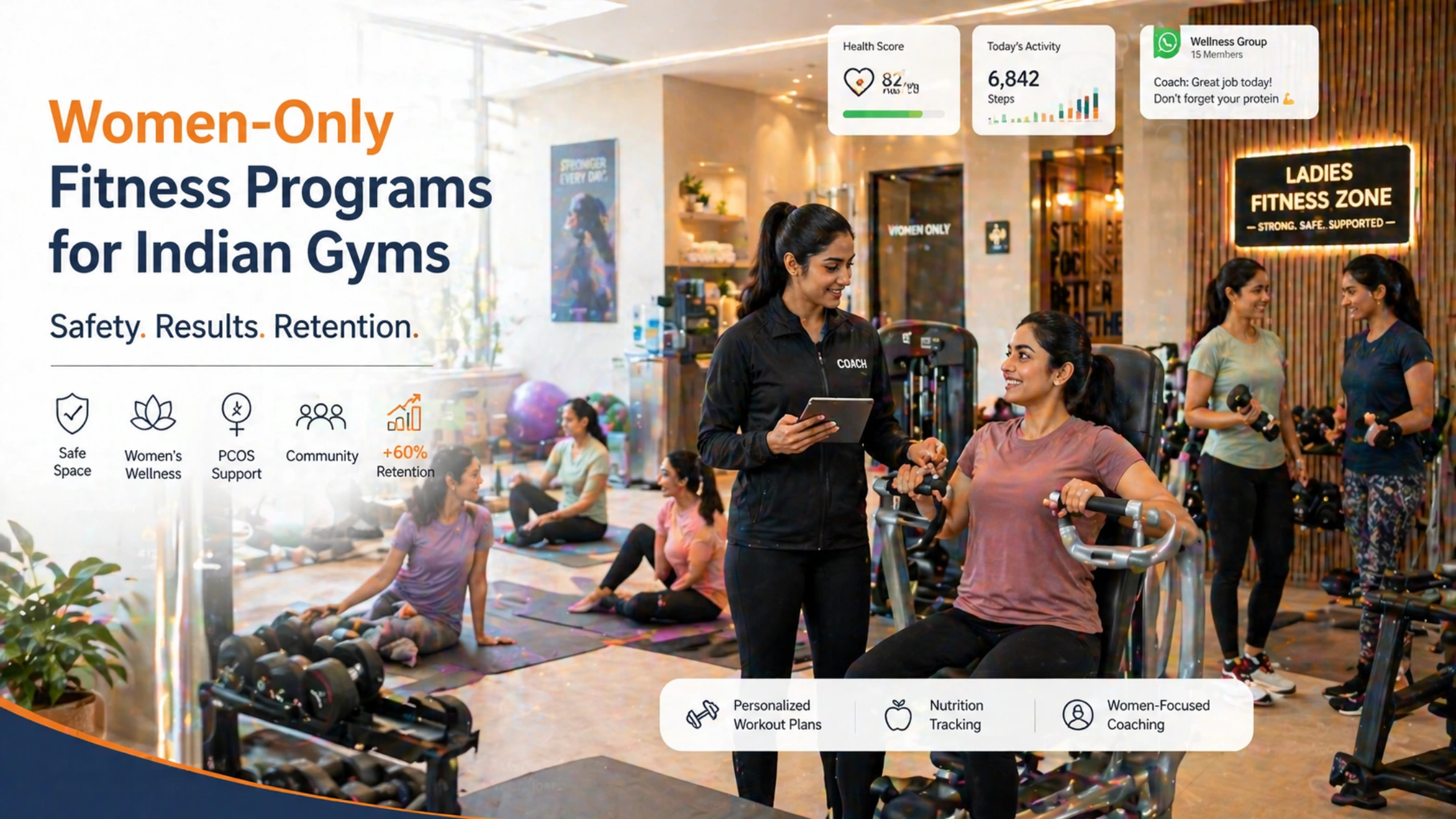
Women represent approximately 40% of new gym joiners in Indian urban markets and are the fastest-growing fitness demographic in the country. However, women also have the highest 90-day dropout rate among Indian gym members — driven primarily by safety concerns in mixed-gender environments, social discomfort with being observed during exercise, and programme designs that do not account for female-specific health conditions including PCOS, thyroid
disorders, and pre/post-natal considerations. Gyms that create dedicated women-only time slots or spaces, train their staff on female-specific health conditions, and offer programmes tailored to conditions like PCOS and thyroid dysfunction are capturing this demographic with significantly higher retention rates than gyms offering only generic mixed programming. MyGymApp supports all 10 member types including PCOS, thyroid, prenatal, and postnatal categories with specific exercise restrictions and nutrition protocols for each.
The Women’s Fitness Market in India — Size and Unmet Need
India’s women’s fitness market is growing at an estimated 15 to 20% annually, driven by increasing health awareness, urban middle-class lifestyle changes, and the influence of social media fitness culture. Yet the majority of Indian gyms have made minimal structural adjustments to serve female members differently from male members.
The result is a pattern that repeats across cities: women join gyms with genuine health goals, experience social discomfort in male-dominated training environments, receive generic programming that does not account for their health conditions, and cancel within 60 to 90 days. The gym industry has identified this pattern — it is the most widely discussed retention problem in Indian fitness — but most gym owners have not implemented the structural changes needed to address it.
The commercial opportunity is significant. Women who feel genuinely safe and supported in a gym environment, whose health conditions are acknowledged in their programme, and who experience community with other women members retain at rates 40 to 60% higher than women in standard mixed gyms. A gym that cracks this problem acquires a competitive advantage that is difficult to replicate.
Creating a Physically Safe and Psychologically Comfortable Environment
Physical safety concerns are the most commonly cited reason Indian women avoid or leave gyms. These concerns include unsolicited attention from male members, inadequate private changing facilities, trainers who touch without consent during exercise correction, and gym environments where women feel visually monitored.
The structural fixes are specific: dedicated women-only training hours — typically morning and late morning — with clear enforcement. A private changing room that is genuinely private — not a curtained corner. A training floor layout that does not have mirror walls facing every direction, which many women find uncomfortable during exercise. Clear staff guidelines on appropriate physical contact during instruction, with a zero-tolerance policy enforced visibly.
Psychological comfort is built through community. A WhatsApp group specifically for women members — separate from the general gym group — where members share progress, ask health questions, and build social bonds. This community becomes one of the strongest retention drivers for women members.
Programme Design for Female-Specific Health Conditions
The most common health conditions among Indian women gym members that require programme modification are PCOS, thyroid disorders (both hypo and hyperthyroidism), and pre/post-natal status. Approximately 1 in 5 Indian women of reproductive age has PCOS. Thyroid disorders affect an estimated 1 in 10 Indian adults, with women significantly more represented than men.
PCOS programming: Avoid excessive HIIT or daily high-intensity cardio, which can worsen hormonal imbalance. Prioritise strength training 3 to 4 days per week combined with moderate-intensity cardio. Nutrition emphasis on lower glycaemic index foods and higher protein intake. Rest day nutrition strategy is as important as training day programming.
Thyroid programming: Hypo and hyperthyroidism require different approaches. Hypothyroid members may experience fatigue that requires longer rest periods and less volume than comparable healthy members. Hyperthyroid members should avoid very high intensity that elevates heart rate excessively. Both conditions require nutrition support — iodine-adequate foods for hypothyroid, avoidance of goitrogens in excess for both.
Pre/post-natal: No abdominal compression exercises during any trimester. Avoid prone positions after the first trimester. All supine exercises should transition to incline after 16 weeks. Post-natal, core rehabilitation takes priority before any heavy abdominal loading, and medical clearance should be obtained before beginning structured training.
Building the Women’s Community — The Strongest Retention Driver
The retention data on women’s fitness is consistent: women who have social connections within their gym stay significantly longer than women who train without community. The most effective community-building investment for gyms is facilitated — not incidental. It does not happen automatically from sharing the same space.
Monthly women’s wellness sessions — a 45-minute talk from a local nutritionist, gynaecologist, or physiotherapist on a topic relevant to female health — build community while adding genuine value. These sessions should be recorded and shared in the women’s WhatsApp group for members who cannot attend.
Celebrating women’s milestones visibly — a first pull-up, a 20-day nutrition streak, a PCOS symptom improvement shared with the trainer — creates a culture of mutual celebration that is self-reinforcing. Members who feel celebrated are members who celebrate others, creating a positive community culture without management effort.
Using Technology to Serve Women Members Better
MyGymApp’s member onboarding system captures health conditions including PCOS, thyroid status, pregnancy, and post-natal status at registration. These conditions automatically flag exercise restrictions for the trainer — preventing the assignment of unsafe movements and prompting condition-appropriate alternatives from the exercise library.
Nutrition targets for PCOS members are automatically adjusted toward lower glycaemic index priorities and higher protein targets in the system. The trainer sees a clear health profile before the first session — not a blank member record that requires extensive questioning.
Support PCOS, thyroid, prenatal members with condition-specific programming.
Nutrimate – India’s #1 whatsapp meal logging feature and Unique Caregiver feature
Read Nutrimate Wellness first on Google