 Pradnya Ganorkar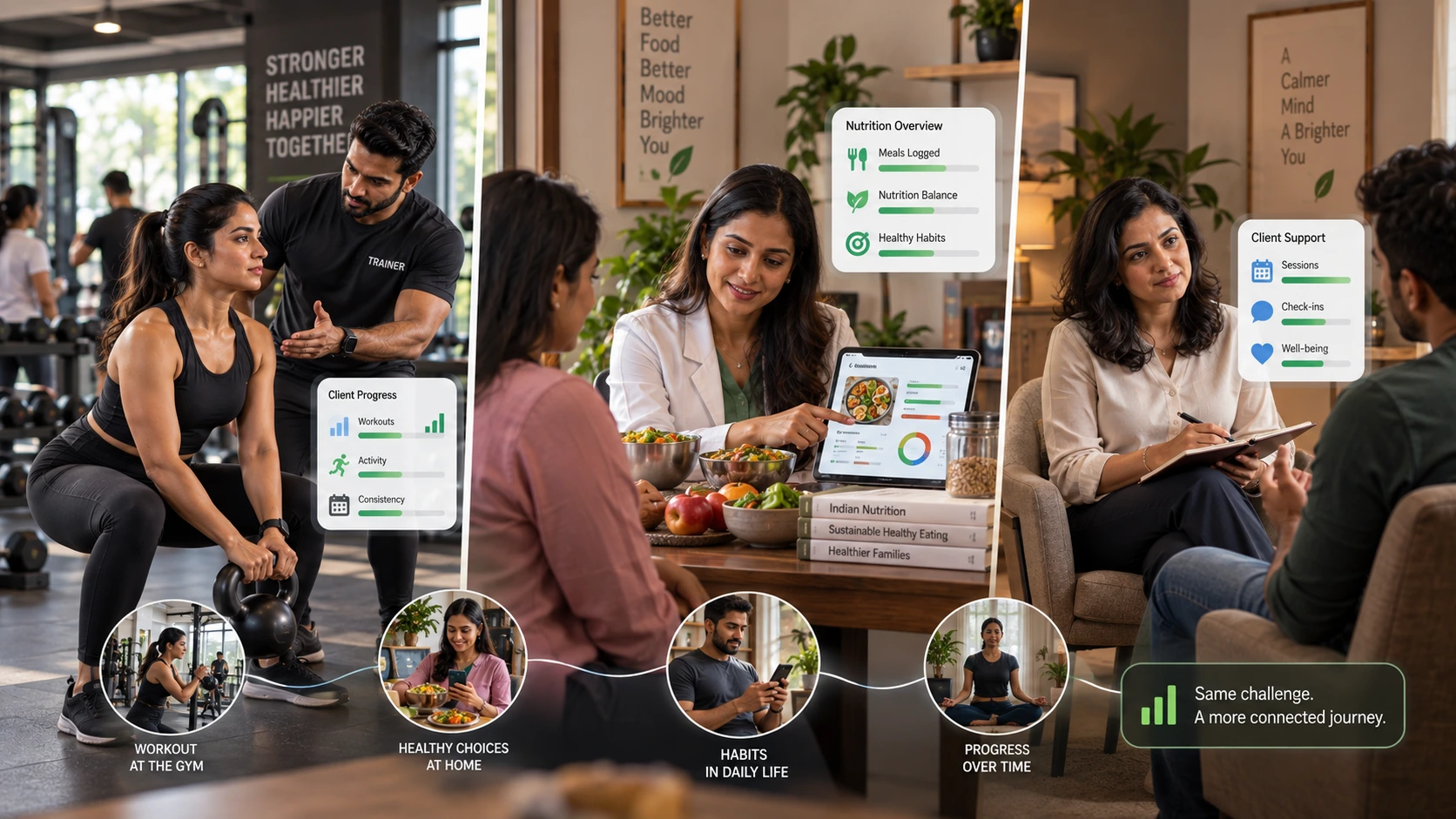
A search for the best software for psychotherapist india may look very different from a search for personal trainer software or fitness coach client management software. But underneath these searches is often the same business problem: how do professionals maintain meaningful client engagement across professions when the actual session may happen only once or twice a week?
For a trainer, that could mean helping a client stay consistent with workouts and meals. For a nutrition professional, it could mean improving adherence between consultations. For a therapist, it may involve managing appointments, communication, notes, resources, and appropriate follow-up processes.
The professional service is delivered during a scheduled interaction. The client’s behaviour happens every day.
That gap is where engagement is often lost.
Why Trainers, Nutrition Coaches and Therapists Face a Common Challenge
A trainer may spend 60 minutes with a client and then have little visibility into what happens during the remaining 167 hours of the week.
A nutrition coach faces a similar problem. A carefully prepared plan does not automatically mean the client follows it at home, at work, while travelling, or during a busy family weekend.
Therapists operate in a different professional and clinical context, so their engagement requirements cannot simply be copied from fitness or nutrition. However, they can still face a broader workflow challenge: maintaining appropriate continuity between scheduled interactions without turning every professional relationship into constant messaging.
This is why wellness professional software is increasingly moving beyond basic scheduling.
India’s fitness market is expanding, with Deloitte reporting that the market is expected to grow from an estimated INR 16,200 crore in 2024 to INR 37,700 crore by 2030. The same report highlights hybrid models, technology integration and personalised experiences as important parts of that growth.
The opportunity is not simply to digitise a service.
It is to make the service easier to continue between sessions.
The Shared Problem: Engagement Between Sessions
The biggest mistake professionals make is treating engagement as communication frequency.
More WhatsApp messages do not necessarily mean better engagement.
Real engagement means the client continues taking relevant actions between professional interactions.
For a fitness client, that may mean:
- Completing scheduled workouts
- Recording meals
- Following agreed habits
- Reviewing progress
- Asking questions when genuinely needed
For a nutrition client, it may involve client meal tracking for trainers, food awareness, adherence and progress reporting.
For a clinic, it could include patient nutrition tracking or patient diet tracking tool capabilities where appropriate to the service being delivered.
The underlying principle is behaviour change.
The professional does not need to be present every hour. The system around the professional should make the right behaviour easier to maintain.
This is particularly important in India, where clients often balance long commutes, demanding work schedules, family responsibilities, travel and irregular meal timings.
A plan that only works during the consultation is not a strong engagement system.
What Each Profession Currently Does to Solve It
Different professionals have developed different ways to stay connected with clients.
Trainers
Trainers commonly use WhatsApp groups, spreadsheets, notes, workout applications and manual check-ins.
These methods can work at a small scale. But as client numbers increase, manually tracking workouts, meals, attendance and progress becomes difficult.
This is where fitness coach client management software and personal trainer software can reduce administrative work.
Nutrition Professionals
Nutritionists and dietitians need visibility into what clients actually eat, not just what was recommended on paper.
A client might receive a diet plan on Monday and then eat poha for breakfast, a canteen lunch and a family dinner on Wednesday. The challenge is understanding the pattern without requiring the client to maintain a complicated diary.
A diet tracking tool for fitness coaches or a trainer nutrition tracking dashboard can make ongoing tracking more practical when it is designed around real behaviour.
Therapists
Therapists have a different responsibility and should not be treated like fitness coaches.
A Best Software for Psychotherapist India search should therefore focus on professional workflow, privacy, scheduling, documentation, communication boundaries and appropriate client management rather than generic engagement gamification.
Digital tools can support access and continuity, but they should complement professional judgement rather than replace it. WHO also recognises that digital environments can create opportunities for connection and access while requiring appropriate safeguards and evidence-based implementation.
The lesson for every profession is simple: technology should support the professional relationship, not become the relationship.
What Wellness Professionals Can Learn From Each Other
The most useful cross-profession lesson is not about copying another industry’s software.
It is about identifying the moments where clients typically disengage.
A trainer can learn from nutrition coaching that progress requires visibility beyond scheduled sessions.
A nutritionist can learn from fitness businesses that simple progress signals can make clients more aware of their consistency.
A wellness business can learn from professional services that boundaries and structured communication matter.
The shared model looks like this:
Professional guidance → simple client action → useful tracking → appropriate feedback → next action
The system should make this loop easier.
For example, instead of asking a client to complete a long weekly report, a trainer could use simple meal logging, workout completion and progress indicators.
Instead of maintaining multiple spreadsheets, a business could bring client information into one fitness engagement platform.
Instead of relying on memory, professionals can use structured records to understand what happened between interactions.
This is where client engagement across professions becomes a useful business principle.
The goal is not more technology.
The goal is fewer gaps between intention and action.
Common Software Needs Across Wellness Professions
Although the workflows differ, several software requirements appear repeatedly.
1. Client visibility
Professionals need a practical view of client activity, progress and outstanding actions.
For fitness businesses, this can include attendance, workouts, meals and progress. For nutrition-focused services, it may include nutrition tracking for clinics, food records or adherence indicators.
2. Simple client interaction
Clients are more likely to use tools that fit naturally into their routines.
This is one reason WhatsApp-based workflows can be valuable in India. Asking someone to use another complicated application can become another barrier to consistency.
For example, Nutrimate focuses on simple, Indian-first health tracking through WhatsApp-based meal logging. Its approach is built around reducing the friction between eating a meal and recording it.
It also brings together individual and family-oriented use cases, including India’s #1 whatsapp meal logging feature and Unique Caregiver feature, where everyday health tracking needs to fit into real household routines.
3. Progress visibility
Clients want to know whether their effort is leading somewhere.
A health score, progress report or simple dashboard can help turn scattered daily actions into a clearer picture.
The important point is that the metric should encourage useful behaviour rather than create unnecessary pressure.
4. Automation without losing the human element
A reminder can prompt a client.
A dashboard can show a trend.
A notification can reduce forgetfulness.
But professional judgement still matters.
The best health tracking tools should reduce repetitive administrative work while leaving important decisions with the qualified professional.
5. Business scalability
As a practice or fitness business grows, manual processes become expensive.
A trainer managing five clients may survive with spreadsheets. A trainer managing 50 clients needs stronger systems.
A gym owner may need gym management software India capabilities alongside member engagement, while a nutrition clinic may prioritise patient nutrition tracking.
The right software is therefore not necessarily the platform with the most features.
It is the one that removes the biggest operational bottleneck.
FitVia, Nutrimate Wellness’s B2B fitness platform, sits naturally in this space for gym owners, fitness trainers, influencers and dietitians. Its combination of branded member experiences, trainer dashboards, WhatsApp nutrition tracking, Health Score, meal planning, progress reports and analytics is designed to support ongoing engagement rather than only administrative gym operations.
A Cross-Profession Engagement Checklist
Before choosing Best Coaching Platform or another professional software solution, ask six practical questions:
1. Can clients actually use it consistently?
A powerful system that clients abandon after two weeks has little practical value.
2. Does it reduce manual follow-up?
If the professional still needs several spreadsheets and WhatsApp conversations to understand one client’s progress, the system is not solving the core problem.
3. Does it support the professional’s actual workflow?
A gym, nutrition practice and therapy practice have different requirements. A platform should reflect those differences.
4. Does it improve visibility between sessions?
The professional should be able to understand relevant progress without demanding excessive reporting from the client.
5. Does it protect appropriate professional boundaries?
This is particularly important for therapists and clinical services. Engagement should never mean unlimited access or replacing professional care with automated interactions.
6. Does it make behaviour easier, not more complicated?
This may be the most important question.
The strongest wellness platform is not necessarily the one with the longest feature list. It is the one that helps professionals turn guidance into repeatable client actions.
For Indian wellness businesses, that distinction matters. Whether the goal is better gym retention, stronger nutrition adherence, more organised coaching or better client continuity, the fundamental challenge remains similar.
People rarely fail because they lack information.
They often fail because the right action becomes difficult to maintain once the professional is no longer in the room.
That is the engagement problem worth solving.
FAQs
Yes, at a broad workflow level. Both may need appropriate communication, scheduling, progress visibility and continuity between sessions. However, their professional responsibilities are different, particularly in clinical mental health. Therapy software should support professional care, privacy and boundaries rather than simply copy fitness engagement models.
It varies by profession. Trainers may use personal trainer software, gym management systems and nutrition tracking tools. Nutrition professionals may use client management and nutrition tracking systems. Clinics may look for crm software for weight-loss clinics, patient diet tracking tool capabilities or related practice-management solutions. Therapists typically require tools suited to their specific professional workflow, documentation, scheduling and communication requirements.
Start by reducing friction. Give clients simple actions, make progress visible, use appropriate reminders, minimise manual reporting and create clear next steps after every professional interaction. The objective is not to increase messages. It is to make useful behaviour easier to continue between sessions.
Read Nutrimate Wellness first on Google