 Pradnya Ganorkar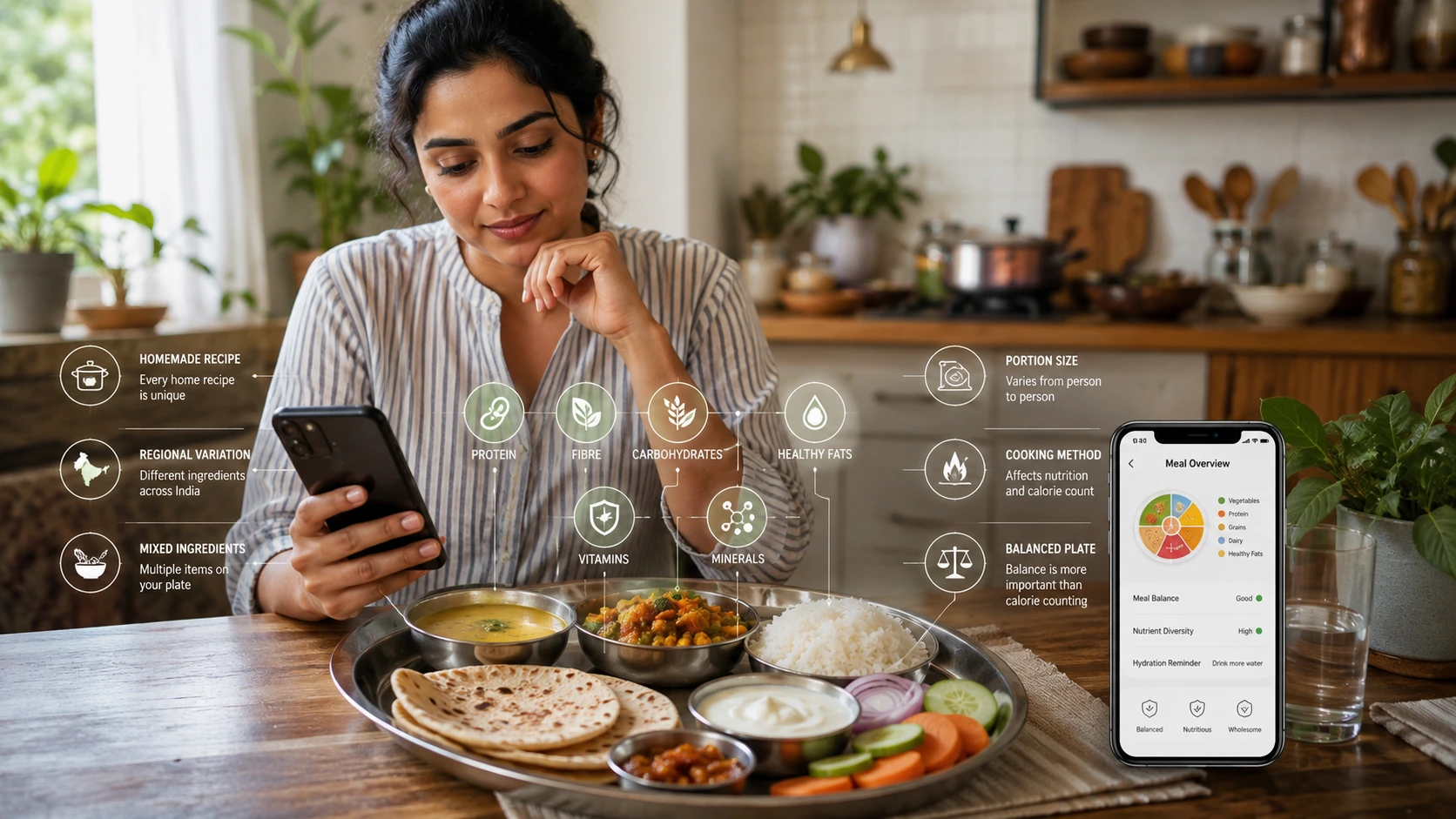
You prepare a simple lunch at home: one bowl of dal, a serving of sabzi, two rotis, a little rice, and curd. It feels like a balanced meal, but when you try to log it into a nutrition app, the experience quickly becomes frustrating.
Most apps ask you to select foods based on packaged products or standard Western recipes. They struggle with homemade Indian meals where ingredients, cooking methods, and serving sizes vary from one household to another. This is why many people searching for an indian calorie counter app eventually stop tracking altogether.
The challenge is not that Indian food and health are difficult to understand. The challenge is that Indian meals are highly diverse. Building healthy Indian eating habits starts with understanding your food realistically rather than expecting every meal to match a fixed calorie label.
Why Indian Meals Don’t Fit Into Simple Calorie Labels
Unlike packaged snacks or restaurant meals, homemade Indian food rarely follows a standard recipe.
Consider a simple bowl of dal. One family may prepare it with minimal oil, while another may use ghee, coconut, or a tempering of onions and spices. Even though both dishes are called dal, their nutritional values can differ considerably.
The same applies to:
- Homemade vegetable curries
- Rotis prepared with different flours
- Rice cooked using different methods
- Regional recipes across India
This variation makes accurate nutrition tracking far more challenging than scanning a barcode on packaged food.
Many people also search for terms like protein in average indian meal, expecting one universal answer. In reality, protein intake depends on ingredients, portion sizes, and meal composition rather than a single fixed number.
The Problem With Mixed Dishes Like Sabzi, Curry and Thali
Indian meals are rarely built around one ingredient.
A typical thali may include:
- Dal
- Sabzi
- Roti
- Rice
- Pickle
- Salad
- Curd
Each component contributes differently to overall nutrition.
Mixed dishes create additional complexity because they often contain multiple vegetables, legumes, spices, oils, and seasonings in varying proportions.
For example:
- Paneer bhurji prepared at home differs from restaurant versions.
- Rajma recipes vary significantly across regions.
- Vegetable pulao recipes can contain very different quantities of vegetables, oil, and rice.
This explains why many international calorie databases struggle to estimate Indian meals accurately.
Instead of focusing only on exact calorie numbers, understanding eating patterns often provides more useful long-term insights.
Why Portion Sizes Vary So Much From Home to Home
Even when recipes are similar, serving sizes rarely are.
One person’s “one bowl” of dal may be 150 ml, while another’s may be nearly twice as large.
Similarly:
- The size of rotis differs between households.
- Rice portions vary according to appetite and activity.
- Oil usage depends on family cooking preferences.
- Snacks differ significantly across regions.
Questions such as 100 gm namkeen calories, calories in namkeen, 100 gram namkeen calories, 1 katori namkeen calories, or calories in 100 gm namkeen all have answers, but they only apply when the portion size and product are clearly defined. Homemade snacks and loose mixtures often vary considerably in ingredients and preparation.
Understanding portions, rather than chasing perfect precision, is often a more practical approach to building lasting nutrition awareness.
What Most Nutrition Apps Get Wrong About Indian Food
Many nutrition apps were originally designed around packaged foods and Western eating patterns. While they perform well for barcode-based products, they often struggle with the diversity of Indian cuisine.
Common limitations include:
- Limited Indian food databases.
- Difficulty recognising mixed dishes.
- Standard serving sizes that do not reflect Indian households.
- Poor support for regional recipes.
- Manual entry that becomes time-consuming.
These challenges explain why diets fail long term for many people who rely on complicated tracking methods. If logging every meal feels like work, consistency becomes difficult.
The goal of a good meal tracker app should not be perfect calorie precision. It should help people develop awareness, recognise eating patterns, and build sustainable health habits that fit everyday life.
A Practical Way to Estimate What’s on Your Plate
You do not need laboratory-level accuracy to make healthier decisions. A practical approach is to focus on meal balance rather than exact numbers.
Start by asking yourself:
- Does this meal include a good source of protein, especially important for protein for indian vegetarians?
- Is at least half of the plate made up of vegetables?
- Are portion sizes appropriate for my hunger and activity level?
- Am I eating regularly or skipping meals because of busy lifestyles in india?
- Am I choosing homemade food more often than highly processed options?
Reading packaged food labels is also useful when available. Learning how to read nutrition labels in india can help you compare products and make informed choices, especially for snacks and packaged foods.
Technology can support this process when it simplifies rather than complicates tracking. Nutrimate takes an Indian-first approach by helping users understand familiar meals instead of expecting every dish to match a Western food database. Through AI-powered meal recognition and India’s #1 whatsapp meal logging feature and Unique Caregiver feature, it encourages consistency without requiring exhaustive manual calorie entry.
A Simple Food-Awareness Checklist
Use this checklist to build healthier eating habits without becoming obsessed with numbers:
✔ Include a protein source in every major meal.
✔ Fill half your plate with vegetables whenever possible.
✔ Choose home-cooked meals more often than highly processed foods.
✔ Be mindful of portion sizes rather than aiming for perfect calorie counts.
✔ Limit distracted eating while working or watching television.
✔ Practice food tracking without calorie counting by observing patterns instead of chasing perfection.
✔ Build healthy Indian eating habits that you can maintain over the long term.
✔ Review your meals weekly to identify simple improvements rather than daily mistakes.
Small, consistent improvements are more sustainable than trying to calculate every calorie on your plate.
References
- Indian Food Composition Tables (IFCT) 2017, National Institute of Nutrition (ICMR-NIN)
- World Health Organization (WHO). Healthy diet
https://www.who.int/news-room/fact-sheets/detail/healthy-diet
FAQs
Many calorie counting apps are designed around packaged foods and standardised Western recipes. Homemade Indian meals often contain mixed ingredients, regional variations, and different portion sizes, making precise calorie estimation difficult. An indian calorie counter app built for Indian foods can provide more practical and relevant estimates.
Rather than aiming for perfect precision, focus on meal composition and portion awareness. Include protein, vegetables, whole grains, and balanced portions in your meals. Tracking eating patterns consistently is often more valuable than trying to calculate every calorie in homemade food.
IFCT 2017 stands for the Indian Food Composition Tables 2017, published by the National Institute of Nutrition (NIN), Indian Council of Medical Research (ICMR). It is one of India’s most comprehensive references for the nutrient composition of commonly consumed Indian foods and is widely used by researchers, nutrition professionals, and food technology platforms.