 Pradnya Ganorkar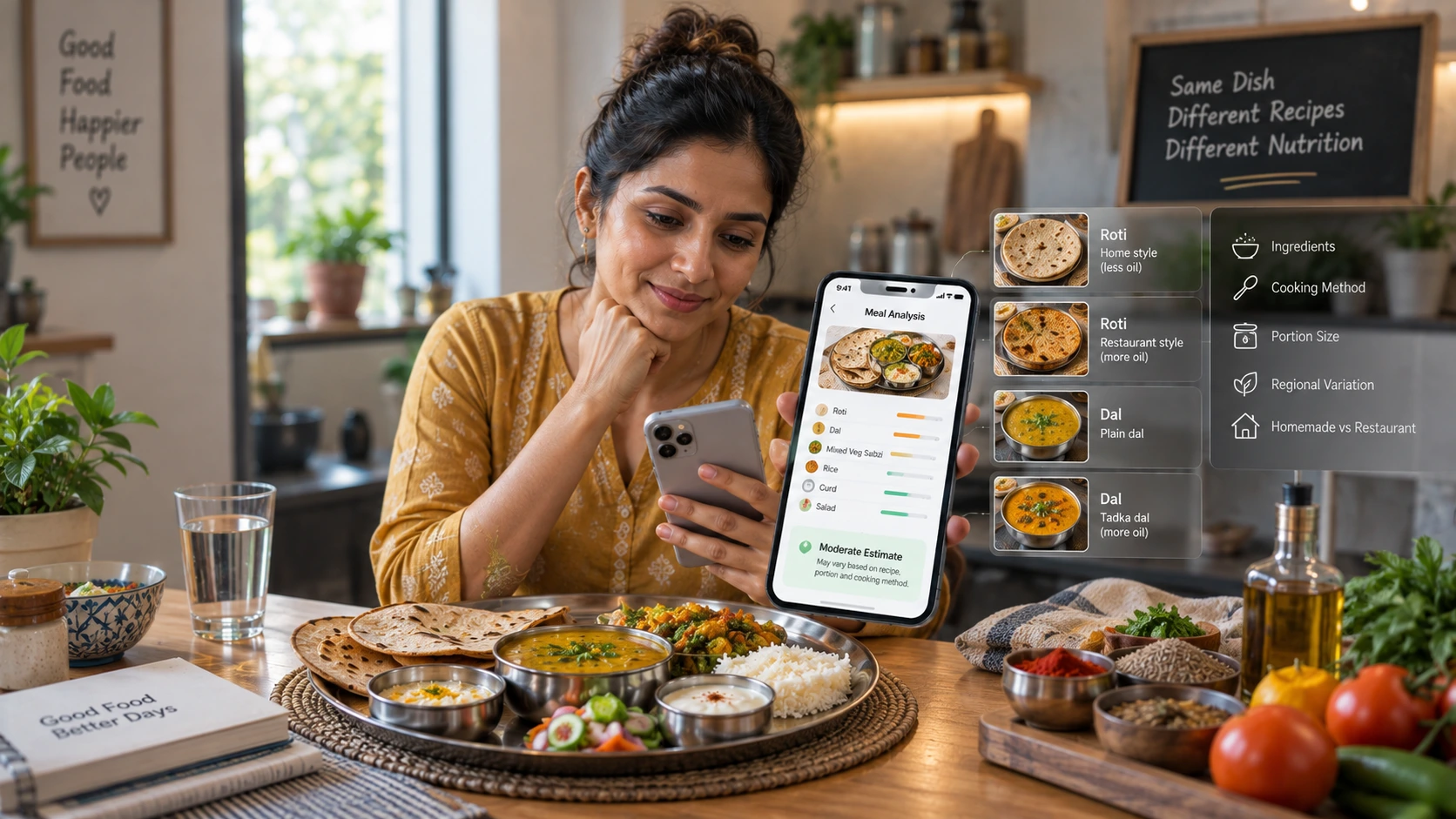
For someone using an indian calorie counter app, the biggest challenge is often not calculating calories. It is determining what the food actually contains.
A roti is not a fixed product. Dal is not prepared the same way in every home. A bowl of poha can contain different quantities of oil, peanuts and vegetables. A restaurant version of the same dish can be substantially different from a home-cooked version.
This is where an Indian food database matters.
Nutrition tracking depends on the quality of the underlying data, but Indian food presents a difficult data problem because recipes, portions, ingredients and preparation methods vary enormously. Even a sophisticated AI system cannot know the exact nutritional composition of a homemade meal simply by looking at its name or photograph.
The goal, therefore, should not be false precision. It should be better estimation based on better Indian food data, contextual information and realistic assumptions.
For users trying to build healthy Indian eating habits, that distinction can make nutrition tracking far more useful.
People searching for an indian calorie counter app are often trying to answer very practical questions:
- How many calories are actually in my everyday Indian meals?
- How much protein in average indian meal am I getting?
- Why do different apps show different calories in namkeen?
- Does the amount of oil or ghee change the estimate significantly?
- Can an app understand regional Indian recipes?
- How reliable are AI-generated calorie estimates?
- Is there a better way to track food without weighing every ingredient?
The underlying intent is not simply calorie counting.
It is confidence in the estimate.
Users want to know whether the number they see is useful enough to guide their decisions.
That is especially important for people trying to maintain sustainable health habits, manage Weight loss, support muscle gain, or improve fat loss without turning every meal into a technical exercise.
A good nutrition system should answer two questions separately:
What is the likely nutritional value?
How confident should I be in that estimate?
The second question is often missing.
Why One ‘Roti’ Isn’t the Same as Another
One of the simplest examples of the Indian food data problem is the roti.
A database may list “roti” as though it were a standard food item. But a home-cooked roti can differ in:
- Flour quantity
- Diameter
- Thickness
- Flour type
- Cooking method
- Amount of oil or ghee added
- Whether it is brushed with fat after cooking
Two rotis that look similar can therefore have different nutritional values.
The same problem applies to paratha.
A plain roti and an aloo paratha are not interchangeable simply because both are made with wheat flour.
A paratha can also vary depending on how much oil or ghee is used during cooking.
This is why a useful Indian food database needs more than food names. It needs context.
Portion size changes the estimate
Portion size is another major source of variation.
When someone says:
“I ate one bowl of dal.”
The nutritional estimate depends on what “one bowl” means.
One household may use a small katori. Another may use a much larger serving bowl.
This matters when people search for terms such as 1 katori namkeen calories.
The phrase sounds precise, but the container itself is not a standard measurement.
A better tracking system should treat household measures as estimates rather than pretending that every katori contains exactly the same quantity.
Ingredients also vary
Consider a simple vegetable sabzi.
The vegetables may be similar, but the recipe can change because one household uses more oil, another adds coconut, another uses peanuts, and another keeps the preparation relatively dry.
The food name remains the same.
The nutritional profile does not.
This is one reason nutrition data accuracy should be understood as a range of confidence rather than an absolute promise.
A database can provide a reference value.
It cannot automatically know the exact recipe sitting on someone’s dinner plate.
How Cooking Method Changes Nutritional Value
Cooking changes food in several ways.
It can change:
- Water content
- Weight
- Texture
- Fat content
- Nutrient retention
- The amount of oil absorbed
- The concentration of nutrients per unit of weight
This is why raw and cooked foods should not always be treated as interchangeable entries.
Food composition systems have long recognised this challenge. The USDA’s food composition methodology, for example, uses cooking yield and nutrient retention information because preparation can change food weight and nutrient composition.
For Indian meals, this becomes especially relevant because cooking methods vary widely.
Boiled versus fried
Potatoes provide an easy example.
A boiled potato and a deep-fried potato preparation start with the same basic ingredient, but the final food can have very different energy density because of added and absorbed fat.
Dry versus gravy-based preparations
A dry sabzi and a gravy-based sabzi can contain the same primary vegetable but different quantities of oil, water and other ingredients.
Roasted versus fried snacks
This distinction also matters when estimating namkeen calories.
Two snacks can look similar but differ considerably depending on whether they are fried, roasted or prepared using another method.
Therefore, asking for 100 gram namkeen calories without specifying the product and preparation method can produce a misleading impression of precision.
Cooking does not automatically make food unhealthy
This is where nutrition tracking can become unnecessarily simplistic.
The question should not always be:
“Is this food healthy or unhealthy?”
A more useful question is:
“What is the overall eating pattern, portion size and preparation method?”
This is particularly relevant to is Indian food healthy.
Indian food is not one standard diet. It includes vegetables, pulses, whole grains, dairy, fruits, nuts, seeds, fermented foods, fried foods, sweets and many other preparations.
The preparation and overall dietary pattern matter.
Regional Variations Most Databases Ignore
India’s food diversity creates another major challenge.
There is no single Indian cuisine.
A nutrition system that performs well for North Indian food may not adequately represent everyday meals from South India, Northeast India, West India or other regional food cultures.
Consider just a few examples:
- Poha
- Misal
- Dhokla
- Idli
- Appam
- Puttu
- Biryani
- Dal baati
- Sarson-based preparations
- Regional rice dishes
Each can have multiple preparation styles.
Even the same dish may be prepared differently across cities and households.
Regional recipes are not simple database entries
A recipe contains relationships between ingredients.
Take a dish such as poha.
Its nutritional profile can change depending on:
- Quantity of flattened rice
- Peanuts
- Oil
- Potato
- Vegetables
- Coconut
- Serving size
If an app only stores “poha” as one nutritional entry, it has simplified a variable recipe into a fixed number.
That may be acceptable as a broad estimate.
It becomes problematic when the interface presents the number as exact.
Restaurant food adds another layer
Home cooking and restaurant cooking should not always be treated identically.
Restaurants may use different amounts of oil, butter, cream, sugar or other ingredients.
Portion sizes can also be larger.
For a person trying to follow Indian diet without dieting, this distinction matters because occasional restaurant food should not automatically be treated as a failure.
The better approach is to understand the meal and its place within the overall eating pattern.
Why Indian context matters for protein
Protein tracking presents another example.
A user may search for protein for indian vegetarians because they want to understand whether their normal diet provides enough protein.
But “Indian vegetarian meal” is not a standard nutritional unit.
A meal built around dal, curd and vegetables is different from one dominated by rice and vegetables.
A meal containing paneer differs again.
Therefore, the useful role of technology is not simply to announce a single number. It should help users identify patterns and understand where protein-rich foods fit into their normal eating habits.
Why Oil and Ghee Quantities Are Rarely Standard
Among all the variables in Indian cooking, visible and hidden cooking fats can create particularly large differences in estimates.
A recipe may be described as:
“Dal tadka.”
But how much oil or ghee was used?
There is no universal answer.
One household may use a small amount. Another may prepare a richer version.
The same applies to:
- Paratha
- Poori
- Sabzi
- Dal
- Upma
- Poha
- Paneer dishes
- Restaurant curries
This does not mean the food database is useless.
It means the database needs to distinguish between a reference value and an individual preparation.
Why calorie estimates can differ between apps
Suppose three apps provide different values for the same dish.
That does not automatically mean one of them is wrong.
They may be using:
- Different ingredient assumptions
- Different portion sizes
- Raw versus cooked reference values
- Different recipe formulations
- Different food composition sources
- Different assumptions about oil or ghee
This is a fundamental issue in nutrition data accuracy.
The quality of an estimate depends partly on how transparent the assumptions are.
The problem with false precision
Imagine two apps show:
Dish A: 347 calories
Dish B: 352 calories
A user may assume the second number is more accurate.
But if the actual portion and recipe are unknown, that five-calorie difference may have no practical meaning.
In many home-cooked meals, a sensible range can be more honest than an apparently exact number.
That is why nutrition technology should prioritise useful estimates over unnecessary decimal-level precision.
What Better Indian Food Data Would Need to Include
A stronger Indian nutrition system requires multiple layers of information.
1. Reliable food composition references
A credible foundation matters.
The IFCT 2017, developed by the ICMR-National Institute of Nutrition, provides nutritional information for 528 key foods across 151 discrete food components. It is an important reference point for Indian food composition data.
However, a food composition table is not the same thing as a complete database of every Indian household recipe.
It provides a scientific foundation.
Digital systems still need to translate that foundation into practical meal-level estimates.
2. Regional food coverage
A useful database should account for foods and preparations across different Indian regions.
This does not mean every possible household recipe can be perfectly represented.
It means the system should recognise that regional diversity is part of Indian nutrition rather than an exception.
3. Recipe context
Mixed dishes should be treated differently from single ingredients.
A dal entry and a dal-based recipe are not necessarily equivalent.
The system should understand the difference between:
- Ingredient
- Prepared dish
- Recipe
- Restaurant preparation
- Household preparation
4. Cooking method
Boiled, steamed, roasted, fried and pressure-cooked preparations may need different treatment.
The method can affect water content, weight and nutrient composition.
5. Portion context
The system should recognise common Indian household measures such as:
- Katori
- Cup
- Spoon
- Roti
- Piece
- Bowl
- Serving
But these should be treated as practical estimates, not perfectly standard units.
6. Oil and ghee assumptions
A better system should account for cooking fat where possible.
If the amount is unknown, the estimate should make that uncertainty clear rather than pretending the recipe is perfectly known.
7. User feedback
People know their food.
If a system repeatedly misinterprets a dish, users should have an easy way to clarify it.
This is where AI can be valuable.
The goal is not for AI to “guess perfectly.”
The goal is for AI to reduce the work required to reach a useful estimate.
8. Confidence-aware outputs
The future of nutrition tracking should ideally distinguish between:
High confidence: Standard packaged food with clear label information.
Moderate confidence: Recognisable dish with a typical recipe.
Lower confidence: Homemade mixed dish where ingredients and quantities are unknown.
This approach is more honest and more useful.
How to Read App Estimates With the Right Amount of Trust
The best nutrition tracker is not necessarily the one that gives the most precise-looking number.
It is the one that helps you make better decisions consistently.
Use estimates as guidance, not laboratory measurements
For everyday health tracking, users generally need to understand patterns.
If your usual lunch contains rice, dal, vegetables and curd, the important question may be whether your overall diet is balanced and sustainable.
You do not necessarily need to know whether the meal contained exactly 612 or 619 calories.
Look for repeated patterns
If an app consistently estimates your meals using a similar method, it can still be useful for tracking changes over time.
Consistency in the measurement approach can matter more than apparent precision.
Pay attention to preparation
When logging food, add context where practical.
Instead of:
“Paratha”
consider:
“2 homemade aloo parathas with curd.”
Instead of:
“Namkeen”
consider:
“Small bowl of fried mixture.”
More context allows the system to produce a more useful estimate.
Do not let tracking become another source of stress
Many people abandon nutrition tracking because it becomes too complicated.
They start weighing every ingredient, searching for every food and worrying about small differences in calorie estimates.
That can undermine the very behaviour they were trying to build.
For people asking how to stay consistent with health, the better principle is:
Track enough to learn, not so much that tracking becomes the problem.
This is especially relevant to food tracking without calorie counting.
A person may benefit from noticing:
- Whether meals are regular
- Whether protein appears consistently
- How often snacks are eaten
- Whether portions are changing
- Whether vegetables and fruits are included
- Whether restaurant meals are frequent
These observations can support sustainable health habits without requiring perfect data.
AI can simplify, but it cannot eliminate uncertainty
Modern AI nutrition India solutions can make meal logging significantly easier.
A user can describe a meal naturally rather than manually entering every ingredient.
But AI has limits.
A photograph cannot always reveal:
- Exact oil quantity
- Hidden ingredients
- Recipe proportions
- Cooking method
- Portion weight
- Ingredients underneath other foods
An AI model can estimate based on visual and contextual information.
It cannot turn an unknown homemade recipe into a laboratory measurement.
That distinction should be central to responsible nutrition technology.
Nutrimate’s Indian-first approach is designed around this reality. By using Indian food references, contextual meal understanding and WhatsApp-first logging, it aims to reduce the estimation gap rather than claim to eliminate it.
The benefit is practical: users can spend less time searching for individual ingredients and more time building consistent awareness around their actual meals.
The same philosophy supports simple meal tracking for Indian food.
Technology should adapt to the food people already eat.
It should not force people to redesign their diets simply to make the database easier to use.
What this means for everyday Indian users
If you are trying to improve your diet, you do not need to wait for a perfectly accurate food database.
You can use current tools more intelligently.
For weight management:
Focus on meal patterns, portion awareness and consistency rather than obsessing over small calorie differences.
For muscle gain:
Pay attention to overall protein intake and whether meals consistently include protein-rich foods.
For busy professionals:
Choose tracking methods that fit your routine rather than systems requiring extensive manual entry.
For families:
Use meal awareness to encourage healthier household routines rather than creating restrictive food rules.
For gym members:
Connect nutrition awareness with training goals, recovery and consistency.
For anyone trying to build a healthier lifestyle:
Use technology to reduce friction, not increase it.
The larger lesson is that nutrition databases are not simply collections of calorie numbers.
They are representations of real food.
When the food is diverse, variable and deeply connected to household traditions, the data model needs to reflect that complexity.
India already has important scientific resources such as IFCT 2017. The next challenge is turning those foundations into digital experiences that understand regional recipes, household preparation, portion variation and everyday Indian eating patterns.
The future of the indian calorie counter app will therefore not be won by whoever displays the most numbers.
It will be shaped by whoever can make those numbers more relevant, transparent and useful to the person sitting at the dinner table.
FAQs
Nutrition apps can give different estimates because they may use different food databases, recipes, portion assumptions and cooking methods. Indian dishes can vary substantially in ingredients, oil or ghee quantities and preparation methods. A dish such as dal, poha or paratha therefore does not always have one fixed nutritional value.
Yes. Cooking can change water content, food weight, nutrient retention and the amount of fat absorbed or added. Boiling, steaming, roasting and frying can therefore produce different nutritional profiles even when the starting ingredient is the same.
AI-based calorie estimates for home food should be treated as useful estimates rather than exact measurements. AI can interpret meal images or descriptions and use food composition references to estimate nutritional values, but it usually cannot know exact ingredients, portion weights or quantities of oil and ghee from an image alone. The most useful approach is to use estimates consistently for awareness and behaviour tracking while recognising their limitations.
Read Nutrimate Wellness first on Google