 Pradnya Ganorkar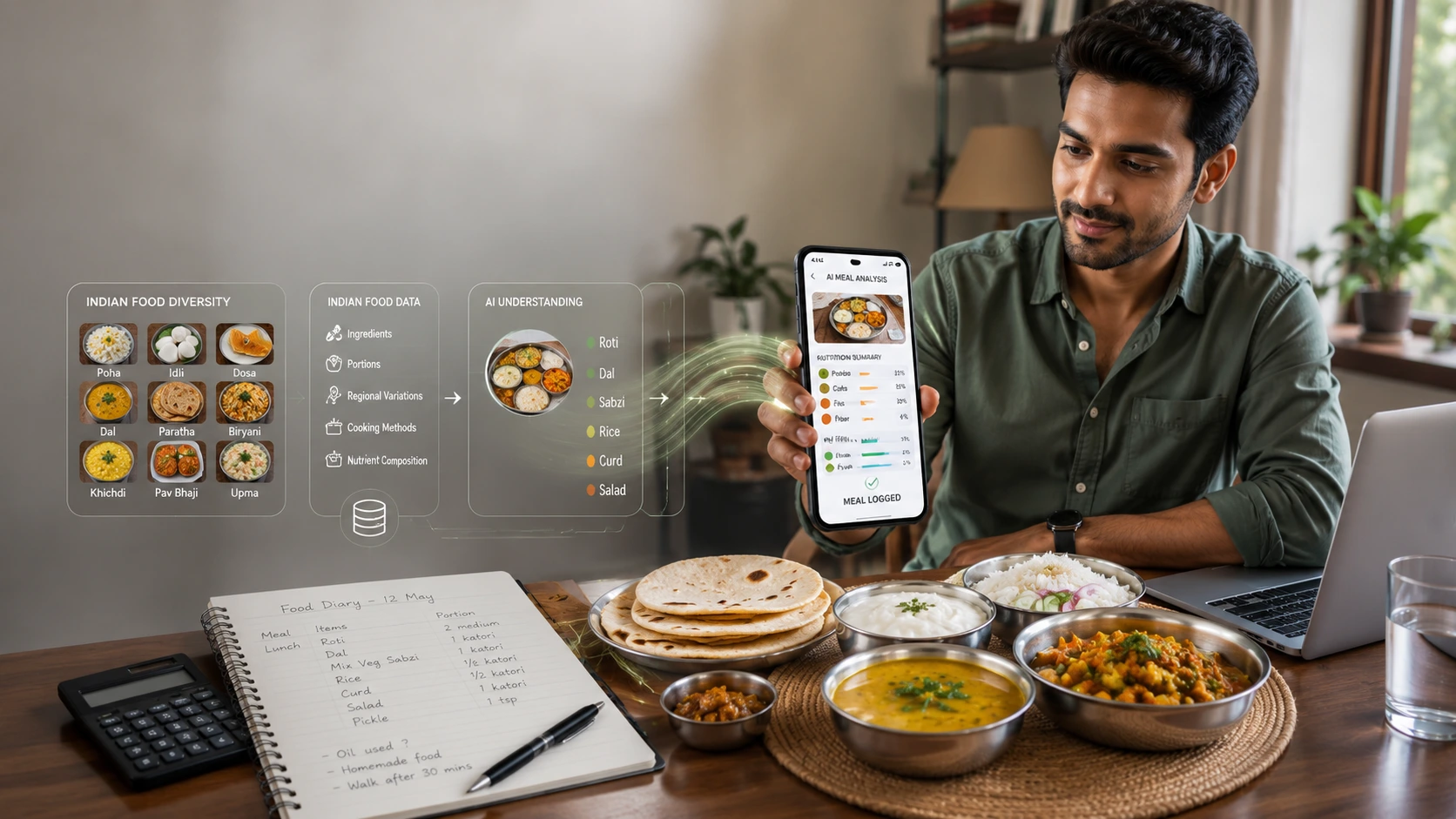
For years, digital nutrition tracking has largely been designed around food systems that do not fully reflect how Indians eat. Someone searching for an indian calorie counter app may not simply want calories. They want a tool that understands dal, roti, poha, dosa, sabzi, idli, curd, namkeen and regional meals in the context of everyday Indian eating.
That distinction matters because nutrition tracking only works when people can recognise their food in the system.
India has already built an important scientific foundation through the IFCT 2017, but turning food composition data into convenient, everyday digital experiences remains a larger challenge. The future of nutrition technology India will therefore depend not only on better AI, but on better Indian food data, regional context and simpler tracking.
People searching for an indian calorie counter app are often trying to answer practical questions:
- How much protein does my regular Indian meal provide?
- How should I estimate calories in namkeen?
- Can an app recognise regional Indian dishes?
- How can I improve my diet without weighing every ingredient?
- Is Indian food nutrition data reliable?
- Can AI understand Indian meals accurately enough to be useful?
The underlying search intent is bigger than calorie counting. Users want nutrition information that fits their actual lives.
For a busy professional eating home-cooked food, a gym member trying to improve muscle gain, or a parent trying to build better healthy Indian eating habits, the usefulness of a tracking tool depends heavily on how well it reflects familiar foods.
Why Global Nutrition Apps Were Built Around Western Food Data
Many nutrition platforms developed around food databases that prioritised packaged products, restaurant chains and commonly consumed foods in Western markets.
That model works reasonably well when meals are relatively standardised.
Indian eating patterns are different.
A single meal can contain several ingredients prepared differently across households. A bowl of dal may vary in consistency. A roti can differ in size. A sabzi may use different amounts of oil. A dosa can vary considerably depending on preparation.
This creates a basic data challenge.
The question is not simply:
“How many calories does this food contain?”
It is:
“What exactly did this person eat, in what quantity, and how was it prepared?”
That distinction is critical for AI nutrition India.
A database can provide a nutritional reference, but the digital experience still needs to interpret real-world meals.
This is also why questions around protein in average indian meal are more complicated than they appear. The answer depends on the combination of cereals, pulses, dairy, eggs, vegetables and other foods consumed.
Nutrition technology needs to reflect that complexity without transferring it to the user.
The Gap This Creates for Indian Users
When an app does not recognise familiar Indian meals effectively, users face three problems.
1. More manual work
People may need to search for individual ingredients instead of simply recording the meal they actually ate.
That friction matters.
Someone already struggling with why staying healthy is hard may abandon tracking if every meal becomes a data-entry exercise.
2. Confusing estimates
Searches such as 100 gm namkeen calories, 1 katori namkeen calories, or calories in 100 gm namkeen show the problem clearly.
There is no single universal answer for every namkeen because composition and preparation can vary. Users therefore need context and sensible estimates rather than false precision.
3. Poor cultural relevance
A nutrition app can technically contain thousands of foods and still feel unfamiliar to an Indian user.
A person eating idli, sambar and coconut chutney does not want to redesign their diet around the database.
The database should adapt to the user’s food habits.
This is particularly important for people trying food tracking without calorie counting. Better tracking should increase awareness without making every meal feel like a mathematics problem.
How Indian Food Databases Like IFCT Are Changing This
The IFCT 2017 is an important foundation for Indian nutrition data.
Developed by the ICMR-National Institute of Nutrition, it provides nutritional information covering 528 key foods and 151 discrete food components. The data was generated from Indian food sampling and analysis, giving digital nutrition systems a stronger Indian reference point.
This matters because reliable food composition data is the foundation underneath useful nutrition technology.
The IFCT 2017 should not be interpreted as a complete representation of every Indian recipe, household preparation or regional dish. Instead, it provides a structured scientific reference that can support more India-relevant nutrition systems.
That distinction is important.
A food composition table tells us about the nutritional composition of foods. A consumer nutrition platform has the additional challenge of understanding how those foods appear in everyday meals.
For example:
Food data: nutritional composition of an ingredient.
Meal context: roti + dal + sabzi + curd.
User context: sedentary workday, gym training, weight-management goal.
The future lies in connecting these layers without overwhelming the person using the system.
What Indian-First Nutrition Technology Looks Like
Indian-first nutrition technology should not mean simply adding more Indian food names to an existing database.
It should make the entire tracking experience more relevant.
Recognising everyday meals
Users should be able to describe or photograph meals using normal language rather than converting everything into technical nutritional terminology.
Understanding Indian food combinations
Nutrition is consumed through meals, not isolated database entries.
A system should understand that dal, rice, vegetables, curd and a small snack form part of a broader eating pattern.
Making protein easier to understand
This is particularly relevant to protein for indian vegetarians.
Instead of treating protein as a specialist fitness concept, useful tracking can help users understand where protein appears across everyday meals and where their intake may be lacking.
Reducing unnecessary precision
Not every user needs to know the exact number of calories in every spoon of oil.
For many people, the priority is building sustainable health habits and understanding patterns.
Supporting simple meal tracking
An easy way to track meals can be more valuable than a sophisticated dashboard that users stop opening after a week.
Nutrimate approaches this through an Indian-first, AI-powered and WhatsApp-first experience designed around familiar Indian meals and practical consistency.
The broader principle is simple: technology should reduce the effort required to understand food, rather than making healthy eating another administrative task.
Nutrimate also combines India’s #1 whatsapp meal logging feature and Unique Caregiver feature, extending the idea of simple nutrition tracking beyond individual users to families and everyday support.
Why Regional Cuisine Diversity Is the Next Challenge
India does not have one standard diet.
The food eaten in Punjab differs from the food eaten in Kerala. Maharashtra, Gujarat, Bengal, Tamil Nadu, Assam and Rajasthan each have distinct ingredients, recipes and eating patterns.
Even within the same city, household recipes can vary significantly.
This makes regional cuisine one of the next major challenges for nutrition technology.
A system that recognises “rice” but does not understand the difference between common regional preparations has only solved part of the problem.
The challenge becomes even greater with mixed dishes.
Consider:
- Sambar
- Pav bhaji
- Misal
- Biryani
- Khichdi
- Upma
- Poha
- Paratha
- Thali meals
These are not single ingredients. Their nutritional profile depends on composition, preparation and portion size.
This is where food data gaps remain important.
The answer is not to claim perfect accuracy. It is to continuously improve food databases, contextual understanding and user-friendly ways of describing portions.
For someone asking is Indian food healthy, the useful answer is rarely a simple yes or no. The nutritional quality of a diet depends on food choices, quantities, preparation methods and overall dietary pattern.
The ICMR-NIN’s Dietary Guidelines for Indians similarly emphasise balanced and varied eating patterns across food groups rather than reducing healthy eating to one nutrient or one food.
What to Expect From Nutrition Apps in the Next Few Years
The next generation of nutrition apps is likely to become less about manual database searches and more about contextual understanding.
Several changes are particularly important.
From food entries to meal understanding
Users will increasingly expect technology to understand meals rather than individual ingredients.
From calorie counting to behaviour awareness
People may care less about recording a perfect number and more about recognising patterns such as low protein intake, inconsistent meals or frequent high-calorie snacks.
From generic databases to local relevance
Indian users will increasingly expect nutrition platforms to understand local foods, regional cuisines and familiar eating habits.
From complicated tracking to conversational tracking
The easier it becomes to record meals through natural interactions, the more realistic consistent tracking becomes for busy lifestyles in india.
From isolated tracking to connected wellness
Nutrition data can increasingly connect with fitness, progress and family support.
For trainers, this could mean better visibility into nutrition tracking for gym members. For families, it could support family health tracking app experiences. For professionals, it could contribute to more practical health habits without requiring extensive manual work.
The long-term opportunity for nutrition technology India is therefore not simply to produce more calorie calculators.
It is to create systems that understand how Indians actually eat and make that information useful in everyday life.
That is the real shift from generic nutrition software to Indian-first nutrition intelligence.
Reference
- ICMR-NIN: Indian Food Composition Tables 2017
Official source for the IFCT 2017 food composition data. - ICMR-NIN: Dietary Guidelines for Indians 2024
Official Indian nutrition guidance supporting the article’s discussion of balanced and varied eating patterns.
FAQs
Many global nutrition systems were built around food databases and eating patterns from markets outside India. Indian meals often involve regional recipes, variable preparation methods, mixed dishes and household-specific portions, making them harder to represent through simple database entries. Better Indian food data and contextual meal understanding can make nutrition tracking more relevant.
IFCT 2017 stands for Indian Food Composition Tables 2017. It was developed by the ICMR-National Institute of Nutrition and provides nutritional information for 528 key foods across 151 discrete food components. It serves as an important scientific foundation for understanding the composition of Indian foods.
Yes. India has established important reference resources such as IFCT 2017, while digital nutrition platforms are increasingly using Indian food data and AI to make tracking more practical. However, regional cuisine, recipe variation and portion differences mean that improving Indian nutrition tracking remains an ongoing process.
Read Nutrimate Wellness first on Google