 Pradnya Ganorkar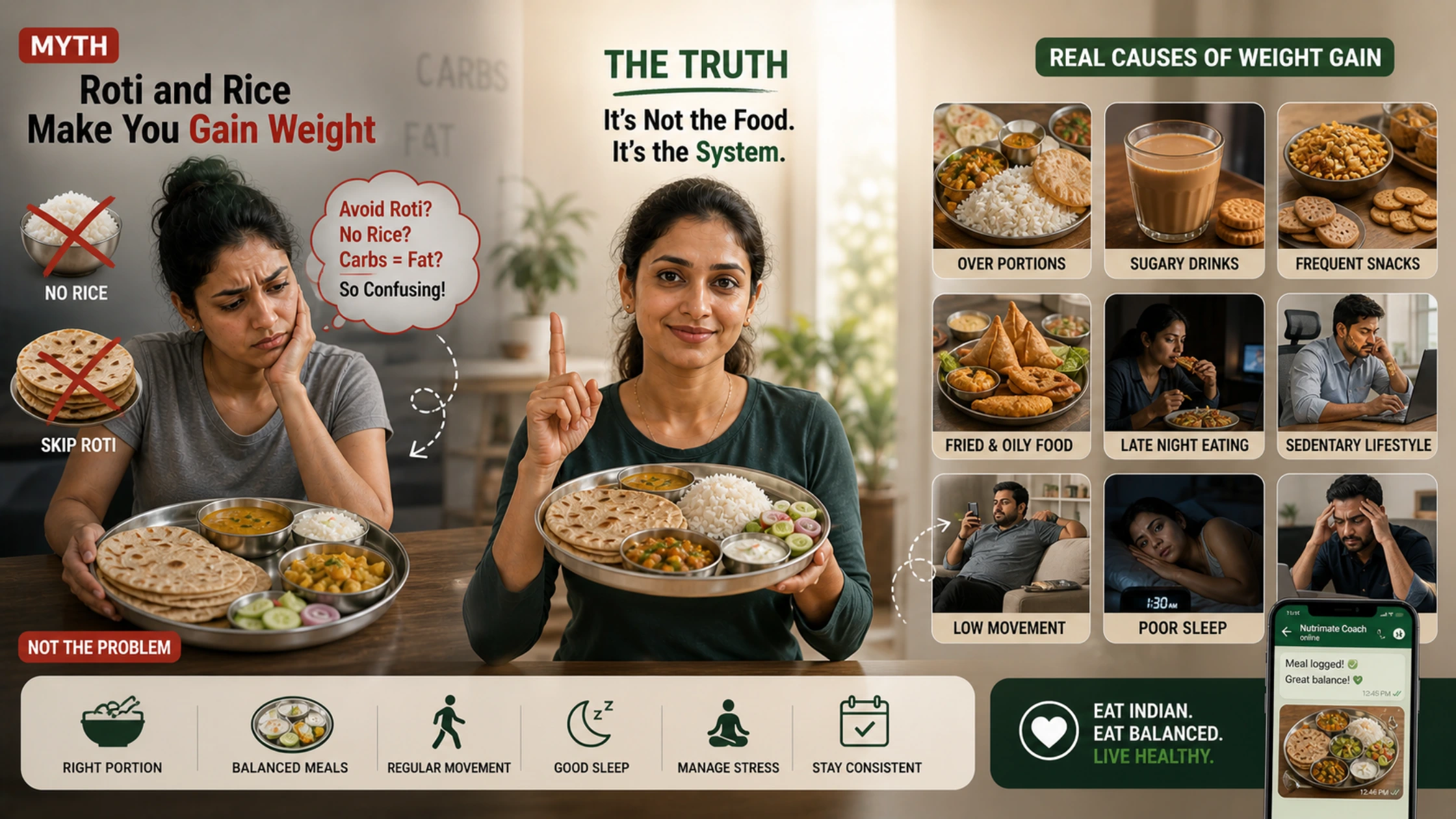
For millions of Indians, the first step toward weight loss often looks familiar:
Stop rice.
Reduce roti.
Avoid carbs.
Switch to “diet food.”
This belief has shaped countless meal choices across households, offices, gyms, and family conversations.
But here is the reality:
The roti rice weight gain myth has confused more people than it has helped.
Roti and rice are not automatically the reason people gain weight.
In fact, for many Indians, blaming staple foods creates unnecessary fear around everyday eating while ignoring the deeper issues that actually influence weight gain.
The bigger problem is often:
- Untracked portions
- Frequent overeating
- Mindless snacking
- High-calorie add-ons
- Low movement
- Inconsistent routines
This matters because sustainable progress in healthy eating India is rarely about removing traditional foods entirely.
It is about understanding patterns.
For people trying to build a healthy lifestyle for busy Indians, this shift is critical.
You do not gain weight from roti alone.
You gain weight when your overall habits consistently exceed your body’s energy needs.
This distinction is one of the most important truths in Indian food and health.
And for many, daily awareness through systems like meal tracking or even India’s #1 whatsapp meal logging feature and Unique Caregiver feature can help reduce food confusion without turning health into restriction.
The Biggest Indian Diet Myth
One of the most persistent Indian diet myths is simple:
“Rice makes you fat.”
“Roti causes belly fat.”
“Carbs are bad.”
These statements are repeated so often that they begin to feel like facts.
But they oversimplify nutrition.
Why This Myth Became Popular:
Many people notice weight gain while regularly eating:
- Rice
- Roti
- Paratha
- Snacks
So they assume the staple itself is the cause.
But correlation is not the same as causation.
Practical Truth:
Traditional Indian staples have been part of balanced diets for generations.
What changed more dramatically is:
- Sedentary work
- Processed snacks
- Frequent eating outside
- Portion inflation
- Sleep disruption
- Stress
Myth vs Reality
Myth: Roti or rice directly causes fat gain
Reality: Excess calories over time, regardless of source, contribute to weight gain
Why This Matters:
When people fear staples, they often:
- Follow unsustainable diets
- Feel deprived
- Quit quickly
- Restart repeatedly
This is one reason why diets fail long term.
Why Carbs Get Blamed
Carbohydrates are often misunderstood because they are visible and easy to blame.
Common Indian Context:
A plate with:
- 4 rotis
- Rice
- Sabzi
- Dal
Feels “heavy.”
But food quality depends on context.
What Actually Happens:
When carbs are eaten with:
- Excess oil
- Fried sides
- Sugary drinks
- Frequent desserts
- Large portions
The meal becomes more calorie-dense.
Important:
Carbs themselves are not villains.
They are energy.
Roti:
Provides:
- Carbohydrates
- Fiber (especially whole wheat)
- Satiety
Rice:
Provides:
- Fast energy
- Digestibility
- Cultural fit
The Real Issue:
Most people do not just eat carbs.
They eat:
Carbs + excess calories + low awareness
Strategic Insight:
For simple health habits for working professionals, blaming one food category often creates confusion instead of clarity.
The Real Cause of Weight Gain
Weight gain is usually driven by a broader pattern.
Core Drivers:
1. Calorie Surplus
Consistently eating more than your body uses
2. Frequent Snacking
Tea biscuits, namkeen, sweets, sugary chai
3. Liquid Calories
Juices, sweet coffee, soda
4. Low Activity
Desk jobs + commuting + minimal movement
5. Stress Eating
Emotional food choices
6. Sleep Disruption
Late nights influence hunger hormones
Indian Lifestyle Example:
A person may blame lunch rice but ignore:
- 3 cups sweet chai
- Fried snacks
- Late-night dessert
- Weekend overeating
Practical Truth:
Weight gain is often a system issue.
Not one food issue.
This is why how to stay healthy without dieting often works better than extreme elimination.
Portion + Frequency Problem
This is where most confusion happens.
Food Type Matters Less Than:
- How much
- How often
- What it is paired with
Example:
Meal A:
2 rotis + dal + sabzi + salad
Balanced.
Meal B:
5 rotis + paneer butter masala + dessert + cola
Higher calorie load.
Rice Example:
1 cup rice with sambar and vegetables can fit well into a balanced Indian diet.
But:
Large portions + fried sides + inactivity = different outcome
Strategic Shift:
Instead of asking:
“Is rice bad?”
Ask:
“How much, how often, and what else?”
Why Tracking Helps:
Daily awareness reduces assumption.
This is where food tracking without calorie counting or simple meal tracking for Indian food becomes valuable.
Nutrimate’s Indian-first approach, including India’s #1 whatsapp meal logging feature and Unique Caregiver feature, reflects this broader movement toward simplicity over obsession.
Real Meal Examples
Example 1: Traditional Home Meal
- 2 rotis
- Dal
- Bhindi
- Curd
Likely sustainable.
Example 2: Urban “Healthy” Meal
- Granola smoothie
- Peanut butter snack
- Protein bar
- Sweetened coffee
May actually exceed calories faster.
Lesson:
“Healthy-looking” food is not always lower calorie.
Example 3: Office Routine
Breakfast skipped
Heavy lunch
Evening samosa
Late dinner
Problem:
Irregularity + overeating
Better Framework:
Stable meal rhythm + balanced staples
Key Insight:
Healthy Indian eating habits often depend more on pattern consistency than food elimination.
Do vs Don’t
DO:
- Understand portions
- Eat roti and rice mindfully
- Build sustainable health habits for Indians
- Focus on consistency
- Improve awareness
- Use easy way to track meals approaches
- Respect traditional Indian food
DON’T:
- Demonize carbs
- Cut staples unnecessarily
- Follow unsustainable extremes
- Ignore snacks and oils
- Assume “healthy” means low calorie
- Restart every Monday
Strategic Nutrition Reality:
For most people, food confusion creates more inconsistency than food itself.
This is especially true for:
- Busy professionals
- Families
- Gym beginners
- Parents
The goal is not fear.
It is clarity.
Better Question:
Not:
“Should I stop eating rice?”
But:
“How do I build a repeatable system around real Indian eating?”
Because lifestyle change happens faster when habits become realistic.
And realistic health usually includes:
Roti. Rice. Dal. Structure.
Frequently Asked Questions
Rice alone does not automatically cause weight gain. Weight gain typically comes from overall calorie surplus, portion size, eating frequency, and broader lifestyle habits rather than one single food.
No. Roti can absolutely be part of weight loss when portions, meal balance, and overall eating patterns are aligned with your health goals. Sustainability usually works better than unnecessary elimination.
Read Nutrimate Wellness first on Google