 Pradnya Ganorkar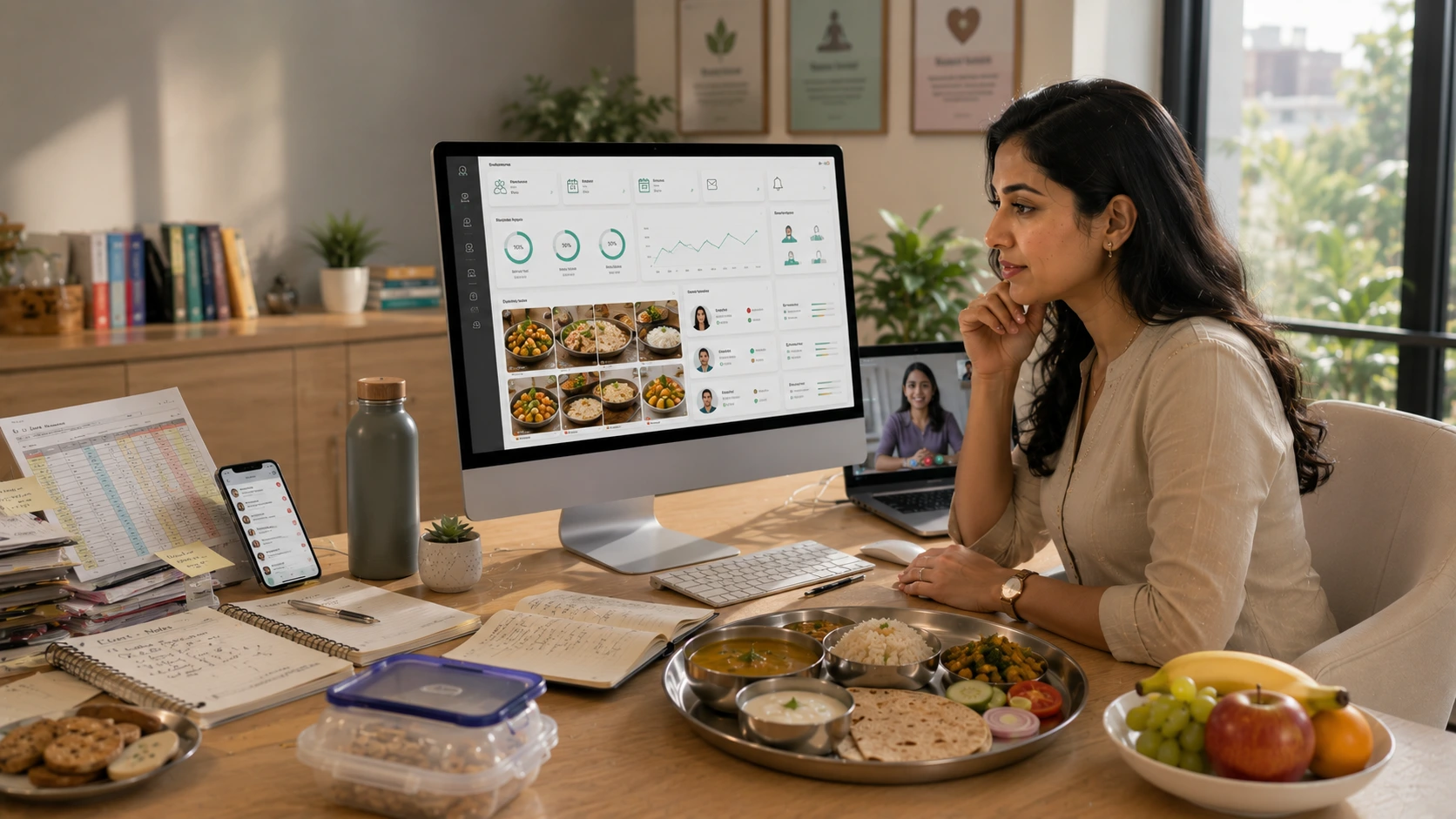
A nutritionist may manage 30, 50, or even hundreds of clients, yet much of the working day can disappear into reviewing WhatsApp messages, checking food photos, updating spreadsheets, searching old consultation notes, sending reminders, and preparing progress reports manually.
This operational burden is one reason nutrition tracking software has become increasingly relevant to modern nutrition practices.
As online nutrition coaching grows and clients expect more personalized, continuous support, nutrition professionals need better visibility between consultations. Effective nutrition practice management is no longer limited to creating diet plans. It requires consistent meal tracking, communication, progress monitoring, and systems that help professionals identify when clients are struggling before they disengage.
Why this topic matters today
The traditional nutrition practice was largely consultation-driven.
A client visited a clinic, discussed health concerns, received recommendations, and returned after several weeks for a follow-up.
Today, expectations are different.
Clients increasingly interact with nutritionists through online consultations, messaging platforms, mobile applications, and other digital health channels. They may expect feedback on meals, guidance between appointments, progress reports, reminders, and ongoing accountability.
For Indian nutritionists, this creates both opportunity and operational pressure.
A professional may serve local clients through a clinic while simultaneously providing virtual nutrition consultation to clients across different cities.
The challenge is maintaining quality as the number of clients increases.
Without structured nutritionist client management, important information can become fragmented across spreadsheets, chat conversations, paper notes, food photographs, and multiple applications.
The World Health Organization’s Global Strategy on Digital Health highlights the role of digital health initiatives in strengthening health systems and supporting more efficient, sustainable, and people-centred healthcare delivery.
The objective is not to replace professional judgement with technology.
It is to build systems that reduce administrative friction and improve visibility into client behaviour.
Biggest challenges professionals face
Most growing nutrition practices encounter similar operational problems.
Fragmented client information
Consultation notes may be stored in one system, meal photographs in WhatsApp, body measurements in spreadsheets, and follow-up schedules in calendars.
This fragmentation creates an inefficient nutrition workflow.
The nutritionist spends more time finding information and less time interpreting it.
Limited visibility between consultations
A client may follow recommendations consistently for three days and gradually return to previous habits.
If the professional only reviews progress during the next consultation, several weeks may pass before the problem becomes visible.
Better client progress tracking helps professionals observe trends over time instead of relying only on memory or self-reported summaries.
Poor client adherence
Providing a technically accurate plan does not guarantee implementation.
Real behavior change requires repetition, awareness, accountability, and realistic adjustments.
Clients may struggle because of travel, family meals, festivals, office schedules, stress, social eating, or difficulty preparing separate meals.
Understanding client adherence nutrition patterns allows professionals to adapt recommendations to everyday life.
Administrative overload
Manual reminders, repetitive follow-ups, progress calculations, report creation, and record updates can consume hours every week.
This creates a scalability problem.
A nutritionist cannot sustainably grow a nutrition coaching business if every additional client creates the same amount of manual work.
Client disengagement
Clients often begin with high motivation.
Over time, participation can decline.
Missed check-ins become less frequent meal updates. Progress becomes difficult to evaluate, and eventually the client stops responding.
Improving nutrition client engagement requires systems that make participation simple and help professionals recognise declining adherence early.
Step-by-step implementation framework
Technology should be introduced only after the practice understands the operational problem it needs to solve.
A practical implementation framework can follow six stages.
Step 1: Map the complete client journey
Document every stage:
Enquiry → Consultation → Assessment → Plan → Daily Implementation → Follow-Up → Progress Review → Renewal
Identify where clients experience friction and where professionals spend unnecessary time.
Step 2: Decide what information actually matters
Tracking everything creates complexity.
Most practices need visibility into a limited number of meaningful indicators, such as:
- Meal consistency and dietary patterns
- Changes in body measurements where relevant
- Physical activity
- Hydration habits
- Sleep and lifestyle routines
- Consultation history
- Goal progress
- Client participation and adherence
The objective of nutrition analytics should be better decision-making, not creating more data.
Step 3: Simplify client participation
The system should require as little effort as reasonably possible.
If logging every meal requires searching large food databases, manually calculating quantities, or completing lengthy forms, participation may decline.
Simple habit tracking and convenient food logging can help professionals collect more consistent information.
Step 4: Create a structured review process
More data does not automatically improve coaching.
Professionals need a routine for reviewing information.
For example:
Daily: Identify missed logs or major adherence issues.
Weekly: Review recurring meal patterns and client participation.
Monthly: Evaluate progress, update recommendations, and prepare reports.
A structured nutrition practice system helps turn raw information into practical coaching decisions.
Step 5: Use automation selectively
Not every interaction should be automated.
Personal conversations remain essential to effective nutrition coaching.
However, repetitive administrative work such as appointment reminders, routine check-ins, progress report generation, and basic follow-up notifications may benefit from thoughtful nutrition automation.
Step 6: Measure business and client outcomes
Evaluate whether the system is improving:
Client adherence.
Response rates.
Renewal rates.
Time spent on administration.
Consultation capacity.
Progress visibility.
Client satisfaction.
The right nutrition practice software should support both client outcomes and sustainable practice growth.
Common mistakes to avoid
Choosing software based only on the number of features
More features do not necessarily create better outcomes.
A complicated nutrition coaching platform may create additional work if clients and professionals struggle to use it consistently.
Prioritize usability, workflow fit, and meaningful visibility.
Tracking data without using it
Collecting hundreds of meal logs is useless if nobody reviews the patterns.
Every tracked metric should support a coaching decision.
Making clients use too many platforms
One tool for appointments, another for messaging, another for meals, and another for progress reports can create unnecessary friction.
A more integrated digital nutrition practice can simplify the experience for both professionals and clients.
Automating the human relationship
Technology can simplify reminders, documentation, and reporting.
It cannot replace empathy, professional judgement, contextual understanding, and personalized guidance.
Effective personalized nutrition still depends on the quality of the professional relationship.
Ignoring data privacy and security
Nutrition professionals may handle sensitive health information.
Any healthcare software used in a practice should be evaluated for appropriate privacy controls, access management, data protection, and compliance responsibilities relevant to the organization and jurisdiction.
India’s Digital Personal Data Protection Act, 2023 establishes obligations related to processing digital personal data, including lawful processing, security safeguards, and responsibilities of organizations handling personal information.
Tools, systems or workflows
A modern nutrition practice needs a connected operating system rather than a collection of disconnected applications.
| Operational Need | Manual Approach | Structured Digital Approach |
| Client records | Paper files and spreadsheets | Centralized nutrition CRM |
| Food monitoring | Scattered photographs and messages | Structured nutrition tracking software |
| Progress reviews | Manual comparisons | Automated client progress tracking |
| Follow-ups | Individual reminders | Scheduled nutrition automation |
| Consultations | Clinic-only appointments | Hybrid and online nutrition coaching |
| Reporting | Manually prepared documents | Nutrition reporting software |
| Client engagement | Reactive communication | Continuous client engagement workflows |
The right system should reduce unnecessary administrative work while improving the nutritionist’s ability to understand client behaviour.
This is where Nutrimate can support visibility and consistency through Indian-first health tracking, practical meal awareness, and WhatsApp-based participation. India’s #1 whatsapp meal logging feature and Unique Caregiver feature can make ongoing health participation more accessible for individuals and families without requiring complicated daily workflows.
For professionals who need a broader B2B ecosystem, FitVia, a service of Nutrimate Wellness, can complement the consumer platform. It supports gym owners, fitness trainers, influencers, and dietitians through branded member experiences, trainer dashboards, WhatsApp nutrition tracking, Indian food intelligence, progress reports, analytics, and engagement workflows.
The strategic value is not simply having more technology.
It is creating better visibility into behaviour, stronger nutrition client engagement, and more efficient coaching operations.
Future trends
Continuous coaching will become more important
The future of nutrition services is likely to move further beyond isolated consultations.
Clients increasingly need guidance while they are making everyday decisions.
Continuous health monitoring, regular feedback, and simple tracking can help professionals identify problems earlier.
AI will support pattern recognition
AI can help organize large volumes of client information, identify recurring behaviours, summarize progress, and support more efficient analysis.
However, professional judgement should remain central to clinical nutrition and individualized health decisions.
Convenience will influence adherence
The best system is not necessarily the one that collects the most information.
It is the one clients can use consistently.
Low-friction meal tracking and familiar communication channels may improve long-term participation.
Nutrition practices will become more integrated
Consultations, client records, food tracking, progress reports, communication, and analytics are likely to become more connected.
Professionals searching for nutritionist software India will increasingly evaluate whether platforms can support the complete client journey rather than solving one isolated task.
Outcome visibility will become a competitive advantage
Clients want to understand whether their efforts are producing meaningful progress.
Clear nutrition reporting software and visual progress summaries can help professionals communicate improvements beyond changes on the weighing scale.
Practices that can demonstrate adherence, habit improvements, progress patterns, and coaching impact may be better positioned to improve client retention and sustainable nutrition business growth.
Key takeaways & checklist
Before choosing or implementing nutrition tracking software, nutrition professionals should evaluate the following:
☐ Can clients log meals and habits easily?
☐ Can the professional view important information in one place?
☐ Does the system support structured nutritionist client management?
☐ Can professionals monitor adherence between consultations?
☐ Does it improve client progress tracking?
☐ Can repetitive administrative tasks be simplified?
☐ Does it support in-person and online nutrition coaching?
☐ Can reports be created without excessive manual work?
☐ Does the system support practice growth without reducing coaching quality?
☐ Are privacy, security, and access controls appropriate?
☐ Does technology strengthen rather than replace the professional relationship?
The purpose of technology in nutrition practice is not to collect more data.
It is to create visibility.
When professionals can understand client behaviour between consultations, identify declining adherence earlier, simplify routine administration, and communicate progress clearly, they can build stronger and more scalable nutrition practice management systems.
FAQs
The best approach is to identify operational problems before choosing technology. Map the client journey, decide what information matters, simplify participation, establish a review process, automate repetitive tasks selectively, and measure outcomes. Effective nutrition practice management begins with a clear workflow rather than purchasing software first.
Professionals should use tools that support client records, meal tracking, habit tracking, progress monitoring, communication, reporting, scheduling, and appropriate data protection. The right combination depends on practice size, client needs, coaching model, and existing workflows.
Practices can improve client retention by making participation easier, providing consistent feedback, personalizing recommendations, monitoring adherence between consultations, communicating progress clearly, and addressing disengagement before clients stop participating.
Avoid choosing complicated software based only on feature count, collecting information without reviewing it, forcing clients to use too many applications, automating every interaction, ignoring privacy responsibilities, and adopting technology without measuring whether it improves coaching quality or operational efficiency.
Reference:
- World Health Organization: Global Strategy on Digital Health 2020–2027
- Digital Personal Data Protection Act, 2023, Ministry of Electronics and Information Technology, Government of India
Read Nutrimate Wellness first on Google