 Pradnya Ganorkar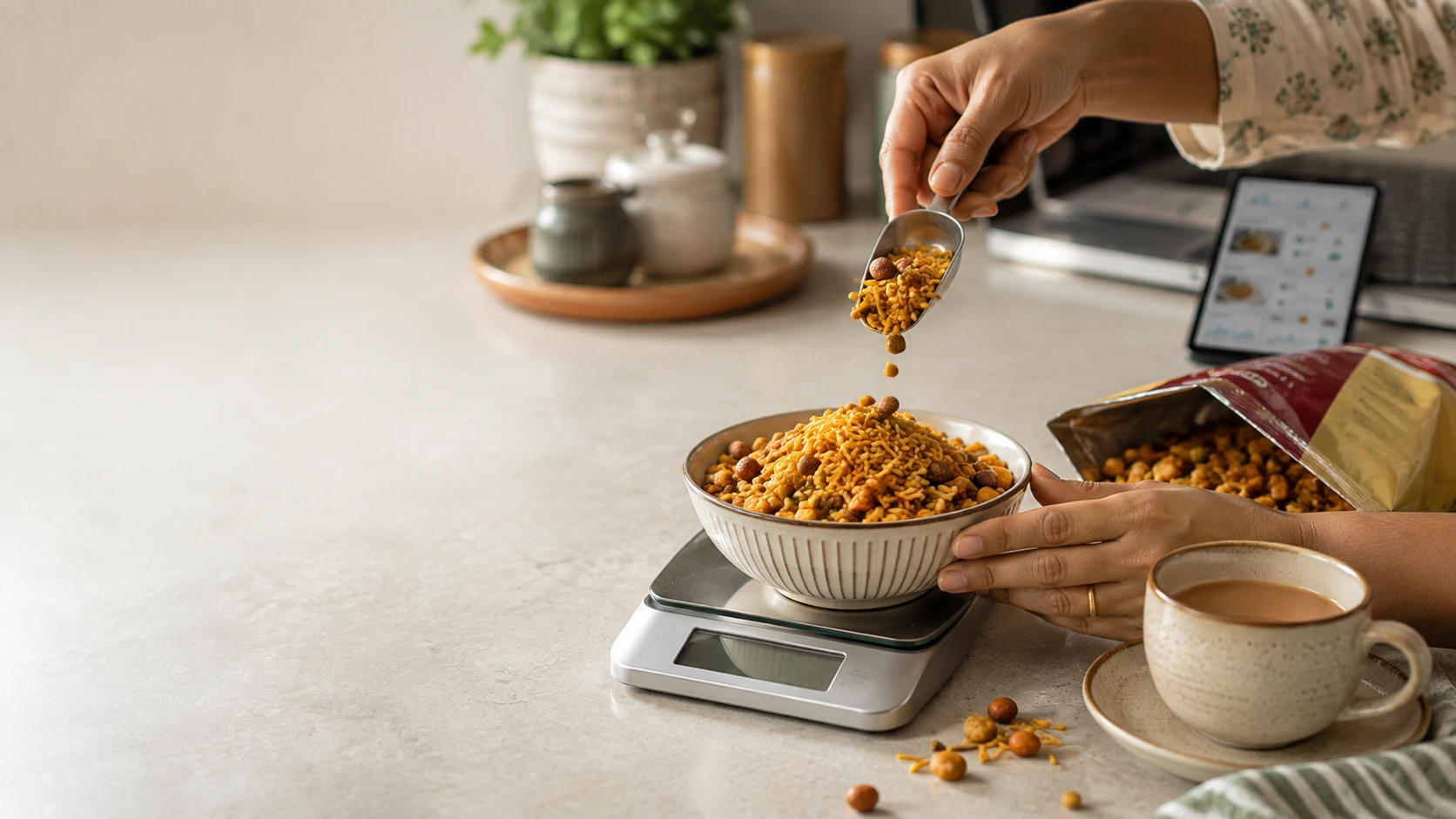
For many Indians, namkeen is the snack that does not feel like a “big” snack. A small bowl with evening tea, a handful while working, or something served when guests arrive can feel harmless.
The challenge is portion awareness.
Understanding namkeen calories is not about avoiding snacks completely. It is about knowing how much you are actually eating, especially because fried and savoury mixtures can be relatively energy-dense.
The Indian Food Composition Tables 2017 provide a comprehensive reference for the nutrient composition of Indian foods, while ICMR-NIN’s dietary guidance highlights the importance of paying attention to foods high in energy, fat, sugar and salt.
Why Namkeen Feels ‘Light’ but Isn’t
Namkeen often creates a misleading sense of portion size.
A handful may weigh very little compared with a full plate of food, but many varieties combine ingredients such as gram flour, cereals, nuts, oil and spices. Frying can also increase the energy density of the finished snack.
That is why asking only, “How much did I eat?” is less useful than asking:
“How much did I eat by weight or portion?”
A small handful could be 15 to 20 grams. A generously filled katori could easily be 30 to 50 grams or more.
The difference matters.
For example, if a namkeen contains around 500 calories per 100 grams, then:
| Approximate portion | Approximate calories |
| 20g | 100 kcal |
| 30g | 150 kcal |
| 40g | 200 kcal |
| 50g | 250 kcal |
| 100g | 500 kcal |
These are illustrative estimates, not universal values. Actual energy content varies significantly by recipe, ingredients, oil absorption and brand.
This is why calories in namkeen should always be interpreted alongside the actual variety and quantity.
The problem is rarely one occasional bowl. It is the repeated habit of eating without noticing the portion.
Calories in 100g of Common Namkeen Varieties
If you search for 100 gm namkeen calories, you will find different numbers because “namkeen” is not one food.
Sev, bhujia, chivda, dal mixtures and regional savoury snacks can have different ingredients and preparation methods.
For practical awareness, many commercially prepared fried namkeen varieties can fall roughly within the 400 to 600 kcal per 100g range, although individual products can fall outside this range.
Here is a practical reference:
| Namkeen type | Approximate calories per 100g |
| Sev | 500 to 600 kcal |
| Bhujia-style mixture | 500 to 600 kcal |
| Fried gram-flour mixture | 450 to 600 kcal |
| Chivda-style mixture | 400 to 550 kcal |
| Mixed namkeen | 450 to 600 kcal |
These ranges should not replace the nutrition panel of a packaged product.
If the packet states 540 kcal per 100g, for example, that figure is more useful than relying on a generic online estimate.
The same principle applies when looking for calories in 100 gm namkeen. The number needs to be connected to the specific product.
For home-prepared namkeen, uncertainty is even greater because the quantity of oil and ingredients can vary between households.
That is one reason food awareness is more useful than pretending every Indian snack has one fixed calorie number.
How Many Calories Are in a Typical Katori of Namkeen?
For Indian households, grams are not always the easiest way to think about snacks.
We use familiar measures such as a katori, handful or small bowl.
A typical small katori of namkeen might contain approximately 25 to 40 grams, depending on the size of the bowl and how tightly it is filled.
If the namkeen contains approximately 500 kcal per 100g:
- 25g: about 125 kcal
- 30g: about 150 kcal
- 40g: about 200 kcal
So, a reasonable practical range for 1 katori namkeen calories can be around 125 to 240 kcal, depending on the variety and serving size.
A large katori can contain considerably more.
This is where visual estimation becomes difficult. Two people can say they had “one bowl” while consuming very different amounts.
The useful habit is not to obsess over exact numbers.
Instead, occasionally measure a normal serving at home. Put the amount you usually eat into a bowl, weigh it once, and use that experience to understand what your usual portion looks like.
After doing this a few times, portion awareness becomes much easier.
Why It’s Easy to Eat Far More Than One Serving
Namkeen is particularly easy to eat while doing something else.
You may be:
- Watching television
- Working at your desk
- Having evening tea
- Talking with family
- Travelling
- Hosting guests
- Preparing food
The hand reaches into the container repeatedly, but the brain does not necessarily register each handful as a separate eating decision.
This is where mindful eating and simple meal tracking can help.
Consider two scenarios.
Scenario A:
You put 30g of namkeen into a bowl and eat it with tea.
Scenario B:
You keep the packet beside your laptop and take a handful every 15 minutes.
The food is identical.
The behaviour is not.
Scenario B makes it much easier to consume significantly more than intended.
This is also why asking only whether a food is “healthy” or “unhealthy” can be misleading. Portion, frequency, preparation and the rest of the day’s diet all matter.
A person who occasionally enjoys a measured serving does not need to treat namkeen as forbidden.
Healthier Ways to Enjoy Namkeen Without Overdoing It
The goal is not to remove every enjoyable snack from an Indian diet.
A more sustainable approach is to make the portion and frequency visible.
1. Serve it instead of eating from the packet
Move a portion into a bowl.
Once the packet is out of reach, it becomes easier to recognise how much you have eaten.
2. Check the label on packaged products
If you are buying packaged namkeen, compare the serving size with the amount you normally eat.
A packet may list nutrition per serving, while the entire packet contains several servings.
The difference can be substantial.
3. Pair snacks thoughtfully
If namkeen is part of your evening routine, consider what else you are consuming at the same time.
Tea with sugar, biscuits, sweets and namkeen can turn a small snack occasion into a much larger intake.
4. Avoid compensating with extreme restriction
Eating a larger snack does not mean you need to skip your next meal.
Extreme compensation can create an unnecessary cycle of restriction and overeating.
5. Look at the whole day
If your regular meals already include vegetables, pulses, suitable protein sources and other nutrient-dense foods, an occasional portion of namkeen can fit into an overall balanced pattern.
The focus should be healthy Indian eating habits, not perfect eating.
A Mindful Snacking Checklist
Before or while eating namkeen, ask:
- Do I know roughly how much I am eating?
- Am I eating from a bowl or directly from the packet?
- Have I checked the serving size?
- Is this actual hunger, habit or simply availability?
- Am I eating while distracted?
- Could I stop after one planned portion?
- How often does this snack appear in my week?
- What does the rest of my day’s food look like?
- Am I getting enough protein and other nutrient-dense foods?
- Can I enjoy the snack without turning it into an all-or-nothing decision?
This is where simple food tracking can become useful.
You do not necessarily need to calculate every ingredient in every meal. Even tracking snacks for a few days can reveal patterns that are otherwise easy to miss.
For people who find manual calculation tedious, an Indian-first nutrition platform such as Nutrimate can make food awareness simpler. Photo-based meal logging can help estimate a portion such as a katori of namkeen without requiring the user to manually search through multiple food entries.
The purpose is not to make every snack a mathematical exercise.
It is to make everyday eating more visible.
That distinction matters because sustainable health habits are usually easier to maintain when they fit normal Indian routines rather than requiring constant restriction.
FAQs
Many fried namkeen varieties contain roughly 400 to 600 kcal per 100g, but the exact value depends on the recipe, ingredients, preparation method and brand. For packaged products, use the nutrition information provided on the label rather than relying on a generic estimate.
A small katori containing approximately 25 to 40g of namkeen could provide roughly 125 to 240 kcal if the product contains around 500 to 600 kcal per 100g. Actual calories vary with the type of namkeen and the amount in the bowl.
Namkeen does not need to be treated as completely off-limits. A reasonable portion can fit into an otherwise balanced eating pattern. The more important considerations are portion size, frequency, preparation method and the overall quality of the diet.
Read Nutrimate Wellness first on Google