 Pradnya Ganorkar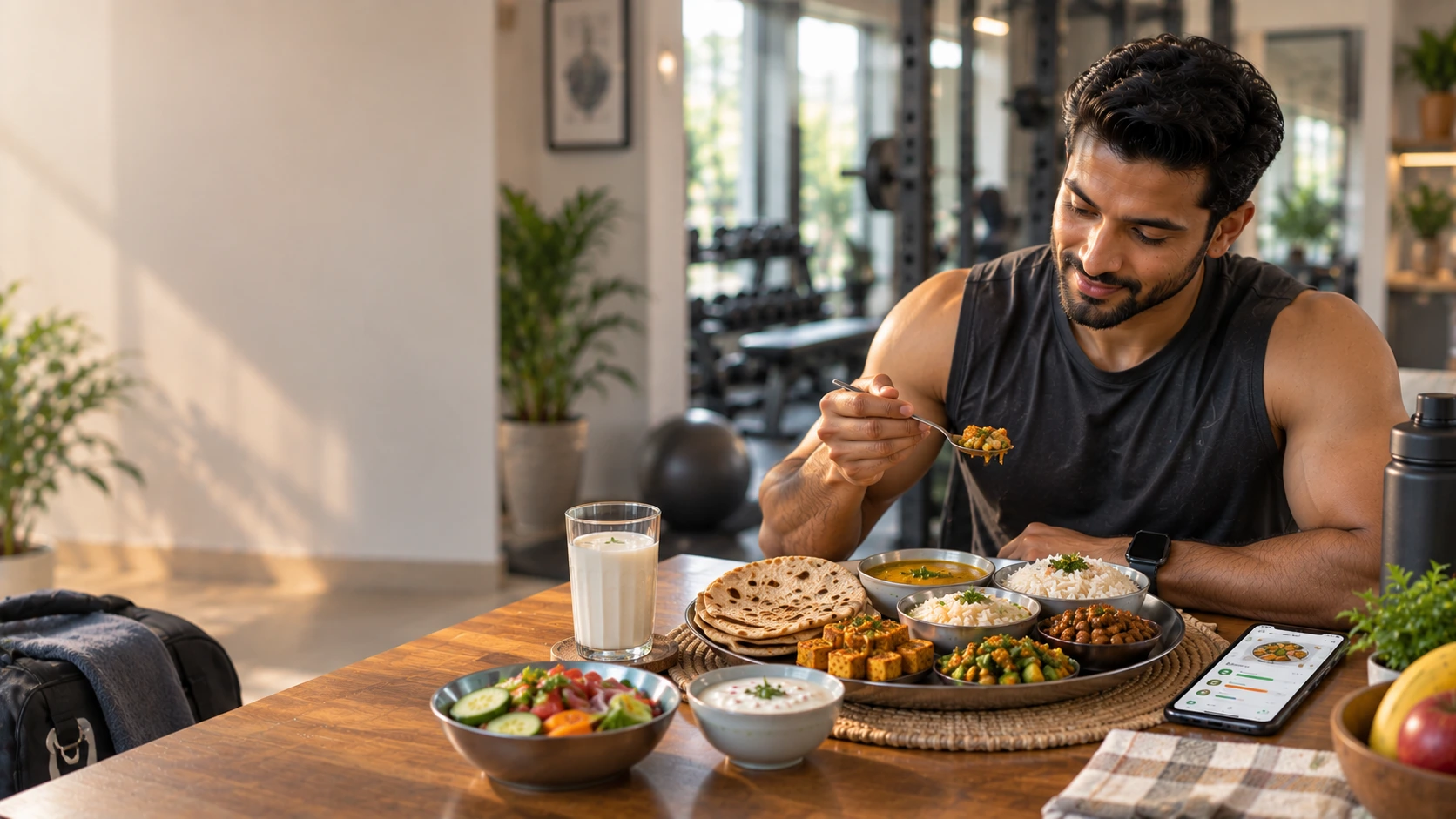
Building muscle on an Indian diet does not require replacing dal, roti, rice, curd or paneer with unfamiliar Western foods. The real challenge is usually knowing whether your meals provide enough protein, calories and consistency to support training. For anyone targeting protein for muscle gain india, understanding an indian food database and using a meal tracker app can make that process much more practical.
Indian gym-goers often know they need “more protein”, but the gap between knowing and consistently eating enough can be substantial. Vegetarian diets, busy work schedules, inconsistent meal timing and dependence on carbohydrate-heavy meals can make muscle gain slower than expected.
The solution is not necessarily a more complicated diet. It is a better structure around familiar Indian foods, adequate protein, progressive resistance training, recovery and consistent tracking.
Why Muscle Building Feels Harder for Indians
Muscle gain requires more than simply going to the gym. Resistance training provides the stimulus, while nutrition and recovery provide the resources needed to adapt.
For many Indians, the first challenge is that traditional meals can be filling without being particularly protein-dense. A typical meal may contain roti or rice, sabzi, dal and curd, but the actual quantity of protein can still fall short of a muscle-building target.
This becomes especially relevant for people following a vegetarian diet. Dal is valuable, but assuming that one small bowl of dal automatically makes a meal high in protein can create a false sense of security.
Three common reasons progress stalls
- Protein is estimated rather than measured.
People may say they eat protein at every meal without knowing how much they actually consume. - Calories are inconsistent.
Some people eat too little to support training and recovery, while others increase calories primarily through snacks, sweets and highly processed foods. - Meals are not planned around the training goal.
A person may train consistently but have breakfast consisting mainly of carbohydrates, a low-protein lunch and an inconsistent dinner.
Muscle gain also requires a suitable resistance-training stimulus and adequate nutrition. The National Strength and Conditioning Association highlights nutrition, resistance training, sleep and lifestyle as interconnected foundations for muscle development.
The practical lesson is simple: training tells your body to adapt, but food and recovery help it do so.
The Protein Requirement for Muscle Gain: Real Numbers for Indian Bodies
For muscle gain, the provided target is 1.6 to 2.2g of protein per kg of bodyweight.
For a 70 kg individual:
| Bodyweight | Protein target at 1.6g/kg | Protein target at 2.2g/kg |
| 60 kg | 96g | 132g |
| 70 kg | 112g | 154g |
| 80 kg | 128g | 176g |
These are useful planning ranges, not a reason to obsess over a single number every day. Individual requirements can vary according to training status, total calorie intake, body composition, age and health considerations.
For someone trying to understand protein for muscle gain india, the bigger issue is often distribution.
Instead of attempting to consume most protein at dinner, divide it across the day. A practical structure is four to five eating occasions, each containing a meaningful protein source.
For example:
- Breakfast: besan cheela with curd
- Mid-morning: milk or curd with nuts
- Lunch: rajma or dal with rice and curd
- Evening: sattu drink or another protein-rich snack
- Dinner: paneer sabzi with roti
This approach is easier to maintain than trying to “catch up” on protein in one meal.
The National Strength and Conditioning Association also notes that protein requirements depend on factors such as bodyweight, total energy intake and training demands rather than existing as one universal number.
Best Indian Foods for Muscle Building
Indian cuisine already contains a strong range of foods that can contribute to muscle growth. The key is combining them strategically and eating sufficient quantities.
Paneer
Paneer is one of the most practical foods for muscle gain in an Indian diet. The provided reference value is approximately 18 to 20g of protein per 100g.
It can be used in:
- Paneer bhurji
- Paneer sabzi
- Paneer wraps
- Paneer with vegetables
- Paneer added to a balanced dinner
The advantage is convenience. A familiar ingredient can be added to meals without completely changing the person’s eating pattern.
Dal
Dal is an important part of the Indian diet, but portion size matters.
A small, diluted serving may contribute much less protein than someone assumes. For a person targeting higher protein intake, dal should be treated as one component of the protein strategy rather than the entire strategy.
Combining dal with curd, paneer, soy or other protein-rich foods can make the overall meal stronger.
Rajma and chana
Rajma and chana are practical options for people looking for protein for indian vegetarians.
They also fit naturally into familiar meals:
- Rajma with rice and curd
- Chana with roti
- Chana salad
- Chole with a balanced portion of roti
- Sprouted legumes as part of a meal
Soy chunks
Soy chunks are particularly useful when someone needs to increase protein without dramatically increasing meal volume.
They can be incorporated into pulao, sabzi, wraps or mixed preparations.
Sattu
Sattu is another culturally familiar option. A simple sattu drink can provide a convenient protein-containing snack, particularly for people who struggle to prepare elaborate meals during busy working days.
Eggs and curd
For people who consume eggs, they provide another straightforward protein source.
Curd can complement meals such as rajma-rice, dal-roti or stuffed parathas, depending on the overall nutritional plan.
The important principle is variety. A good Indian muscle-building diet does not need to depend on one food.
The Vegetarian Muscle Building Challenge and How to Solve It
The challenge with vegetarian muscle building indian diet plans is rarely the absence of protein-containing foods. It is usually insufficient quantity, inconsistent distribution or excessive dependence on one source.
Consider two lunches.
Lunch A
- 2 rotis
- Small bowl of dal
- Sabzi
- Salad
Lunch B
- 2 rotis
- Larger serving of dal
- Paneer
- Sabzi
- Curd
Both look like conventional Indian meals. The second is deliberately structured around a stronger protein contribution.
This is an important distinction because muscle building does not require abandoning Indian food. It requires improving the nutritional structure of familiar meals.
A simple vegetarian protein framework
At each major meal, ask:
Where is my primary protein source?
If the answer is unclear, the meal may need adjustment.
Useful combinations include:
| Meal | Practical combination |
| Breakfast | Besan cheela + curd |
| Lunch | Rajma + rice + curd |
| Lunch | Dal + roti + paneer |
| Snack | Sattu drink |
| Dinner | Paneer sabzi + roti |
| Dinner | Soy-based preparation + vegetables |
This is also where an indian food database becomes useful. Indian portions and preparations vary significantly, so relying on generic international food entries can make tracking less intuitive.
The Indian Food Composition Tables 2017 from the ICMR-National Institute of Nutrition provide detailed composition data for Indian foods and cover 528 key foods across numerous food components.
Meal Timing for Muscle Growth: Does It Matter for Indians?
Meal timing matters, but it should not become another source of unnecessary complexity.
The first priority is reaching an appropriate daily protein intake. After that, distributing protein across multiple meals can make it easier to consistently support training and recovery.
For an Indian professional who works from 9 AM to 6 PM, a practical schedule could look like:
7:30 AM: Besan cheela + curd
10:30 AM: Milk or another protein-containing snack
1:30 PM: Dal + rice + curd + vegetables
5:30 PM: Sattu or another planned snack
8:30 PM: Paneer or soy-based dinner + roti + vegetables
This does not need to be followed exactly. The objective is to prevent the common pattern of consuming very little protein throughout the day and then attempting to compensate at night.
Before and after training
A pre-workout meal should provide sufficient energy without creating digestive discomfort.
A post-workout meal can include protein alongside carbohydrates, especially when the next meal is several hours away.
For most people, consistency across the entire day matters more than finding a perfect “30-minute anabolic window.”
Common Mistakes Indians Make When Trying to Build Muscle
Mistake 1: Assuming a vegetarian meal is automatically high in protein
Dal, roti and vegetables are nutritious, but nutritious does not automatically mean sufficiently high in protein for a specific muscle-building target.
Mistake 2: Increasing calories without improving food quality
Some gym-goers hear that they need a calorie surplus and respond by adding sweets, fried snacks or large quantities of processed food.
A muscle-building diet still needs nutritional quality.
Mistake 3: Treating supplements as mandatory
Protein supplements can be convenient, but they are not automatically necessary.
If whole foods consistently provide the required protein, supplements are simply an optional convenience rather than a prerequisite.
Mistake 4: Ignoring the roti rice weight gain myth
Roti and rice are not inherently incompatible with muscle gain.
They provide carbohydrates, which can support training. The relevant question is how much total energy and protein the overall diet provides.
Mistake 5: Tracking workouts but not nutrition
Many people record every set and repetition while having no idea whether they are eating enough protein.
This creates an information gap.
Mistake 6: Changing the diet every week
Muscle gain takes time. Constantly switching between diets because progress is not immediately visible makes it difficult to determine what is actually working.
A sustainable approach is to establish a manageable routine, track it and make gradual adjustments.
Tracking Your Nutrition for Consistent Muscle Progress
Nutrition tracking becomes valuable when it answers practical questions.
Instead of asking:
“Am I eating healthy?”
Ask:
- How much protein did I consume today?
- Which meal was lowest in protein?
- Am I consistently reaching my target?
- Is my calorie intake appropriate for my goal?
- Which Indian foods make it easiest for me to hit my target?
- Where does my routine break down on busy days?
This is where a meal tracker app can reduce guesswork.
Traditional tracking can become tiring because Indian meals involve multiple ingredients, different portion sizes and regional preparations. A simple Indian-first approach can make the process easier to sustain.
Nutrimate uses Indian food intelligence and WhatsApp-first logging to help users see their food intake without requiring them to manually enter every meal into a complicated system. The objective is not perfect tracking. It is enough awareness to identify patterns and make better decisions consistently.
For fitness businesses, the same principle can extend beyond an individual user. FitVia, Nutrimate’s B2B fitness platform, provides trainers and fitness businesses with tools including WhatsApp nutrition tracking, trainer dashboards, meal planning, progress reports and an Indian food database. This allows coaches to focus more on client adherence and less on manually collecting nutrition information.
What to track for muscle gain
A useful minimum dashboard can include:
| Metric | Why it matters |
| Daily protein | Shows whether the primary nutrition target is being met |
| Total calories | Helps assess whether energy intake supports the goal |
| Bodyweight trend | Indicates longer-term changes |
| Training performance | Shows whether strength is progressing |
| Meal consistency | Identifies behavioural gaps |
| Recovery | Helps contextualise changes in performance |
The goal is not to turn eating into accounting.
The goal is to turn an unclear process into a feedback loop:
Eat → Track → Observe → Adjust → Repeat
For someone following busy lifestyles in india, this approach is particularly useful because the biggest obstacle is often not knowledge. It is consistency.
A person may know that paneer, dal, curd, rajma and soy are useful protein sources. The harder question is whether those foods consistently appear in appropriate quantities across Monday’s office lunch, Wednesday’s late meeting and Sunday’s family meal.
That is why sustainable health habits for Indians matter more than a theoretically perfect diet that becomes impossible to maintain.
A well-structured meal tracker app can make that process more visible. Nutrimate’s WhatsApp-first approach is designed around reducing the friction between eating a meal and recording it, helping users build awareness without making tracking another complicated task.
For gym-goers, the long-term objective is straightforward: train consistently, eat enough protein and energy, recover properly, and use tracking to identify where the routine needs improvement.
References
- National Strength and Conditioning Association, Muscle Growth
- ICMR-National Institute of Nutrition, Indian Food Composition Tables 2017
FAQs
For muscle gain, 1.6 to 2.2g of protein per kg of bodyweight is recommended. For a 70kg individual, that is 112 to 154g daily, achievable through dal, paneer, eggs, curd, and legumes.
Yes, with careful planning around protein sources. Paneer, curd, soy chunks, rajma, chana, and sattu provide sufficient protein for muscle building when consumed in adequate quantities.
Paneer contains approximately 18 to 20g of protein per 100g making it one of the most effective Indian muscle-building foods.
Supplements are not necessary if dietary protein from whole food sources meets your daily target. Track your intake with a meal tracker app to determine whether supplementation is needed.