 Pradnya Ganorkar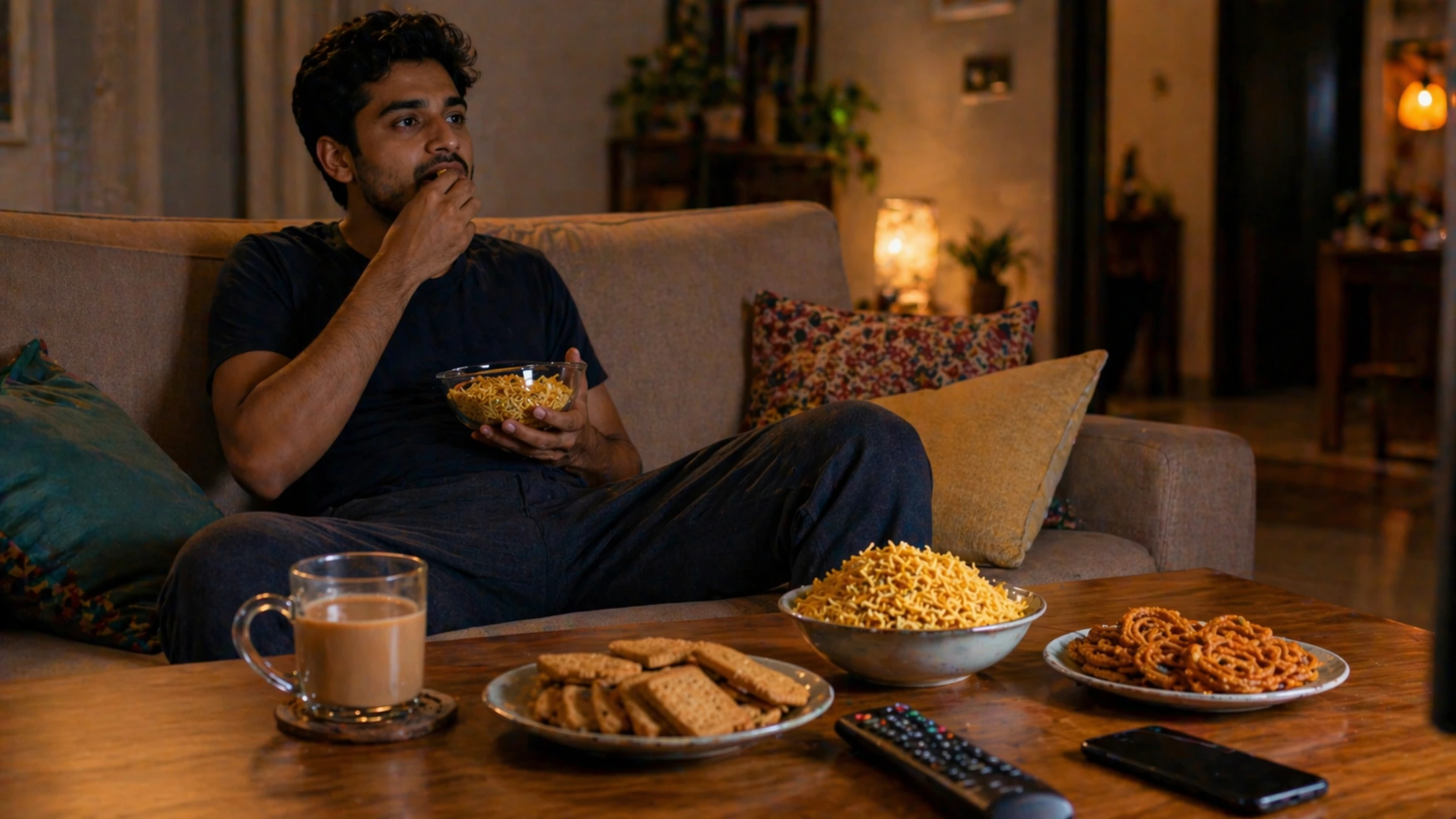
Indian snacks are responsible for 300 to 700 untracked calories per day in the average urban Indian diet. The most calorie-dense common Indian snacks are: Bhujia Sev at 550 calories per 100g, Mixture at 480 calories per 100g, Chakli at 510 calories per 100g, Mathri at 490 calories per 100g, and standard salted biscuits at 440 to 510 calories per 100g. Even chai with milk and two teaspoons of sugar adds 60 to 80 calories per cup, and most Indians drink three to four cups daily. The key insight is that most Indian snacking is unconscious — eating from a shared bowl during conversations, nibbling while watching television, or finishing what family members left on the plate. Nutrimate’s Indian food database includes all common Indian snacks with accurate calorie data, and the Custom Dish feature allows logging of homemade namkeen and chakna accurately.
The Hidden Calorie Problem in Indian Snacking Culture
Snacking in India is deeply social. Namkeen appears at every family gathering, biscuits accompany every cup of chai, and a shared plate of chiwda or bhujia is common during evening conversations. The calories in these snacks are rarely counted because they do not feel like meals. They are side events — accompaniments to social interactions rather than deliberate food choices.
Yet the calorie mathematics are unforgiving. A small bowl of bhujia — perhaps 40 grams — contains approximately 220 calories. Three cups of chai with sugar throughout the day add 180 to 240 calories. Four Marie biscuits with the afternoon chai add another 140 calories. A small packet of Kurkure during the evening news adds 130 calories. Together these add up to 670 to 730 calories — almost half a full day’s intake for someone on a weight loss target — without counting any actual meals.
Exact Calorie Count — The Most Common Indian Snacks
Bhujia Sev: 550 calories per 100g. A small katori serving of approximately 30 to 40 grams contains 165 to 220 calories. The popular snack that comes in a bowl at tea time is almost always more than 40 grams if no one is measuring.
Mathri: 490 calories per 100g. A single medium mathri weighs approximately 15 grams and contains 73 calories. A small plate of 5 to 6 mathris — typical for tea time — totals 365 to 440 calories.
Parle-G biscuits: 130 calories per 7 biscuits. Often consumed 5 to 6 per chai session, 3 to 4 times a day. This alone can contribute 300 to 450 calories daily.
Chakli: 510 calories per 100g. One medium chakli weighs approximately 20 grams and contains 102 calories. Festival servings of 5 to 6 chaklis total 500+ calories.
Chai with milk and 2 teaspoons sugar: 65 to 80 calories per cup. Three cups = 195 to 240 calories per day. Five cups — common in many Indian households — = 325 to 400 calories per day from chai alone.
Lower-Calorie Indian Snack Swaps That Actually Satisfy
Replacing bhujia with roasted chana: 360 calories per 100g but provides 19 grams of protein per 100g — significantly more satiating and nutritionally superior. A 40-gram serving provides 144 calories and 7.6 grams of protein vs 220 calories and less than 2 grams of protein from bhujia.
Replacing biscuits with makhana: 325 calories per 100g and 9.7 grams of protein per 100g. Roasted makhana is crunchy, filling, and culturally appropriate as a chai accompaniment. A 30-gram serving provides 97 calories — significantly less than the same weight in biscuits.
Replacing sweet chai with masala chai without sugar or with jaggery in small amounts: cutting two teaspoons of sugar per cup and drinking three cups per day saves 90 to 120 calories. Over 30 days, this equals approximately 0.4 kilograms of fat not stored.
The Unconscious Snacking Problem — And How Awareness Fixes It
Research on eating behaviour consistently shows that people underestimate snack consumption by 30 to 50% compared to their actual intake. This is not dishonesty — it is the nature of untracked, social eating. When food is shared from a common bowl, portions are not measured. When snacking happens during a conversation or while watching television, the food barely registers as a conscious act.
The single most effective intervention for unconscious snacking is logging. Not restricting — logging. When a person accurately tracks every snack for two weeks, the data reveals the pattern clearly. The goal is not to eliminate chai and namkeen from Indian life — that is neither realistic nor desirable. The goal is to know what is being consumed so that conscious choices can be made about when and how much.
How Nutrimate Handles Indian Snack Tracking
Nutrimate’s Indian food database includes all major Indian snack categories — namkeen varieties, biscuit brands, makhana, roasted chana, chakli, mathri, murukku, and regional snacks across Maharashtra, Gujarat, Tamil Nadu, and Rajasthan. If a specific snack is not in the database, the WhatsApp logging feature allows natural language entry — type ‘half a katori of bhujia’ and Nutrimate calculates the nutrition automatically.
For homemade chakna or festival snacks prepared at home, the Custom Dish feature allows you to enter each ingredient with its quantity, and Nutrimate calculates the complete nutrition automatically. Once saved, the dish is permanently in your personal library for fast logging on every subsequent snacking occasion.
Log every Indian snack in 10 seconds with Nutrimate’s 1 Lakh+ Indian food database. Free on Android and iOS — nutrimate.in