 Pradnya Ganorkar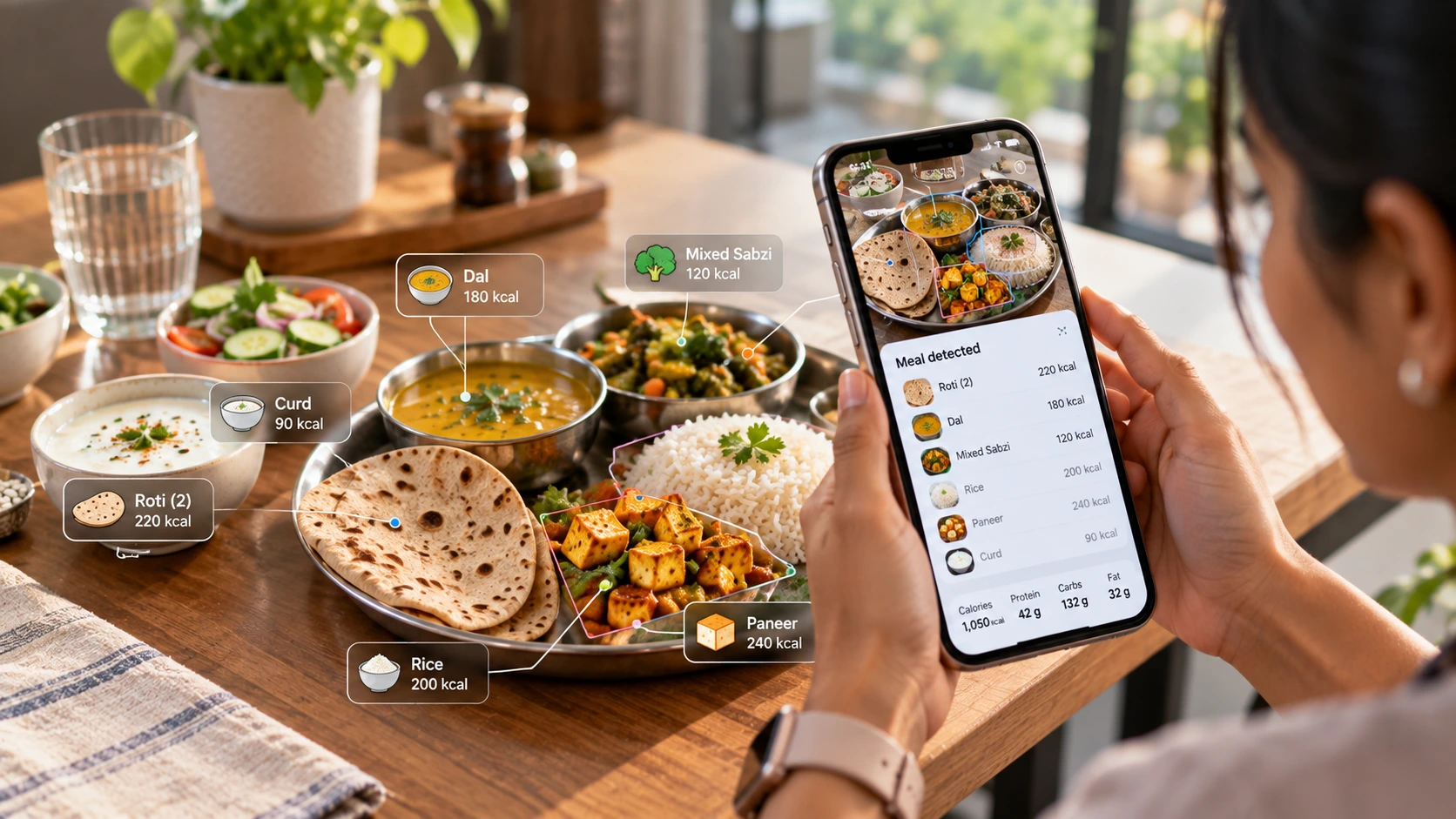
For any nutrition tracking app serving Indian consumers, accuracy is not simply a technology problem. It is a food-context problem. Indian meals vary by region, household, preparation method, portion size, and recipe. A useful indian calorie counter app therefore needs more than a generic food database. It needs strong Indian food intelligence and an indian food database that reflects what people actually eat.
This matters for consumers, nutritionists, fitness businesses, corporate wellness teams, and digital health platforms. If a user logs poha, dal, sabzi, dosa, biryani, or a mixed thali and receives an inaccurate nutritional estimate, the tracking system can gradually lose credibility.
AI can improve the speed and scale of food logging, but its usefulness depends on the quality of the data behind it.
Why Indian Food Tracking Accuracy Has Always Been a Problem
Manual food tracking creates friction.
A user may need to search through several variations of the same dish, estimate portion sizes, identify ingredients, and decide whether the entry should be recorded as homemade, restaurant-prepared, or packaged.
This becomes particularly difficult with Indian mixed dishes.
A bowl of sabzi can contain different vegetables, cooking oils, spices, and preparation methods. A home-cooked dal may have a different consistency and ingredient ratio from another household’s dal.
The same challenge appears with a thali. Several foods may appear in one photograph, while their nutritional composition depends heavily on portion size and preparation.
Research evaluating AI-enabled food recognition in nutrition apps has also found that automatic energy estimates can remain inaccurate, particularly for Asian diets and culturally diverse or mixed foods. The researchers highlighted the need for better food databases and improved models for mixed and culturally diverse dishes.
This is why an effective nutrition tracking app cannot treat Indian cuisine as a small extension of a Western food database.
How AI Food Recognition Works for Indian Meals
AI food recognition typically starts with an image.
A user photographs a meal, and the model analyses visual characteristics such as shape, colour, texture, and the relationship between different foods in the image.
The system then attempts to identify the food and connect that identification with nutritional information from a database.
For an Indian meal, the workflow can be understood as:
Photo → food identification → regional or dish matching → database lookup → nutritional estimate
The important distinction is between recognition and nutrition estimation.
Identifying something as “dal” is only the first step. The system still needs appropriate nutritional information and, where possible, contextual information about preparation and portion size.
An AI food recognition india solution therefore becomes more useful when visual recognition is connected to a reliable Indian nutritional reference rather than relying only on a model’s general knowledge.
The Indian Food Composition Tables published by the National Institute of Nutrition provide nutritional information for Indian foods and cover 528 key foods across 151 food components.
The Gap Between Generic AI Models and Indian Cuisine
Generic AI models can recognise common food categories, but Indian cuisine creates several additional challenges.
Consider the difference between:
- Plain rice and pulao
- Roti and stuffed paratha
- Dal and dal makhani
- Vegetable curry and paneer curry
- Plain dosa and masala dosa
- A packaged snack and homemade namkeen
The visual difference may be small, while the nutritional difference can be significant.
Regional terminology creates another layer of complexity. A dish may have different names across states or communities, while similar names can refer to different preparations.
This makes indian meal recognition dependent on both visual understanding and food-context knowledge.
The objective should not be to make AI appear perfect. The objective should be to make food logging substantially easier while being transparent about where estimation is involved.
That distinction is important for any best food tracking app evaluation.
Training Data Requirements for Accurate Indian Food AI
The quality of an AI food system is closely connected to its training and reference data.
For Indian applications, useful training data should account for:
- Regional Indian dishes
- Multiple names for the same food
- Different preparation styles
- Homemade and restaurant variations
- Mixed dishes
- Different serving sizes
- Common Indian snacks
- Traditional foods alongside modern packaged foods
A strong indian food database provides the nutritional foundation, while diverse food images help the model understand what those foods look like in real-world settings.
This is particularly important for foods that do not have a standard appearance.
A packaged product with a barcode may have relatively fixed nutritional information. A homemade bowl of mixed vegetable curry does not.
That is why machine learning nutrition systems should be evaluated on realistic Indian meals rather than only simple individual food items.
For wellness businesses, this distinction matters because inaccurate logging can affect everything downstream, including progress reports, coaching conversations, and engagement.
How Platforms Are Using AI to Close the Indian Food Accuracy Gap
The most practical role of AI is to remove unnecessary manual work.
Instead of forcing a user to search through a large database, an AI-powered system can interpret a meal photograph or other input and suggest the most relevant food entries.
Nutrimate is built around this principle, combining AI-powered Indian food intelligence with simple, WhatsApp-first meal logging. The technology is useful because it reduces the effort required to maintain a daily record.
The same principle extends into the B2B fitness ecosystem.
FitVia, Nutrimate Wellness’s B2B fitness platform, applies Indian food intelligence, WhatsApp nutrition tracking, Health Score, trainer dashboards, analytics, and member engagement tools for gym owners, fitness trainers, influencers, and dietitians.
For these professionals, easier logging can support more consistent client data without making every coaching interaction dependent on manual food-entry work.
The key is that AI should remain an enabler.
It can improve data collection, reduce friction, and help platforms operate at scale. It should not replace the professional relationship between a nutritionist, trainer, or coach and the person receiving guidance.
Clinical Implications of Improved Food Tracking Accuracy
Better food tracking can make dietary information more useful for professionals, but accuracy needs to be considered carefully.
A nutrition professional may use food records to understand:
- Meal patterns
- Protein intake
- Frequency of packaged foods
- Meal timing
- Changes in eating behaviour
- Adherence to a nutrition plan
For example, a client may report that they are following their plan consistently. A reliable food log can provide additional context around what meals actually look like across the week.
However, food recognition should not be confused with clinical assessment.
A photograph cannot automatically determine every ingredient, cooking quantity, portion weight, or health requirement.
This is especially important for patient nutrition tracking, chronic-condition management, and personalised dietary interventions.
AI can improve the collection and organisation of information. Clinical interpretation still requires appropriate professional judgment.
The same principle applies to diabetes diet tracking india. A digital tool can make logging easier, but dietary decisions for a person with diabetes should not be reduced to an automated image interpretation.
What Professionals Should Ask AI Nutrition Tools
Nutritionists, wellness technology vendors, corporate wellness teams, gym owners, and fitness professionals should evaluate an AI nutrition platform beyond its demonstration.
Before adopting a nutrition tracking app, ask:
1. What is the Indian food database based on?
Look for a clearly identified nutritional reference rather than vague claims about a large food database.
2. Can it handle regional Indian foods?
Test foods that your actual users eat. Try regional meals rather than only common items such as rice, banana, or eggs.
3. How does it handle mixed dishes?
Ask how the platform approaches thalis, curries, mixed sabzis, biryani, and combination meals.
4. Can users correct an AI result?
A practical system should allow users or professionals to correct an incorrect identification rather than treating every output as final.
5. Is professional oversight possible?
Nutritionists and dietitians should remain able to review and interpret information when the use case requires professional intervention.
6. Is the experience simple enough for daily use?
Accuracy has limited value if users stop logging because the process is too complicated.
This is also where platforms serving fitness businesses need to think beyond food recognition. A trainer may need trainer nutrition tracking dashboard capabilities, while a gym owner may care about fitness client engagement platform features and member retention.
FitVia brings these elements together for fitness businesses, while Nutrimate focuses on making everyday nutrition tracking simpler for consumers and families.
The strongest AI nutrition platforms will not be those that simply produce the most sophisticated technical output. They will be the ones that combine relevant Indian food data, useful AI assistance, professional oversight, and an experience people can realistically use every day.
FAQs
AI trained on Indian food images with regional names can identify dishes from photographs and match them to validated nutritional database entries, removing the need for manual search.
Reliability depends on training data. AI models trained specifically on Indian regional cuisine and validated against IFCT 2017 deliver clinical-grade accuracy. Generic models do not.
No. AI improves data collection accuracy and scale. Clinical judgment, behavioural coaching, and personalised prescription remain the nutritionist domain.
Verify the Indian food database source, test accuracy on regional dishes, check whether AI outputs are validated by clinical nutritionists, and assess the patient interface for ease of use.