 Pradnya Ganorkar
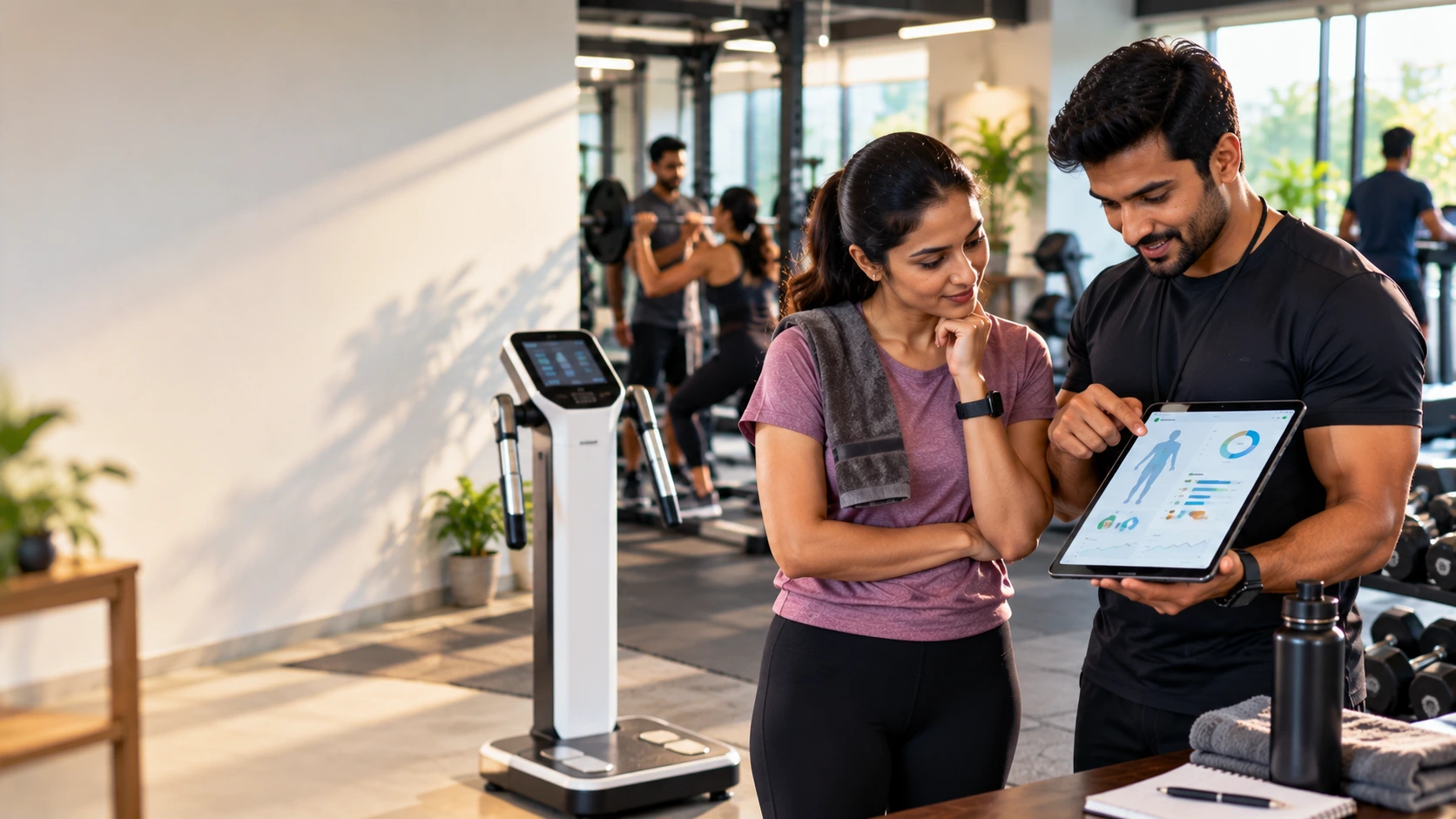
Your first gym body composition report can be confusing. You may see your body fat percentage, muscle mass, BMI and other measurements without knowing which numbers matter or what to change next.
For beginners working towards fat loss, understanding these results can be more useful than watching your weight alone. Your bodyweight may remain stable while you lose fat and build muscle, particularly when you are new to strength training.
The goal is not to achieve perfect numbers overnight. It is to understand your starting point, identify realistic improvements and track progress consistently using measurements that make sense for your body and health.
Why BMI Is Not Enough to Understand Your Body Composition
Body mass index, or BMI, is calculated using your weight and height. It is a useful screening measure, but it does not distinguish between body fat, muscle, bone and other components of bodyweight.
Imagine two Indian men who are both 5 feet 8 inches tall and weigh 75 kg. One may have more muscle from regular strength training, while the other may have a higher proportion of body fat. Their BMI could be identical despite meaningful differences in body composition.
This is why BMI vs body fat india is an important distinction for fitness beginners.
For Indian adults, BMI also needs to be interpreted using population-appropriate thresholds. Indian and South Asian clinical guidance commonly uses a BMI of 23 kg/m² as the threshold for overweight and 25 kg/m² for obesity, rather than the conventional international thresholds of 25 and 30. These are screening thresholds, not a complete diagnosis. Source: Ethnic-Specific Criteria for Classification of Body Mass Index, available through the National Library of Medicine.
When reviewing your results, consider BMI alongside waist circumference, body composition, physical activity and relevant health indicators. If you have concerns about metabolic health, consult a qualified healthcare professional rather than relying on a single number.
The Difference Between Body Fat Percentage and Bodyweight
Bodyweight tells you how much you weigh. Body fat percentage estimates what proportion of your total bodyweight is fat.
For example, a person weighing 80 kg with an estimated body fat percentage of 25% has approximately 20 kg of fat mass. The remaining weight includes muscle, bone, organs, water and other lean tissues.
This distinction matters because weight loss and fat loss are not identical.
- Weight loss means your total bodyweight decreases, which may include fat, muscle and water.
- Fat loss means your fat mass decreases.
- Muscle gain means increasing muscle tissue, which may occur alongside fat loss.
Suppose you start strength training and improve your diet. Over several weeks, you may lose 2 kg of fat while gaining some muscle. Your scale weight might change very little, even though your body composition has improved.
This is one reason beginners should not automatically reduce food intake whenever the scale stops moving.
Instead, review multiple indicators, including strength, waist measurements, energy levels, clothing fit and body composition trends. A single reading cannot reliably tell you whether your approach is working.
Healthy Body Fat Ranges for Indian Adults
The brief ranges often used as general fitness references are 15% to 25% body fat for men and 20% to 30% for women. However, these should not be treated as universal medical targets for every Indian adult.
Age, sex, measurement method, health status and individual circumstances affect how body fat results should be interpreted. Body fat percentage alone also cannot establish whether someone is metabolically healthy.
Indian and other South Asian populations can experience metabolic risk at lower BMI levels than some Western populations. This makes it important to consider abdominal fat and broader health indicators rather than focusing only on appearance.
For beginners, a practical approach is to:
- Discuss your results with a qualified trainer or healthcare professional when needed.
- Set goals based on your starting point, fitness experience and health requirements.
- Avoid extreme calorie restriction in pursuit of a particular percentage.
- Prioritise resistance training, adequate protein, sleep and regular physical activity.
- Review progress over several weeks instead of reacting to daily changes.
If your goal is fat loss for indians, your routine should fit the way you actually eat and live. Meals such as dal, roti, rice, curd, paneer, eggs and regional vegetable preparations can all fit into a balanced diet. The overall intake, portions and nutritional balance matter more than labelling an entire cuisine as unsuitable.
Common Body Composition Measurement Methods Available in India
Several methods are available through gyms, fitness centres and specialised facilities. They differ in cost, convenience and measurement precision.
1. Bioelectrical impedance analysis (BIA)
Many gym body composition machines and smart scales use BIA. They send a small electrical current through the body and use the resulting measurements, together with prediction equations, to estimate body composition.
BIA is convenient for routine monitoring, but estimates can be affected by hydration, recent meals, exercise and the device’s underlying equations. Research comparing BIA with DEXA in Indian adults has also found meaningful differences between the methods. Source: Comparison of DEXA-derived body fat measurement to two race-specific bioelectrical impedance equations in healthy Indians, PubMed.
2. DEXA scan
A DEXA scan india search will typically lead to specialised diagnostic or medical facilities. DEXA uses low-dose X-rays to estimate bone mineral content, fat mass and lean soft tissue.
It is a widely used reference method for body composition assessment, but it costs more than most gym assessments and is not necessary for everyone pursuing a general fitness goal.
3. Skinfold calipers
A trained practitioner measures the thickness of skinfolds at specific body sites. Equations are then used to estimate body fat.
The quality of the result depends on the practitioner’s technique and the equation used. It can be useful for monitoring trends when the same trained person follows a consistent method.
For most beginners, choosing an accessible method and repeating it under similar conditions is more practical than paying for frequent high-cost scans.
How to Interpret Your Body Composition Report
A body composition report can include several measurements. Understanding the purpose and limitations of each prevents unnecessary worry over numbers that may not require immediate action.
Body fat percentage: Estimates the proportion of your weight that is fat. Use it as a trend indicator rather than a standalone judgement of health.
Fat mass: Estimates the total weight of fat tissue. Changes over time may help you evaluate your fat loss progress.
Lean mass: Includes tissues other than fat, such as muscle, organs and body water. It is not the same as skeletal muscle mass.
Skeletal muscle mass: Estimates muscle associated with movement. The exact definition and calculation depend on the device, so compare readings from the same machine when possible.
Visceral fat estimate: Some machines provide an estimate or rating related to fat around internal organs. These scores are device-specific and should not be interpreted as a medical diagnosis.
BMI: Provides a height-to-weight screening measure but does not directly measure fat.
When reviewing your report, ask three questions:
- What does this measurement actually represent?
- How reliable is the method used to estimate it?
- Has it changed meaningfully over time under comparable conditions?
Avoid comparing results from different machines as if they were interchangeable. If the numbers look unusual or conflict with other health information, ask a qualified professional to interpret them.
Using Body Composition Data to Set Realistic Goals
Your report becomes valuable when it informs a manageable plan rather than creating pressure to change everything at once.
For someone beginning a calorie deficit india approach, the objective should be to support gradual fat reduction without unnecessarily compromising strength, recovery or nutrition.
A practical framework includes four areas.
Nutrition: Build meals around familiar foods and include suitable protein sources. For vegetarians, options may include dal, beans, chickpeas, soy foods, paneer, milk and curd. Eggs, fish and lean meats may also suit people who eat them.
Strength training: Follow a progressive programme appropriate to your experience. Track exercises, repetitions and loads rather than relying entirely on visual changes.
Recovery: Get sufficient sleep and allow time for recovery between demanding sessions. Fatigue and poor recovery can make consistency harder.
Monitoring: Record bodyweight under consistent conditions, measure waist circumference periodically and repeat body composition assessments at reasonable intervals.
If your goal is muscle building indian diet planning, avoid assuming that eating as little as possible will improve your results. Adequate energy, appropriate protein intake and structured resistance training are important for muscle development.
Nutrimate can support the nutrition side of this process through simple Indian meal logging, helping users build awareness of the dietary habits that influence progress. Its India’s #1 whatsapp meal logging feature and Unique Caregiver feature reflect its broader focus on convenient meal awareness and family wellness, rather than treating health tracking as a numbers-only exercise.
Tracking Progress Using Body Composition Rather Than Scale Weight
The most useful progress measurement is one that helps you make better decisions without causing unnecessary stress.
For example, consider a beginner whose weight remains almost unchanged for four weeks. Their waist measurement decreases, gym performance improves and clothing fits differently. These changes may indicate progress even if the scale does not show a dramatic reduction.
A simple tracking routine can include:
- Bodyweight: Measure under similar conditions, preferably at a consistent time.
- Waist circumference: Measure consistently at the same anatomical location.
- Strength: Record improvements in exercises, repetitions or training capacity.
- Body composition: Repeat scans using the same device and similar conditions.
- Nutrition consistency: Review whether your eating habits support your goals.
- Recovery and wellbeing: Pay attention to energy, sleep and exercise recovery.
Do not interpret every short-term fluctuation as fat gain or loss. Hydration, carbohydrate intake, digestion, menstrual-cycle changes and recent exercise can influence measurements.
For many beginners, reviewing these indicators every few weeks is more helpful than checking every measurement daily.
Remember that progress is not limited to a smaller waist or lower body fat percentage. Better strength, improved exercise tolerance and sustainable eating habits are meaningful outcomes too.
FAQs
For Indian men, 15 to 25 percent body fat is generally considered healthy. For Indian women, 20 to 30 percent is a healthy range. Asian populations including Indians have higher metabolic risk at lower body fat percentages than Western reference ranges suggest.
BMI systematically underestimates health risk for Indian adults. Research suggests Indians should use a lower BMI cutoff of 23 for overweight and 25 for obesity rather than the Western standard of 25 and 30 respectively.
DEXA scans are the most accurate but expensive. BIA scales found in most modern gyms provide a reasonable estimate. Skinfold caliper measurement by a trained practitioner is also reliable.
Yes. Waist circumference, clothing fit, strength levels, and how you feel are all meaningful proxies for tracking fat loss progress over time.