 Pradnya Ganorkar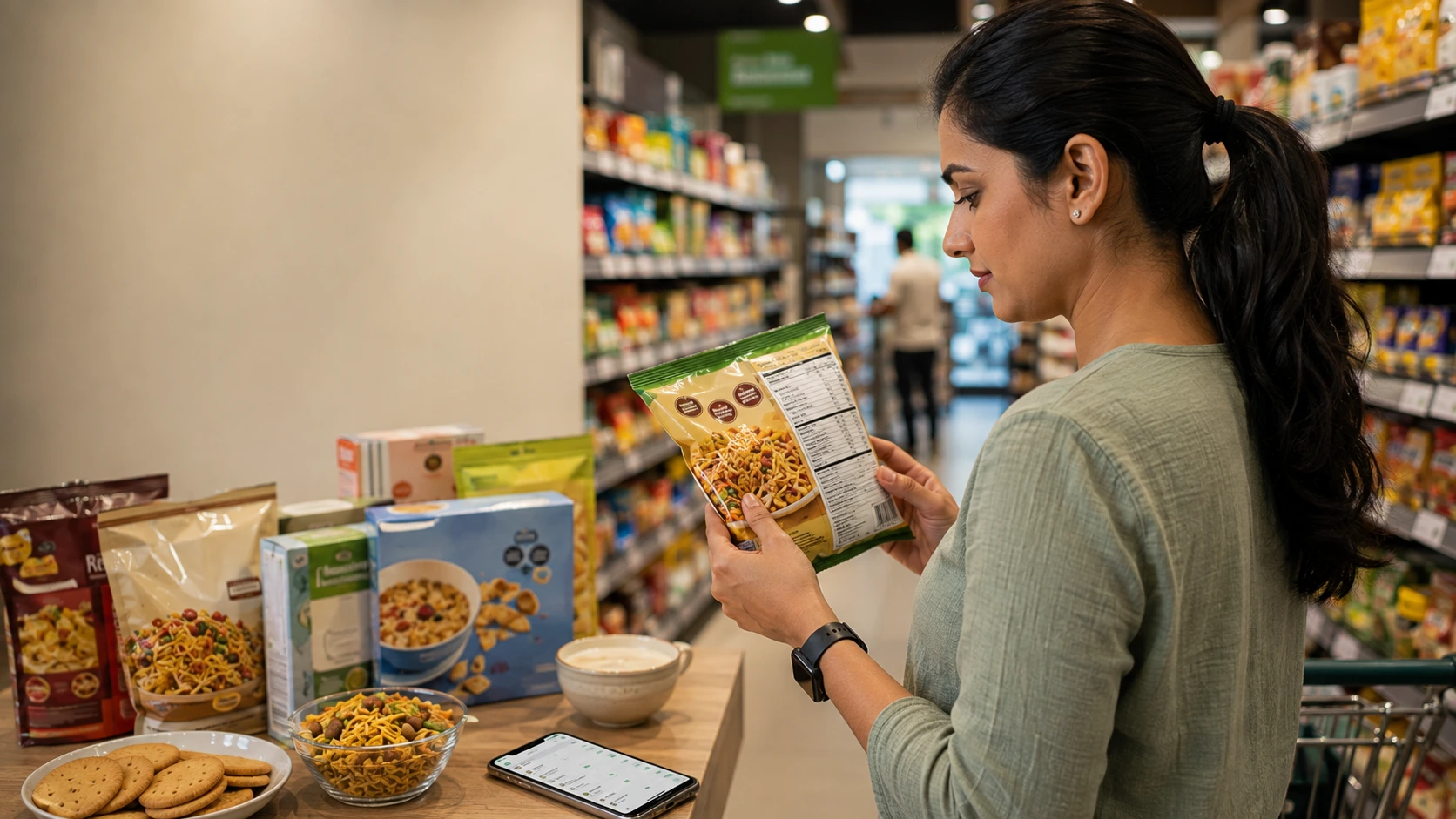
Buying packaged food in India can involve a surprising amount of guesswork. A packet may say “high protein”, “baked”, “multigrain” or “no added sugar”, but understanding what you are actually eating requires looking beyond the front of the pack.
Learning how to read nutrition labels in india is therefore less about memorising nutrition science and more about knowing which numbers matter. This is especially useful for people trying to build healthy Indian eating habits, manage portions, or make better choices during busy workdays.
The most important rule is simple: do not judge a product only by its front-of-pack claims. Check the serving size, calories, protein, sugars, fat and the number of servings in the package.
Why Indian Packaged Food Labels Are Often Misread
Nutrition labels can look complicated because several pieces of information appear together.
A consumer may see a product containing 120 calories and assume the entire packet contains 120 calories. But that number may refer to only one serving, while the packet contains three or four servings.
This is one of the most common mistakes when estimating calories in namkeen or other packaged snacks.
Indian packaged foods also vary considerably in size. A small-looking snack pouch, family pack or multipack may contain several servings.
Under India’s current food labelling framework, nutritional information can be provided per 100g or 100ml, or per single-consumption pack in applicable cases, along with serving-related information. The label includes information such as energy, protein, carbohydrate, sugars and fat.
This means the label gives you useful information. The challenge is interpreting it correctly.
A practical way to start is to ignore the marketing language for a moment and ask:
- What is the serving size?
- How many servings are in the pack?
- How many calories does my actual portion contain?
- How much protein does it provide?
- How much sugar and fat does it contain?
Those five questions can make most labels much easier to understand.
Per 100g vs Per Serving: The Confusion That Changes Everything
This is arguably the most important concept in nutrition label India.
Imagine a namkeen packet showing:
Per 100g: 500 kcal
Serving size: 25g
Servings per pack: 4
If you eat the entire packet, you have not consumed 125 calories. You have consumed approximately 500 calories.
If you eat half the packet, you have consumed approximately 250 calories.
The label becomes much more useful once you compare the declared serving with what you actually eat.
Why per 100g is useful
Per 100g lets you compare different products more easily.
For example, if two snack products have different packet sizes, comparing their per-100g values gives you a more consistent basis for comparison.
This is particularly useful when comparing:
- Namkeen
- Biscuits
- Breakfast cereals
- Granola
- Chips
- Snack mixes
- Protein bars
Why serving size is useful
Serving size helps you understand the amount the manufacturer is using for its nutrition calculation.
But the declared serving may not always match your real eating behaviour.
If a packet says one serving is 20g and you normally eat 60g, you need to multiply the nutrition values accordingly.
This distinction is especially important when researching 100 gm namkeen calories, 100 gram namkeen calories, or 1 katori namkeen calories.
The same principle applies to other foods. A number on a label is meaningful only when you know how much of the food you actually consume.
Where Sugar and Oil Hide in ‘Healthy-Looking’ Products
Front-of-pack claims can create a health halo.
Words such as “multigrain”, “baked”, “natural”, “light” or “high fibre” can sound positive, but none of them tells you the complete nutritional picture.
This does not mean these claims are meaningless. It means they should not replace reading the nutrition panel.
Look at total sugars and added sugars
When comparing packaged foods, check the sugar information instead of relying only on claims such as “no refined sugar”.
A product can use ingredients such as syrups or other sweetening ingredients and still contribute to overall sugar intake.
The label can help you distinguish total sugars from added sugars where the information is declared.
Look at total fat
Fat is not automatically unhealthy. It is a nutrient and contributes energy.
The useful question is how much total fat the product provides and what the rest of the diet looks like.
Also look at saturated fat and trans fat where declared.
Look at protein
A product described as “protein-rich” should be evaluated by its actual protein quantity.
For someone trying to improve protein for indian vegetarians, a snack that provides only a small amount of protein may not make a major contribution despite prominent front-of-pack messaging.
Do not ignore calories
Calories are not the only measure of food quality, but they provide useful information about energy density.
For example, a small amount of namkeen can be relatively easy to eat quickly without feeling like a substantial meal.
This is why understanding namkeen calories can be more useful than simply deciding that namkeen is “good” or “bad”.
A Step-by-Step Way to Read Any Indian Food Label
Use this five-step process while shopping.
Step 1: Find the serving size
Look for the serving quantity in grams or millilitres.
Do not assume the whole packet equals one serving.
Step 2: Check servings per package
If this information is provided, multiply the nutrition values by the number of servings you actually consume.
For example:
100 calories per serving × 3 servings eaten = 300 calories
This simple calculation prevents many portion mistakes.
Step 3: Check protein
Ask whether the product meaningfully contributes protein to your meal or snack.
For someone building a high protein Indian meal, packaged food should be assessed based on its actual nutrition rather than its marketing claims.
Step 4: Check sugars and fats
Look at total sugars, added sugars where declared, total fat and saturated fat.
Do not automatically reject a product because it contains fat. Instead, consider quantity and how frequently you consume it.
Step 5: Check the ingredient list
The nutrition panel tells you the quantities. The ingredient list tells you what the product is made from.
Look at the ingredients alongside the nutrition numbers.
A product with an attractive front label may still deserve closer examination if it is highly processed or provides little nutritional value for the amount consumed.
FSSAI’s labelling guidance also sets out requirements around nutrition declarations, including energy, protein, carbohydrate, sugars and fat, helping consumers access standardised information on packaged foods.
Common Traps in Snack and Namkeen Packaging
Snack foods are where label confusion becomes particularly relevant.
Consider a packet of namkeen that contains four servings.
You eat the entire packet while watching television.
The front of the package may make the snack look like a small, ordinary purchase. But the nutrition panel needs to be interpreted based on the total amount consumed.
This is why searches for calories in 100 gm namkeen, 100 gm namkeen calories and 1 katori namkeen calories can produce very different answers depending on the product, recipe and portion.
There is no single calorie number for every namkeen.
The same applies to biscuits, mixtures and flavoured snacks.
Watch for the “small serving” problem
If the stated serving is much smaller than what you normally eat, the headline nutrition number can be misleading in practice.
Always compare:
Declared serving size vs your actual portion.
Do not assume “baked” means low calorie
Baking can change how a product is prepared, but it does not automatically make the product low in calories.
Check the actual nutrition information.
Do not choose only by protein claims
A snack can contain protein but still be high in calories, fat, sugar or sodium.
Think about the entire nutrition profile.
Be careful with health halos
“Multigrain” does not automatically mean low calorie.
“Natural” does not automatically mean nutritionally superior.
“High protein” does not automatically make a snack suitable for every meal or goal.
The label is more reliable than the headline.
A Label-Reading Checklist for Grocery Shopping
Before putting a packaged food item into your basket, ask:
- What is the serving size?
- How many servings are in the packet?
- How much will I actually eat?
- What are the calories per serving?
- What are the calories per 100g?
- How much protein does it contain?
- How much total sugar does it contain?
- Is added sugar declared?
- How much total fat does it contain?
- What about saturated and trans fat?
- Does the ingredient list match the product’s main claim?
- Am I buying it because of the front label or because the nutrition profile fits my needs?
This approach makes packaged food decisions much simpler.
It also prevents another common problem: trying to track every number manually without understanding the context. For people using meal tracking, the goal should not be to become obsessed with labels. It should be to develop enough nutrition awareness to make better decisions consistently.
For Indian meals, the challenge is even broader because much of everyday food is home-cooked and does not come with a label. A person may understand the calories in a packaged snack but still struggle to estimate a plate containing roti, dal, sabzi and curd.
This is where Indian-first food tracking can complement label reading. Nutrimate, for example, uses AI-powered Indian food intelligence and photo-based meal logging to make everyday food awareness simpler, rather than requiring users to manually calculate every ingredient.
The objective is not perfect measurement.
It is better visibility into what you eat, how much you eat and where small changes could improve your routine.
References
FSSAI Food Safety and Standards (Labelling and Display) Regulations
FSSAI Guidance Note on Labelling Requirements
FAQs
Start with the serving size, number of servings per package, calories, protein, carbohydrates, sugars, total fat and relevant saturated or trans fat information. Then compare the declared serving with the portion you actually consume. Use the ingredient list alongside the nutrition panel rather than relying only on front-of-pack claims.
“Per serving” refers to the nutritional quantity calculated for the serving size specified on the package. It does not necessarily mean the entire packet. If you eat two or three servings, the relevant nutrition values need to be multiplied accordingly.
FSSAI regulations establish requirements for nutrition information on applicable packaged foods. Labels provide a useful standardised source of information, but consumers still need to interpret serving sizes and portions correctly. Current FSSAI regulations and amendments should be consulted for the latest requirements.