 Pradnya Ganorkar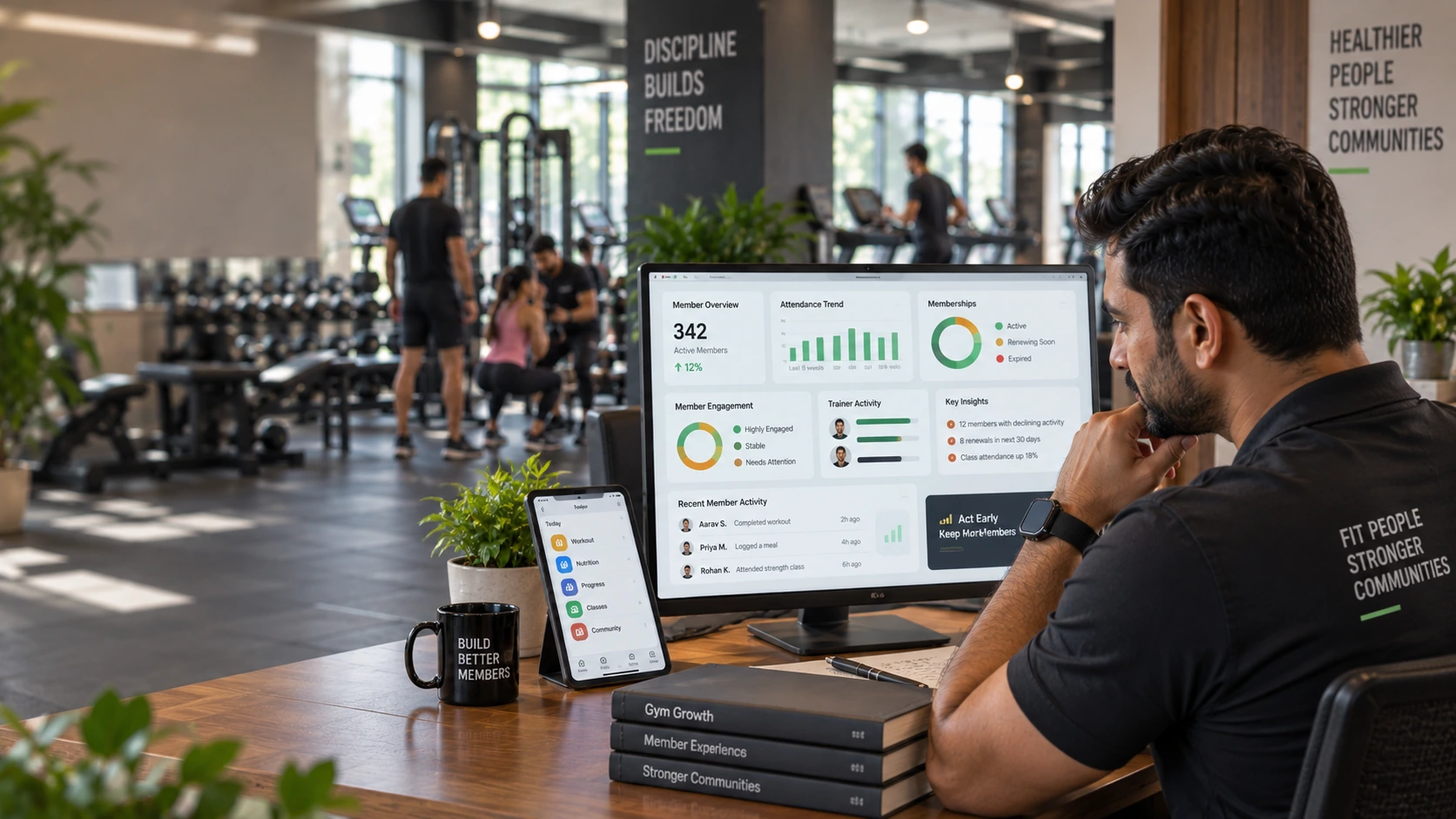
Gym owners make dozens of decisions every week: which members need attention, whether a trainer is managing clients effectively, when to follow up on renewals, and where member engagement is declining.
The problem is that many of these decisions are still based on instinct.
A gym owner may notice that the floor feels quieter, but not know whether attendance has actually fallen. A member may stop visiting regularly weeks before cancelling. A renewal may be missed simply because nobody noticed the pattern.
This is where a fitness engagement platform becomes useful. Instead of replacing the owner’s judgement, it turns everyday member activity into clearer signals.
Modern fitness businesses are increasingly combining physical experiences with digital tools, personalised engagement and data-driven decision-making. Deloitte’s India fitness market report highlights technology and personalised experiences as important factors shaping the industry’s growth.
The objective is simple: see the pattern early, understand what it means, and act before a small problem becomes a business problem.
Why Gym Decisions Are Often Made on Gut Feel
Experience matters in the fitness business.
A gym owner who has spent years working with members can often sense when something is changing. But intuition becomes less reliable as the business grows.
Consider a gym with 500 members.
An owner may personally recognise 30 or 40 regular members. But it becomes much harder to remember who has reduced their visits, whose membership is approaching renewal, which trainer’s clients are becoming inactive, or which members have stopped engaging with the gym outside their workouts.
This is where gym analytics can add practical value.
Data does not have to mean complicated dashboards filled with dozens of numbers. Even a few consistent signals can improve decisions:
- Attendance frequency
- Membership renewals
- Missed sessions
- Member activity over time
- Trainer-client engagement
- Progress indicators
- Nutrition activity where relevant
For an Indian gym dealing with seasonal attendance changes, new-year membership spikes, exam periods, festivals and changing work schedules, context matters as much as the number itself.
The goal is not to collect more data.
It is to make existing data more useful.
What Kinds of Data Actually Matter for Gyms
Not every metric deserves the owner’s attention.
A useful gym management software india setup should help answer business questions rather than simply display information.
Attendance
Attendance is one of the simplest indicators of engagement.
A member who visits four times every week and suddenly drops to once a week may need attention before their membership expires.
The important insight is not one missed visit. It is the trend.
Renewal behaviour
Missed renewals can directly affect revenue.
Tracking upcoming renewals, expired memberships and previous renewal patterns can help teams prioritise follow-ups instead of contacting everyone in the same way.
Member engagement
Attendance alone does not tell the entire story.
A member may visit the gym but stop interacting with their trainer. Another may be consistently logging meals, completing workouts and reviewing progress.
This is where a health score can become useful as a simple indicator of broader engagement, provided it is interpreted alongside other information.
Trainer activity
For gyms that provide personal coaching, owner visibility should extend beyond membership numbers.
A fitness client engagement platform can help owners understand whether trainers are actively managing clients, monitoring progress and maintaining continuity.
Nutrition and lifestyle activity
Nutrition is increasingly connected to the fitness experience.
Tools supporting whatsapp nutrition or nutrition tracking for gym members can help trainers understand behaviours beyond the workout floor.
The ICMR-NIN Indian Food Composition Tables provide nutritional information for hundreds of key Indian foods, illustrating why local food context matters when building nutrition-related systems for Indian users.
The right data is therefore not necessarily the most data.
It is the information that helps answer: What should we do next?
Moving Beyond Attendance as the Only Metric
Attendance is important, but it can create a misleading picture when used alone.
Imagine two members.
Member A attends four times every week but has not spoken to their trainer, reviewed their plan or tracked progress for several weeks.
Member B attends three times a week, follows their programme, communicates with their trainer and consistently works toward their goals.
Looking only at attendance makes them appear similar.
Looking at engagement tells a different story.
This is why gym owners should consider a combination of:
Attendance + engagement + progress + renewal behaviour
That combination creates more useful member insights.
It can also help gyms identify different types of members.
For example:
| Member pattern | Possible signal | Useful action |
| Attendance falling | Engagement may be declining | Trainer or member check-in |
| Attendance stable, progress stalled | Programme may need review | Discuss goals and plan |
| Strong activity, renewal approaching | High-value engagement | Early renewal conversation |
| Low attendance, low interaction | Higher disengagement risk | Personalised outreach |
| Strong workout activity, no nutrition activity | Coaching opportunity | Introduce suitable nutrition support |
These are signals, not automatic conclusions.
A gym owner still needs context.
A member may be travelling, recovering from an injury, facing exams or dealing with work pressure.
Data helps identify who may need attention. Human interaction determines why.
How Data Helps Predict (and Prevent) Member Drop-Off
Member churn rarely appears without warning.
Often, small changes happen first.
A regular member starts attending less frequently. Then trainer interactions decline. Then progress tracking stops. Eventually, the membership expires.
This is where gym member retention tools can be valuable.
A practical approach is to create an early-warning sequence:
Step 1: Detect
Identify a meaningful decline in activity.
Step 2: Understand
Check whether attendance, trainer interaction, progress or renewal activity has changed.
Step 3: Reach out
Ask the member what has changed instead of immediately sending a sales message.
Step 4: Solve
The issue might be scheduling, lack of progress, motivation, programme difficulty or something unrelated to the gym.
Step 5: Re-engage
Give the member one realistic next action.
This approach is more useful than sending the same automated message to every inactive member.
A gym does not need to predict the exact date someone will cancel.
It needs to notice when a member’s relationship with the gym is weakening.
That is the practical value of churn prediction.
Building a Simple Data-Informed Decision Process
Data becomes useful when it changes behaviour inside the business.
A simple weekly process can be enough.
Monday: Review
Look at:
- Attendance changes
- Upcoming renewals
- Recently inactive members
- Trainer activity
- Important engagement indicators
Tuesday to Wednesday: Prioritise
Do not contact everyone.
Identify the members where intervention is most likely to matter.
For example, someone who has gone from four weekly visits to one deserves more attention than someone who has always attended once a week.
Thursday: Act
Give trainers or staff clear follow-up actions.
The objective should be specific:
- Check in
- Review programme
- Discuss progress
- Help restart a routine
- Address a practical barrier
Friday: Learn
Review what happened.
Did members return?
Did some renew?
Did certain engagement problems repeatedly appear?
This creates a simple feedback loop.
Data → decision → action → outcome → better decision
That is much more valuable than a dashboard that nobody uses.
For gyms evaluating best gym management software in india, this distinction should matter. A platform should not simply digitise membership records. It should help owners understand what is happening across the member journey.
A Practical Framework for Owners
Before investing in best gym software in india, ask five questions.
1. Can I identify declining engagement early?
The system should make meaningful changes visible without requiring manual spreadsheet analysis.
2. Can my team act on the information?
Insights are only valuable when trainers and staff know what action to take.
3. Can I understand more than attendance?
Look for visibility into renewals, progress and engagement alongside visits.
4. Can nutrition become part of the member experience?
For gyms offering coaching, client meal tracking for trainers and related nutrition workflows can provide additional context around member behaviour.
5. Does the system fit my gym’s actual workflow?
A small independent gym and a multi-location fitness business may need different levels of reporting and automation.
The best solution is the one that fits the business rather than the one with the longest feature list.
This is where FitVia can complement Nutrimate’s consumer wellness ecosystem. FitVia is designed for gym owners, fitness trainers, influencers and dietitians, bringing together branded member experiences, trainer dashboards, WhatsApp nutrition tracking, Health Score, progress reports, analytics and gym management capabilities.
The broader opportunity is to connect everyday member activity with decisions an owner can actually act on.
A gym owner should not have to wait until a member cancels to realise engagement has been declining.
With the right fitness software, simple signals can become useful business intelligence.
The competitive advantage is not having more numbers.
It is knowing which numbers matter, recognising meaningful changes early, and giving the team a practical way to respond.
FAQs
Gym owners should focus on data that supports decisions, including attendance trends, membership renewals, member engagement, trainer activity, progress and relevant nutrition activity. The goal is to identify meaningful patterns rather than collect every available metric.
Data cannot guarantee that a member will leave, but changes in attendance, engagement and renewal behaviour can provide early warning signals. Churn prediction is most useful when treated as a prompt for human follow-up rather than an automatic conclusion.
Gyms can use gym analytics to identify declining engagement, improve retention, prioritise follow-ups, understand member behaviour and evaluate which parts of the member experience need improvement. The strongest approach connects reporting with clear actions rather than treating analytics as a standalone activity.
Read Nutrimate Wellness first on Google