 Pradnya Ganorkar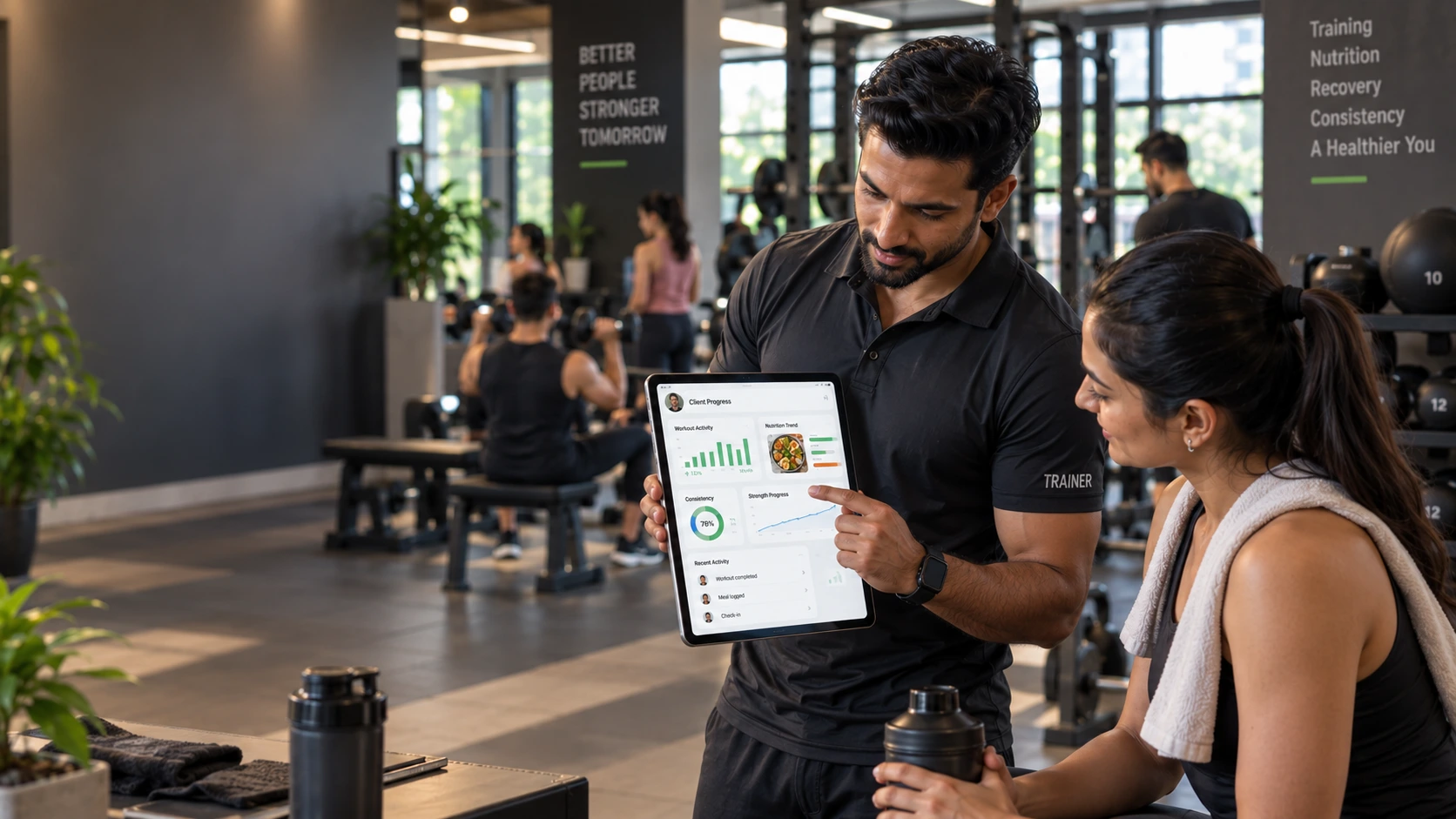
Personal training in India is moving beyond workout plans and weekly check-ins. Coaches increasingly need to understand what happens between sessions: whether clients complete workouts, follow nutrition guidance, miss meals, maintain routines or gradually disengage.
This is where personal trainer software can become valuable.
The purpose is not to replace a coach’s experience. It is to give that experience better information.
A coach working with five clients can remember individual details relatively easily. A coach managing 30 or 50 clients needs a more structured way to identify patterns.
That is where coaching analytics, client insights and data-informed decisions can improve the coaching process.
The opportunity is particularly relevant in India, where clients often combine gym routines with demanding work schedules, irregular meals, commuting, family responsibilities and frequent changes in routine.
Data helps coaches see what intuition alone may miss.
Why Coaching Decisions Are Often Based on Intuition Alone
Experienced trainers develop a strong sense of their clients.
They know when someone looks tired, when motivation appears low and when a client may be struggling with a programme.
That experience is valuable. But intuition becomes harder to scale.
Imagine a trainer managing 40 clients.
One client has missed three workouts. Another has stopped logging meals. A third is attending regularly but has made little progress. A fourth has suddenly become inconsistent after several months of strong adherence.
Without structured information, these situations can blend together.
The trainer may eventually notice a problem, but only after the client has already disengaged.
A good fitness coach client management software system can bring these signals together.
The advantage is not simply having more information. It is reducing the time between a behaviour change and a useful coaching conversation.
Instead of asking, “Why have you stopped progressing?”, the coach can start with something more specific:
“I noticed your training consistency has changed over the last few weeks. Has something changed in your routine?”
That creates a better conversation.
What Data Actually Helps Coaches Decide
Not every metric deserves attention.
For personal trainers, useful data generally falls into a few practical categories.
Training consistency
Workout completion and attendance can show whether a client is maintaining the planned routine.
One missed session means very little.
A consistent decline can be a meaningful signal.
Nutrition consistency
For clients working toward muscle gain, fat loss or general fitness goals, nutrition behaviour can provide important context.
A coach may see that workouts are consistent but meal logging has stopped.
That does not automatically mean the client is eating poorly. It means the coach has an opportunity to ask what changed.
This is where client meal tracking for trainers and a diet tracking tool for fitness coaches can become useful.
Progress indicators
Weight is only one possible indicator.
Depending on the coaching goal, trainers may also consider strength progression, workout completion, measurements, adherence and client-reported progress.
The important point is to avoid treating a single number as the complete story.
Engagement
Communication, check-ins and other relevant activity can reveal whether a client is still actively participating in the coaching process.
A trainer nutrition tracking dashboard can help bring nutrition-related activity into the same coaching view when nutrition is part of the service.
The right metric is therefore the one that helps the coach decide what conversation or action should happen next.
Moving Beyond Attendance and Weight as the Only Metrics
Attendance and weight are easy to measure.
That is precisely why they can become overused.
A client may attend the gym regularly while struggling with nutrition, recovery or programme adherence.
Another may have a stable weight while becoming stronger and more consistent.
Data-driven coaching requires a broader view.
A useful framework is:
Activity + adherence + progress + engagement + context
For example:
| Signal | What it may indicate | Coaching question |
| Attendance falling | Routine disruption | “What’s making sessions difficult right now?” |
| Meal logging becoming inconsistent | Nutrition routine may have changed | “Has your meal routine changed?” |
| Training consistent, progress stalled | Programme or recovery may need review | “What feels different recently?” |
| Strong activity, upcoming renewal | High engagement | “What should we focus on next?” |
| Several signals declining | Possible disengagement | “How can we make the routine easier?” |
These are not diagnoses.
They are prompts for better conversations.
This distinction matters because data should support professional judgement, not make decisions automatically.
How Data Helps Coaches Personalise Programs at Scale
Personalisation becomes difficult when client numbers grow.
A trainer can manually remember preferences, limitations and progress for a handful of people. At larger scale, important details can get lost.
A structured system can help coaches segment clients according to actual behaviour.
For example:
Group 1: Highly consistent
These clients may need progression rather than reminders.
Group 2: Consistent training, inconsistent nutrition
They may benefit from simpler nutrition guidance or easier nutrition tracking.
Group 3: Declining engagement
They may need a conversation about barriers rather than another generic motivational message.
Group 4: New clients
They may need more onboarding and habit-building support.
This is where client insights become commercially valuable as well as useful for coaching.
Better personalisation can improve the member experience because clients receive guidance that reflects their actual behaviour.
For gym owners, the same principle can extend into gym management software india systems where member activity, trainer engagement and retention signals are considered together.
The goal is not to create a complicated coaching operation.
It is to make the coach’s attention more targeted.
Using Data Responsibly Without Overwhelming Clients
There is a temptation to track everything simply because technology makes it possible.
That can backfire.
Clients already deal with enough pressure from work, family commitments, travel and changing schedules.
If every missed workout generates an alert and every meal becomes a performance score, tracking can become another source of stress.
Good data-driven coaching should therefore follow three principles.
Keep the client view simple
The trainer may need detailed information.
The client may only need to see a few useful indicators.
Use data to ask better questions
A declining metric should start a conversation, not end it.
Avoid false precision
A tracking system can show patterns, but it cannot always explain why they occurred.
A client who misses workouts may be travelling, sick, dealing with family responsibilities or simply changing their schedule.
The data identifies the signal.
The professional provides the context.
This approach makes health tracking tools more useful without allowing technology to dominate the coaching relationship.
A Practical Data-Informed Coaching Framework
Trainers can implement a simple five-step process without building a complex analytics operation.
1. Track
Capture only the information relevant to the coaching goal.
For example:
- Workout attendance
- Programme adherence
- Meal activity
- Progress indicators
- Engagement
- Membership status
2. Spot
Look for changes rather than isolated events.
A missed workout is not necessarily important.
A three-week decline may be.
3. Ask
Use the information to start a human conversation.
Avoid assuming the reason behind the behaviour.
4. Adjust
Change the programme, routine, goal or level of support when appropriate.
A busy professional may need shorter sessions.
A client struggling with nutrition may need simpler meal guidance.
Someone losing motivation may need a more achievable short-term target.
5. Review
Check whether the intervention worked.
Did attendance improve?
Did nutrition consistency return?
Did engagement increase?
Did progress resume?
This creates a practical cycle:
Track → Spot → Ask → Adjust → Review
FitVia, Nutrimate Wellness’s B2B fitness platform for gym owners, trainers, influencers and dietitians, applies this principle by bringing together trainer dashboards, member engagement tools, WhatsApp nutrition tracking, Health Score, progress reports and analytics.
It is designed to turn everyday member activity into information that fitness businesses can use for coaching, retention and operational decisions.
For coaches considering Best Fitness Software For Fitness Trainers, the important question should therefore not be how many features a platform offers.
It should be whether the system helps transform everyday client behaviour into better coaching decisions.
Data-driven coaching is ultimately not about turning trainers into analysts.
It is about giving experienced professionals better visibility into the people they already care about coaching.
When a trainer can identify declining consistency earlier, understand the context and respond with a more relevant intervention, technology has done its job.
The competitive advantage is not the dashboard itself.
It is the better coaching conversation that happens because of it.
FAQs
Data is helping trainers move from broad assumptions to more informed coaching decisions. Attendance, workout consistency, nutrition activity, progress and engagement can reveal patterns that are difficult to identify when managing many clients manually. The most effective approach uses these signals to support, rather than replace, professional judgement.
Coaches should track metrics that directly relate to the client’s goal, such as attendance, workout adherence, relevant progress indicators, nutrition activity and engagement. A trainer nutrition tracking dashboard can be useful when nutrition is part of the coaching service. The focus should be on actionable information rather than collecting every available metric.
Yes. Data can help coaches identify differences in consistency, nutrition behaviour, progress and engagement across clients. These patterns can support more relevant programme adjustments, follow-ups and conversations. However, the data should be interpreted alongside the client’s circumstances rather than used as an automatic decision-maker.
Read Nutrimate Wellness first on Google