 Pradnya Ganorkar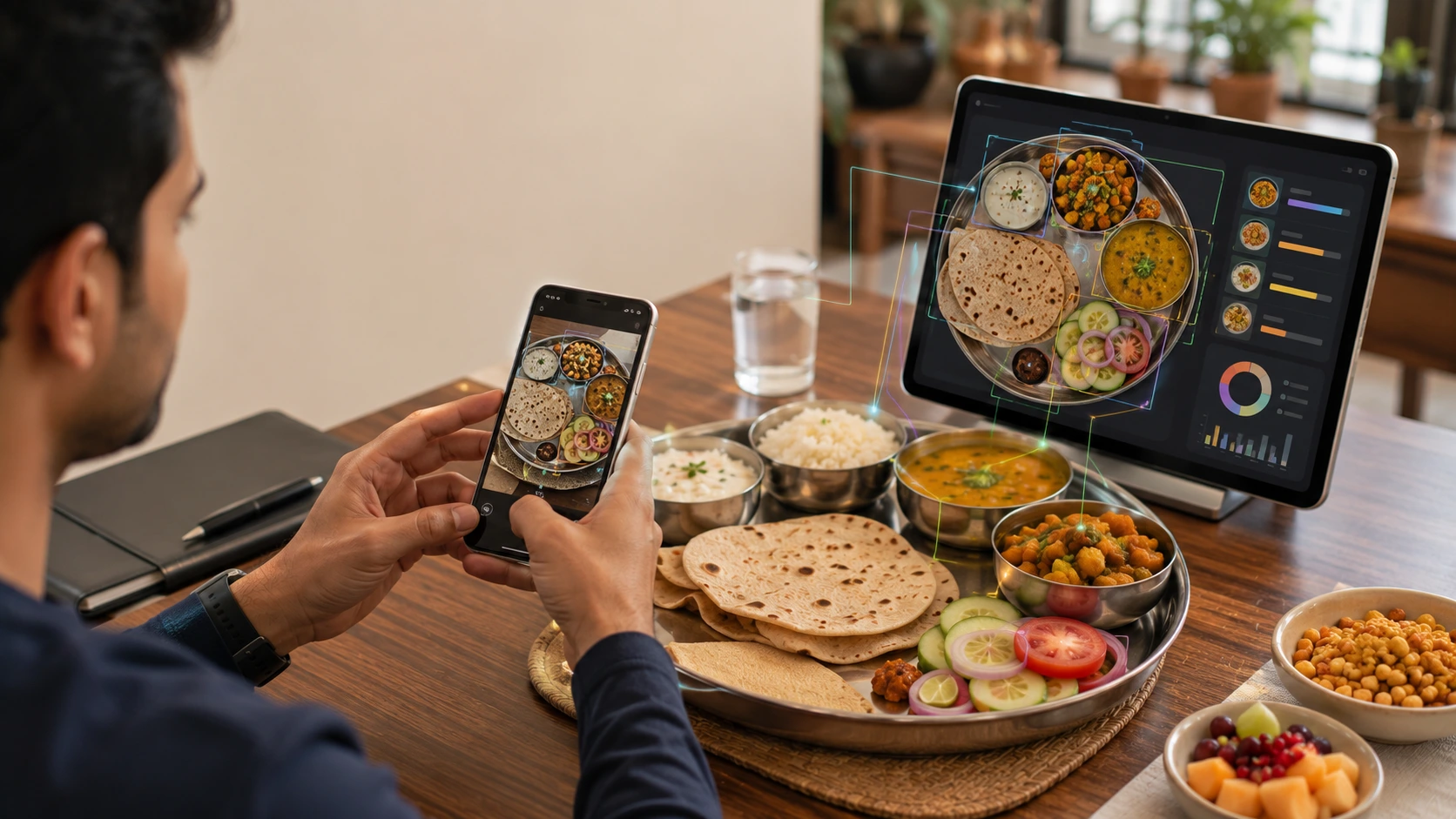
For anyone looking for an indian calorie counter app, the biggest challenge is often not calculating calories. It is getting the food itself right. An AI meal tracker needs to recognise what people actually eat, from a bowl of dal and rice to a mixed vegetable sabzi, dosa, poha or a full thali.
This is where an Indian food database becomes important. Indian meals are diverse, regional and often made from several ingredients at once. A useful system therefore needs to understand Indian food patterns rather than simply apply assumptions from Western food databases.
The goal is not perfect technology for its own sake. It is simpler meal tracking, better food awareness and less manual effort for people trying to build sustainable everyday habits.
This article explains why Indian food presents a distinctive challenge for AI-based nutrition tools, how Indian-specific food data can improve recognition and estimation, and what consumers should realistically expect from AI food logging.
Why Indian Food Has Historically Been Hard for Food-Recognition AI
Recognising a packaged food is relatively straightforward.
A packaged snack may have a barcode, standard serving size and clearly printed nutrition information. A photograph of a homemade Indian meal is very different.
Consider a typical lunch:
- Two rotis
- Dal
- A mixed vegetable sabzi
- Curd
- Salad
- A small portion of rice
The appearance of each food can vary depending on the recipe, preparation method, region and household.
Even the same dish can look different from one kitchen to another.
Oil quantity can vary. A sabzi may contain several vegetables. Dal may be thinner or thicker. A homemade dosa can differ significantly in size.
This makes photo recognition more challenging than simply identifying the name of a food.
The underlying problem is important for anyone interested in Indian food and health: identifying a food correctly is only the first step. A useful nutrition system also needs to estimate the portion and understand how different foods combine within the same meal.
What Makes Mixed Dishes Difficult to Estimate
Mixed dishes are particularly challenging because a single visible item can contain multiple ingredients.
Take pav bhaji as an example.
A photograph may show the dish clearly, but its nutritional composition depends on factors such as the amount of vegetables, butter or oil used, portion size and accompanying pav.
The same applies to foods such as:
- Vegetable pulao
- Biryani
- Upma
- Poha
- Khichdi
- Sambar
- Mixed sabzi
- Chole
- Rajma
- Thali combinations
This is why mixed dish estimation requires more than basic image recognition.
A useful AI system needs to make a reasonable interpretation of the meal and communicate that the result is an estimate, not a laboratory measurement.
Portion size adds another layer.
Two plates may contain the same food but very different quantities. A small bowl of rice and a large serving of rice should not produce the same nutritional estimate.
For consumers, this means AI food logging should be viewed as a practical tracking aid rather than a guarantee of exact nutritional values.
How Modern AI Models Are Being Trained on Indian Food Data
Better food recognition starts with better reference data.
The IFCT 2017 provides an important Indian reference point. The Indian Council of Medical Research’s National Institute of Nutrition states that the Indian Food Composition Tables 2017 compile nutritional information for 528 key foods across 151 discrete food components.
That matters because an AI system designed for Indian users needs appropriate Indian food references.
An AI nutrition India approach should account for foods that are common in Indian households rather than assuming that the most useful examples are packaged Western foods or restaurant meals.
Indian-first data can help a system better understand the nutritional context of foods such as:
- Dal and pulses
- Rice and different grains
- Roti and other cereal-based foods
- Indian vegetables
- Regional dishes
- Dairy foods such as curd and paneer
- Traditional snacks
- Common mixed dishes
The quality of the underlying reference data still matters even when AI is responsible for interpreting an image.
In practical terms, AI can help connect:
What the camera sees → what the food is likely to be → what the portion may represent → what nutritional information is relevant
Each step involves uncertainty, so the system should prioritise useful estimation rather than pretending that every photograph can produce an exact result.
What This Means for Everyday Meal Logging
For users, the biggest benefit is convenience.
Traditional food diaries can require searching for individual ingredients, entering quantities and selecting foods manually.
That can become tiring quickly, particularly for people with busy lifestyles in india.
Imagine someone eating a home-cooked lunch at work.
Instead of searching separately for dal, rice, sabzi and curd, an AI-based system can use a photograph as the starting point for understanding the meal.
This makes easy way to track meals more realistic for everyday users.
The advantage is not that AI removes the need for food awareness. It reduces the friction involved in creating that awareness.
This distinction matters because why staying healthy is hard is often connected to consistency rather than lack of knowledge.
A person may know that their meals matter but still stop tracking because entering every meal takes too much time.
Nutrimate approaches this problem through Indian-first food intelligence and WhatsApp-first logging. Instead of making users adapt their everyday meals to a complicated tracking workflow, the aim is to make tracking fit more naturally into existing routines.
For someone who has previously abandoned a meal tracker app, reducing the number of steps required to record food can be more valuable than adding another dozen nutritional metrics.
The phrase India’s #1 whatsapp meal logging feature and Unique Caregiver feature should be understood as a positioning statement around convenience and family-oriented tracking, not as a claim that AI can remove all uncertainty from nutrition estimation.
The technology should remain an enabler.
The outcome users actually want is simpler: better awareness, less manual effort and more consistency.
Limitations Readers Should Still Be Aware Of
AI food recognition is useful, but it is not perfect.
Several factors can affect the quality of an estimate.
Portion size
A photograph does not always provide a reliable measurement of weight or volume.
A serving of rice may look similar in two photographs despite containing different quantities.
Hidden ingredients
Oil, ghee, sugar, butter and sauces may not be visually obvious.
A dish that looks similar can therefore have a different nutritional profile depending on preparation.
Similar-looking foods
Some foods have similar visual characteristics.
A model may need additional context to distinguish between dishes that look alike.
Regional variation
Indian cuisine is not one standardised diet.
The same dish can have different ingredients, preparation methods and serving styles across regions and households.
Homemade recipes
Family recipes are particularly difficult to standardise.
A home-cooked curry may use a different ingredient ratio from the same dish prepared elsewhere.
Estimates are not medical measurements
AI-based food logging should not be treated as a clinical assessment.
People managing diabetes, kidney disease, eating disorders or other medical conditions should follow guidance from qualified healthcare professionals rather than relying solely on an automated food estimate.
The right mindset is therefore:
Use AI for awareness and convenience, while understanding its limits.
What to Look For When Choosing an AI-Based Food App
Not every app that claims to use AI will provide the same practical value.
Before choosing one, look at the fundamentals.
1. Depth of Indian food coverage
Ask whether the system genuinely understands Indian meals or simply includes a small list of Indian foods inside a larger generic database.
A strong Indian food database should reflect the variety of foods people actually eat.
2. Support for mixed meals
The system should be able to work with combinations rather than forcing users to photograph or enter every ingredient separately.
3. Practical portion estimation
Food identification alone is not enough.
The system should attempt to account for the amount of food being consumed while making it clear that the result is an estimate.
4. Low-friction logging
If recording a meal takes several minutes, users may stop doing it.
Look for simple meal tracking for Indian food that fits naturally into daily routines.
5. Useful nutritional context
The objective should not be to overwhelm users with numbers.
A good system should help answer practical questions such as:
- What did I eat?
- Was the meal reasonably balanced?
- Which meals are consistently working for me?
- Where might I need to make small changes?
6. Transparency about limitations
Trust increases when an app communicates uncertainty instead of presenting every estimate as exact.
7. A system that supports consistency
The best technology is rarely the one with the most impressive demonstration.
It is the one people continue using after the novelty disappears.
For consumers exploring food tracking without calorie counting, an awareness-focused approach may be more sustainable than manually entering every ingredient and quantity.
Nutrimate’s Indian-first approach is built around this principle: use AI and convenient logging to reduce friction while keeping the focus on everyday behaviour.
Ultimately, the value of AI in Indian nutrition tracking is not that it knows every meal perfectly.
It is that the technology is getting better at understanding the meals people actually eat.
When food recognition becomes more relevant to Indian kitchens, tracking becomes less about translating your food into an app’s language and more about making the app understand your food.
FAQs
AI can provide useful estimates, but it cannot guarantee exact calorie values from a photograph. Portion size, cooking methods, hidden ingredients and recipe variations can all affect accuracy. AI food logging is best used for practical awareness and consistency rather than as a precise measurement.
Indian meals often contain mixed dishes, homemade recipes, regional ingredients and variable portions. A photograph may show what a meal looks like without revealing the exact ingredients, cooking method or quantity. This makes Indian food recognition more complex than identifying a standardised packaged product.
AI food logging can be useful, but accuracy varies by food, image quality, portion visibility and recipe complexity. It should be treated as an estimation and tracking tool. For medical nutrition needs, users should rely on guidance from qualified healthcare professionals.
Read Nutrimate Wellness first on Google