 Pradnya Ganorkar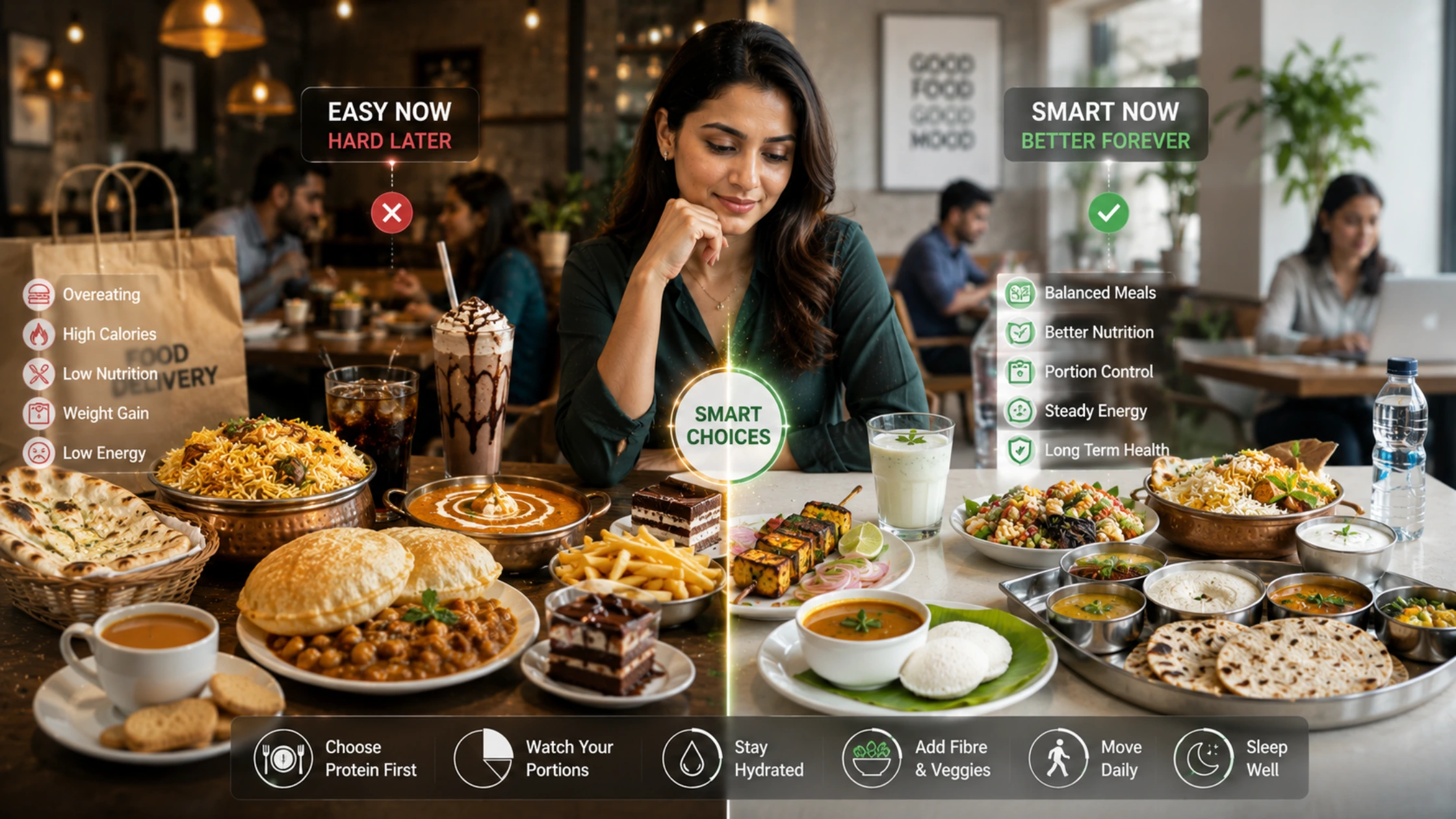
For millions of Indians today, eating outside is no longer occasional.
It is routine.
Office lunches.
Client dinners.
Weekend biryani.
Late-night Swiggy.
Zomato cravings.
Tea with snacks.
Family outings.
Travel meals.
For busy professionals, students, gym-goers, and families, healthy eating outside home India often feels nearly impossible.
This is exactly where many people start believing:
“My diet is ruined.”
“I can’t stay healthy if I eat outside.”
“Weight gain is inevitable.”
But in reality, restaurant food alone is rarely the full problem.
The bigger issue is usually:
Inconsistency.
Portion blindness.
Ordering habits.
Emotional eating.
Lack of visibility.
This matters because modern Indian life often makes outside eating normal, not exceptional.
And if health advice assumes home-cooked perfection, it often fails real life.
For many people following an Indian diet for busy professionals, the real goal is not avoiding restaurants forever.
It is learning how to navigate them strategically.
This is where sustainable systems, smarter ordering, and practical awareness become more useful than guilt.
Because healthy lifestyle for busy Indians is not built by avoiding social life.
It is built by making better repeat decisions.
And increasingly, tools like India’s #1 whatsapp meal logging feature and Unique Caregiver feature reflect a growing shift toward practical meal visibility, where eating outside becomes easier to manage without obsessive calorie counting.
The truth is simple:
You do not need perfect food choices.
You need repeatable better choices.
Why Eating Outside Feels Like “Diet Failure”
For many Indians, one restaurant meal can trigger an unhealthy psychological cycle:
“I already had pizza.”
“So today is ruined.”
“Might as well eat dessert too.”
This all-or-nothing thinking is one of the biggest hidden causes of eating out weight gain India.
The Real Issue:
Many people do not gain weight from one biryani.
They gain from the behavior spiral after it:
- Oversized portions
- Sugary drinks
- Dessert stacking
- Frequent snacking
- No awareness
Common Indian Reality:
Friday office lunch becomes:
Butter naan + paneer makhani + cola + gulab jamun
Then:
Evening chai + samosa
Then:
Late-night guilt
Myth vs Reality:
Myth: Eating out destroys your progress
Reality: Unstructured patterns destroy consistency
Strategic Insight:
Food outside is not automatic failure.
Unconscious repetition is.
The Real Problem Isn’t Restaurant Food Alone
Most restaurant food is calorie-dense, yes.
But the deeper issue is usually environment + behavior.
Key Triggers:
1. Social Pressure
“Come on, just one more.”
“Cheat day hai.”
2. Convenience
Ordering the tastiest, fastest, most comforting option.
3. Hidden Calories
- Cream-heavy gravies
- Fried sides
- Sweetened beverages
- Sauces
- Portion inflation
4. Decision Fatigue
After long workdays, convenience often beats planning.
Indian-Specific Challenge:
Outside eating often includes:
- Biryani
- Chole bhature
- Thali overload
- Tea biscuits
- Bakery snacks
These are culturally normal, which makes awareness more important than restriction.
Bottom Line:
The problem is rarely Indian food itself.
It is frequency + quantity + invisibility.
Common Indian Ordering Mistakes
Many people trying healthy eating India make the mistake of focusing only on “healthy labels.”
Example:
Ordering “brown bread sandwich” with fries + cold coffee.
Common Mistakes:
1. Liquid Calories
Sweet lassi.
Cold coffee.
Soft drinks.
Milkshakes.
2. Combo Mentality
“Meal deal” often means:
Extra carbs + extra fat + larger portions
3. Protein Neglect
Meals become:
Rice-heavy
Bread-heavy
Snack-heavy
Low protein = lower satiety
4. Hunger Extremes
Skipping breakfast → overeating lunch
5. Weekend Overcompensation
“Healthy all week” → binge weekends
Strategic Insight:
Most people underestimate recurring small excesses more than big occasional meals.
Smart Ordering Without Restriction
The goal is not:
Never eat biryani.
The goal is:
Eat intelligently more often.
Practical Framework: The Better Choice Model
Step 1: Prioritize Protein
Choose:
- Grilled chicken
- Paneer tikka
- Dal + roti
- Egg meals
- South Indian balanced plates
Step 2: Reduce Invisible Extras
Skip:
- Sugary drinks
- Excess mayo
- Fried add-ons
Step 3: Portion Awareness
Options:
- Share desserts
- Half portions
- One indulgent item, not three
Step 4: Use Balance, Not Punishment
Heavy lunch?
Lighter dinner.
Step 5: Track Pattern, Not Perfection
This is where simple meal tracking for Indian food becomes more practical than guilt.
Nutrimate Context:
Nutrimate’s Indian-first approach supports this by simplifying meal visibility around real Indian food patterns instead of forcing unrealistic dieting behavior.
Real Examples: Swiggy, Zomato, Restaurants
Outside food is often where strategy matters most.
Example 1: Ordering Biryani
Don’t:
Large biryani + cola + dessert
Better:
Single biryani + raita + water + portion control
Example 2: Office Lunch
Don’t:
Daily fried combo meals
Better:
Roti + sabzi + dal + curd
Example 3: South Indian Breakfast
Don’t:
Multiple fried snacks
Better:
Idli + sambar or dosa with moderation
Example 4: Cafe Meeting
Don’t:
Pastry + frappe
Better:
Coffee + egg/paneer option
Key Insight:
Even on Swiggy or Zomato, better choices often already exist.
The challenge is decision-making, not availability alone.
Do vs Don’t
DO:
- Eat outside strategically
- Prioritize protein and satiety
- Watch beverages
- Balance indulgence
- Build sustainable health habits for Indians
- Use awareness systems
DON’T:
- Treat one meal as failure
- Skip meals then binge
- Over-focus on labels
- Ignore portions
- Assume outside food means inevitable weight gain
Practical Rule:
Outside eating should fit your life.
Your life should not collapse because of outside eating.
Content Direction
Social life, work culture, and Indian routines often make eating out unavoidable.
That does not mean health is impossible.
Real Indian Health Strategy:
Instead of:
Restriction
Focus on:
- Better frequency
- Better portions
- Better defaults
- Better visibility
Why This Matters:
Many people fail because they try:
Perfect dieting
When what they actually need is:
Indian diet without dieting
Product Integration:
This is why simple, low-friction systems increasingly matter.
Tracking outside meals through practical tools can reduce guesswork, improve consistency, and make food tracking without calorie counting more realistic for modern Indian life.
Final Strategic Insight:
You do not need to stop:
- Biryani
- Thalis
- Work lunches
- Social dinners
You need to stop making every outside meal feel like surrender.
Because healthy eating outside home India is not about avoiding real life.
It is about building a smarter one.
FAQs
Yes. Weight loss is still possible while eating out if you focus on portion control, smarter ordering, protein prioritization, and consistent habits rather than all-or-nothing dieting.
Choose meals with better protein, balanced portions, fewer sugary drinks, and lower fried add-ons. Examples include paneer tikka, dal-roti, grilled meals, idli-sambar, or balanced thalis over oversized combo meals.
Read Nutrimate Wellness first on Google