 Pradnya Ganorkar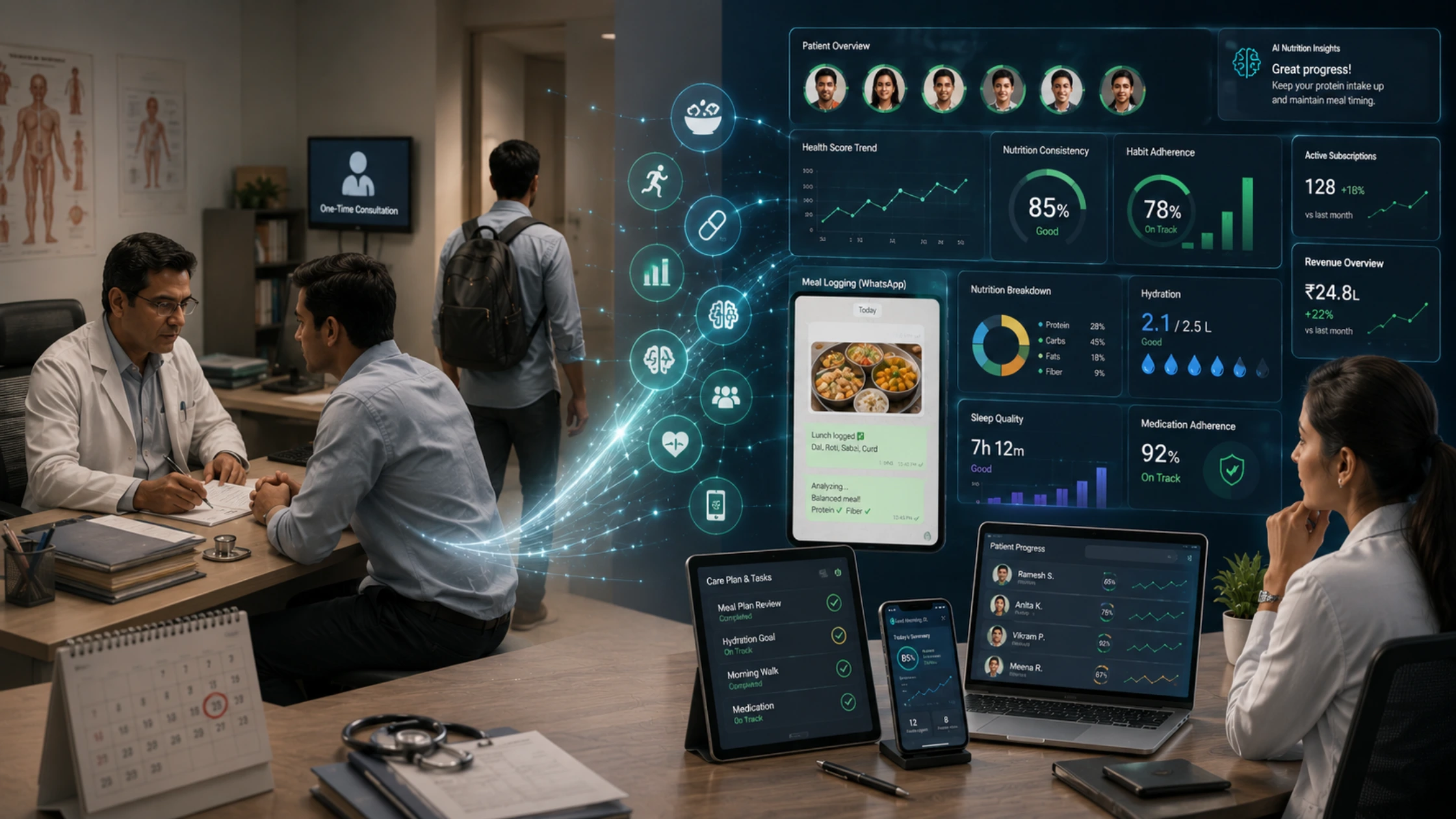
The Indian healthcare industry is changing rapidly.
For decades, most clinics, dietitians, wellness centers, and preventive healthcare providers operated using a simple model:
Patient books appointment → consultation happens → patient leaves → clinic waits for next visit.
The problem is that health outcomes rarely improve through isolated consultations.
Whether the issue is diabetes, obesity, PCOS, hypertension, nutrition compliance, mental wellness, or preventive care, success depends on what happens between appointments.
This is why many healthcare businesses across India are now investing in a healthcare digital platform India strategy.
The goal is not simply digitization.
The goal is continuity.
Patients increasingly expect:
- Ongoing support
- Digital communication
- Easy tracking
- Personalized engagement
- Convenience
- Remote access
Meanwhile, healthcare providers need:
- Better retention
- Predictable revenue
- Stronger patient relationships
- Scalable service delivery
This shift is driving demand for solutions such as preventive health software India, clinic nutrition software India, digital health infrastructure India, and patient engagement systems that extend care beyond clinic walls.
The future belongs to healthcare businesses that build ecosystems, not just appointments.
That ecosystem includes:
- Tracking
- Communication
- Compliance monitoring
- Nutrition visibility
- Habit management
- Progress dashboards
- Ongoing engagement
Instead of relying entirely on one-time consultations, providers can build recurring revenue through long-term care relationships.
This model is becoming increasingly relevant in India, where lifestyle diseases, chronic conditions, and preventive healthcare needs continue to rise.
Why One-Time Consultations Limit Growth
Most clinics still operate around episodic care.
A patient visits when there is a problem.
The provider offers recommendations.
The patient leaves.
Then one of two things happens:
- The patient follows the advice briefly and disappears.
- The patient never fully implements the recommendations.
This creates challenges for both sides.
For patients:
- Low accountability
- Poor adherence
- Limited visibility
- Reduced outcomes
For providers:
- Revenue volatility
- Dependence on new appointments
- Difficulty measuring impact
- Limited long-term engagement
This is especially visible in:
- Nutrition practices
- Diabetes clinics
- Weight management centers
- Preventive wellness programs
- Lifestyle medicine clinics
For example, a nutritionist may create a detailed meal plan.
But if the patient struggles with adherence for the next 30 days, the consultation alone provides little value.
This is where a patient diet tracking tool becomes more valuable than another appointment.
Healthcare businesses increasingly realize that outcomes improve when support continues after the consultation ends.
That is one reason demand for healthcare SaaS India solutions is growing.
The business model is evolving from:
Consultation-based care
to
Subscription-based care.
This transition creates stronger patient outcomes while generating more predictable revenue.
The Shift to Ongoing Digital Care
Modern healthcare is becoming relationship-driven rather than visit-driven.
The most successful providers increasingly focus on continuous engagement.
Examples include:
- Daily nutrition monitoring
- Habit tracking
- Compliance reminders
- Remote check-ins
- Health dashboards
- Progress reporting
- Digital coaching
This creates a genuine digital wellness platform India experience.
Patients no longer feel abandoned after a consultation.
Instead, they remain connected to the care process.
This approach is especially effective for:
- Diabetes management
- Weight loss programs
- PCOS support
- Preventive healthcare
- Corporate wellness
- Mental wellness
- Family health programs
Many healthcare providers now recognize that behavior change happens daily, not monthly.
A patient with diabetes makes dozens of food decisions every week.
A single consultation cannot influence all those decisions.
A connected ecosystem can.
This is why solutions such as diabetes tracking software India and preventive health monitoring tools are becoming central to long-term healthcare delivery.
Why Patients Prefer Continuous Care
Patients increasingly want:
- Convenience
- Visibility
- Simplicity
- Accountability
- Faster feedback
They do not want to wait four weeks to know whether they are progressing.
They want ongoing support.
That support can include:
- Nutrition tracking
- Daily check-ins
- Progress scores
- Habit monitoring
- Meal visibility
This creates better engagement and stronger compliance.
Membership + Tracking + Compliance
Recurring revenue in healthcare is rarely built through technology alone.
It is built through value continuity.
A practical framework includes three components:
Membership
Membership transforms healthcare from transactional to ongoing.
Instead of paying only for appointments, patients pay for continued support.
Examples:
- Monthly diabetes programs
- Nutrition coaching subscriptions
- Family wellness plans
- Preventive health memberships
- Corporate wellness subscriptions
This model improves both retention and predictability.
Tracking
Tracking creates visibility.
Without visibility, neither patient nor provider knows what is happening between appointments.
Modern systems increasingly support:
- Food logging
- Activity tracking
- Compliance scoring
- Habit monitoring
- Progress reporting
This is where solutions such as nutrition tracking for clinics, health tracking tools, and employee health tracking solutions become valuable.
The objective is not collecting data.
The objective is improving adherence.
Compliance
Compliance is where most programs succeed or fail.
Patients usually know what to do.
The challenge is doing it consistently.
Examples:
- Following nutrition plans
- Managing diabetes meals
- Taking supplements
- Maintaining routines
- Tracking symptoms
Simple digital systems help reduce this gap.
This is why many clinics are moving toward WhatsApp-based engagement and low-friction tracking rather than complicated applications.
Building a Health Ecosystem
A digital care ecosystem is broader than a patient portal.
It combines multiple layers of support.
A modern healthcare digital platform India strategy may include:
Patient Layer
- Food tracking
- Habit tracking
- Progress visibility
- Compliance reminders
Provider Layer
- Patient dashboards
- Reporting
- Care management
- Communication tools
Analytics Layer
- Population insights
- Compliance trends
- Risk identification
- Outcome measurement
Business Layer
- Membership management
- Subscription billing
- Retention tracking
- Revenue forecasting
Together, these components create a scalable care ecosystem.
This approach is similar to how modern wellness businesses operate.
For example, FitVia, a platform developed by Nutrimate Wellness, demonstrates how engagement infrastructure can extend beyond simple consultations.
Fitness trainers, gym owners, and dietitians increasingly use integrated systems combining:
- My own branded Fitness app
- Nutrition tracking
- Progress dashboards
- Member engagement tools
- Workout planning
- Client communication
The same principle applies to healthcare.
Patients stay engaged when care becomes part of everyday life.
The Importance of Indian Context
Many global platforms struggle in India because they ignore local realities.
Indian patients need systems that understand:
- Regional foods
- Home-cooked meals
- Family eating habits
- WhatsApp-based communication
- Multiple languages
- Local healthcare behavior
This is why Indian-first solutions are gaining traction.
Platforms designed around Indian users create stronger adherence and better long-term engagement.
Revenue Model Examples
Healthcare businesses often ask:
How do recurring revenue models actually work?
Here are several practical examples.
Diabetes Care Program
Monthly subscription includes:
- Diet monitoring
- Progress tracking
- Educational content
- Compliance support
Supported through diabetes diet tracking India systems.
Nutrition Practice Membership
Monthly package includes:
- Meal reviews
- Habit tracking
- Progress reports
- Ongoing communication
Supported through nutrition tracking for clinics infrastructure.
Preventive Wellness Subscription
Includes:
- Health assessments
- Lifestyle tracking
- Wellness coaching
- Family health support
Often powered by preventive health software India.
Corporate Wellness Program
Organizations increasingly invest in:
- Employee engagement
- Nutrition awareness
- Lifestyle monitoring
- Wellness analytics
This creates opportunities for:
- corporate wellness tools India
- workplace wellness engagement tools
- employee health dashboard India
- corporate wellness platform India
These models create recurring relationships rather than isolated transactions.
Expansion Framework
Healthcare businesses looking to scale can follow a structured framework.
Stage 1: Digitize Existing Care
Start with:
- Digital records
- Basic communication
- Progress tracking
Stage 2: Add Patient Engagement
Introduce:
- Tracking
- Reminders
- Education
- Compliance monitoring
Stage 3: Create Membership Programs
Offer:
- Monthly subscriptions
- Family plans
- Chronic care programs
- Wellness memberships
Stage 4: Build Ecosystem Services
Expand into:
- Corporate wellness
- Family health
- Preventive programs
- Partner networks
Stage 5: Use Data for Personalization
Leverage:
- Behavioral insights
- Risk prediction
- Program optimization
- Engagement improvements
This evolution transforms a clinic into a long-term health partner.
Content Direction
Pain:
“Clinics depend on appointments, not continuity”
The healthcare businesses growing fastest today are not necessarily seeing more patients.
They are creating stronger relationships with existing patients.
The future of healthcare is less about transactions and more about engagement.
Continuous care creates:
- Better adherence
- Better outcomes
- Better retention
- Better revenue stability
Product Integration
“Continuous digital tracking can expand care beyond appointments…”
Modern healthcare ecosystems increasingly rely on simple engagement systems that fit naturally into daily life.
Nutrimate supports this through:
- AI-powered nutrition intelligence
- WhatsApp-first engagement
- Simple meal tracking
- Family health visibility
- Indian food understanding
- Consistency-focused health monitoring
Its India’s #1 whatsapp meal logging feature and Unique Caregiver feature help clinics and wellness providers stay connected to patients between consultations.
For nutritionists, wellness coaches, and preventive care providers, continuous tracking can significantly improve adherence compared to appointment-only models.
The same philosophy powers FitVia’s infrastructure for trainers, gyms, and dietitians, where long-term engagement, tracking, and progress visibility drive stronger retention and recurring revenue.
References
- World Health Organization Digital Health Overview
- National Digital Health Mission (ABDM), Government of India
FAQs
Clinics can build recurring revenue through membership programs, nutrition tracking, chronic disease management plans, preventive care subscriptions, digital monitoring, and ongoing patient engagement beyond consultations.
A digital care ecosystem is a connected healthcare model that combines consultations, tracking, communication, compliance monitoring, analytics, and continuous patient engagement to improve outcomes and retention.
Read Nutrimate Wellness first on Google