 Pradnya Ganorkar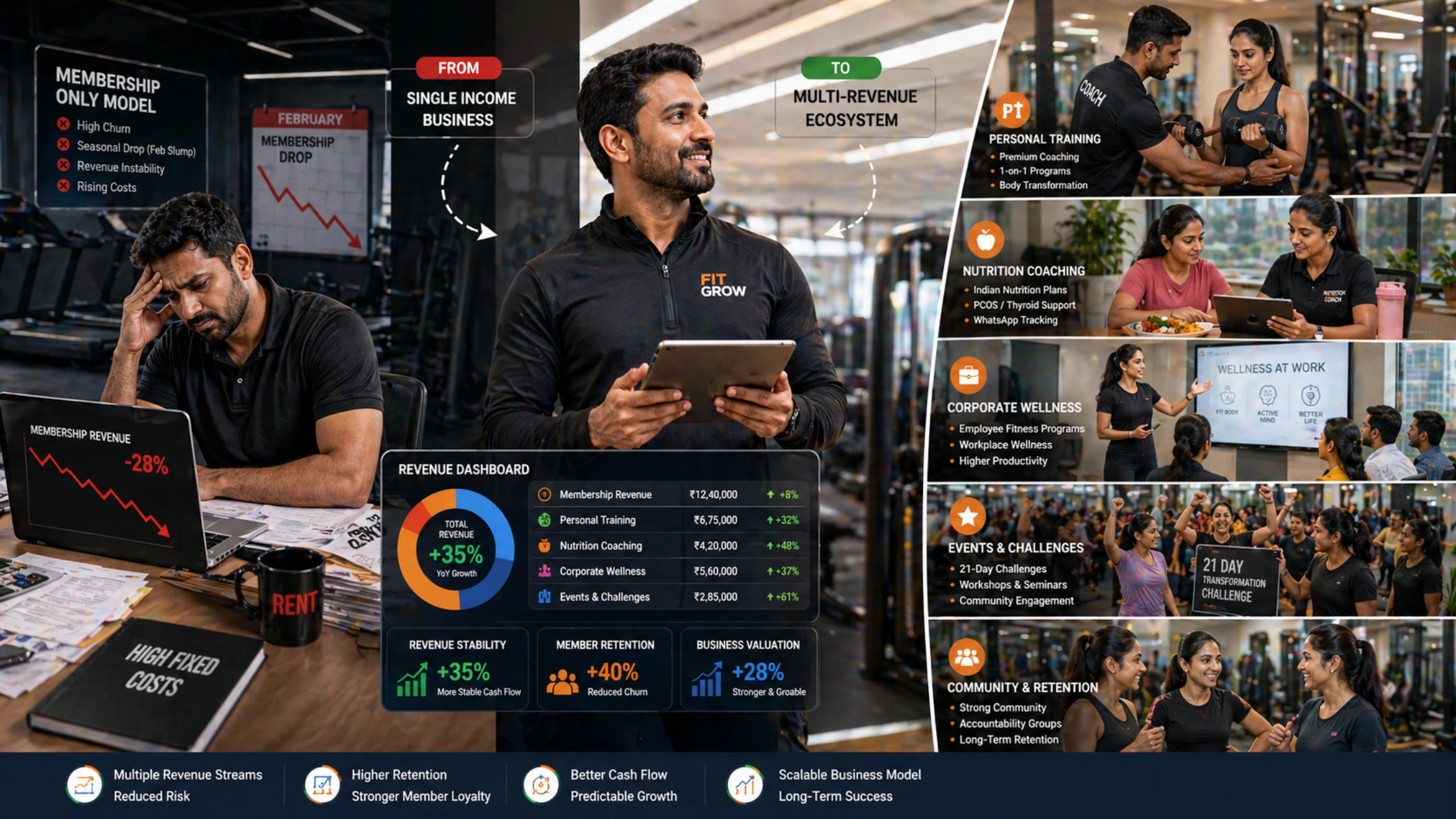
Indian gym businesses are among the most revenue-concentrated businesses in the wellness industry — typically earning 85 to 95% of all revenue from a single source: monthly membership fees. This concentration creates fragility. A January membership rush followed by a February dropout wave leaves revenue swinging by 30 to 40% month-to month. Price competition with a new gym in the same area forces membership rates down, directly compressing margins. The most financially resilient Indian gyms have diversified into at least 3 to 4 revenue streams beyond
standard membership: personal training packages, nutrition coaching, corporate wellness contracts, merchandise, supplement retail, and events. Digital platforms make several of these revenue streams significantly more accessible to smaller gyms — personal training can be delivered remotely, nutrition coaching can be systematised through an app, and corporate wellness programmes can be managed with minimal overhead.
Why Single-Stream Gym Revenue Is Dangerously Fragile
January is every Indian gym’s best month. February is typically the worst. The January membership surge — driven by new year resolutions, post-holiday motivation, and aggressive January promotions — is followed by a February dropout wave that can reduce active membership by 20 to 30% within six weeks.
A gym earning Rs 3 lakh in January memberships may collect only Rs 2.1 to 2.4 lakh in February from the same membership base — a drop of Rs 60,000 to Rs 90,000 in a single month — without any change in operating costs. Rent, trainer salaries, electricity, and maintenance are fixed regardless of how many members are using the gym.
This seasonal volatility, combined with the structural vulnerability of a single revenue stream, makes most Indian gyms operationally fragile. A competing gym opening nearby, a local economic disruption, or a health scare reducing gym attendance — any of these can threaten viability if membership fees are the only income.
Revenue Stream 1 — Personal Training Packages
Personal training is the most immediately accessible premium revenue stream for any gym with trained staff. Unlike group membership, personal training is priced on a session basis at rates typically 3 to 5 times the implied per session value of a membership.
A gym charging Rs 1,500 per month for unlimited access implies a per-session value of approximately Rs 50 to 60 (assuming 25 sessions per month). Personal training sessions from the same trainer in the same facility can be priced at Rs 500 to 800 per session — 8 to 15 times the implied membership rate.
The key to selling personal training without it feeling pushy is data. When a trainer shows a member that their protein has been below target for 8 weeks, that their Health Score has been declining, and that a personalised programme review could address these specific gaps — the conversation becomes consultative rather than commercial. Data based upsells convert at significantly higher rates than sales-pitch upsells.
Revenue Stream 2 — Nutrition Coaching Packages
Nutrition coaching is the highest-margin service a gym can offer because it requires no additional equipment, minimal time investment per client beyond the initial consultation, and addresses the primary reason members do not see results.
A structured nutrition coaching package — including an initial dietary assessment, personalised calorie and macro targets, weekly check-ins via WhatsApp, and a monthly progress review — can be priced at Rs 2,000 to 4,000 per month depending on the depth of personalisation and the trainer’s credentials.
The infrastructure for nutrition coaching is already in place for gyms using MyGymApp — the trainer dashboard shows every member’s daily nutrition data. Converting this into a formal nutrition coaching service requires only a pricing structure, a service description, and a communication system to reach the members most likely to buy.
Revenue Stream 3 — Corporate Wellness Contracts
Corporate wellness is the highest-value revenue stream available to Indian gyms and is almost universally untapped by independent operators. A corporate wellness contract with a local company provides guaranteed monthly revenue regardless of individual member retention, typically at premium pricing.
The service is simple: the gym provides subsidised or fully-funded memberships to company employees, plus periodic onsite wellness sessions — lunchtime fitness talks, posture correction workshops, stress management sessions — delivered by gym trainers at the company’s premises.
Pricing for corporate contracts ranges from Rs 500 to Rs 1,000 per employee per month for gym access, with onsite sessions priced separately at Rs 3,000 to 8,000 per session. A contract with a 50-person company at Rs 700 per employee generates Rs 35,000 per month in guaranteed revenue independent of any membership fluctuations.
Revenue Stream 4 — Events, Challenges and Workshops
Periodic events — a fitness challenge, a nutrition workshop, a 21-day transformation programme — generate one time revenue while creating marketing opportunities, community engagement, and new member acquisition.
A 21-day transformation challenge, priced at Rs 1,500 to 2,500 per participant, run twice a year with 20 to 30 participants, generates Rs 60,000 to Rs 1.5 lakh per event in addition to conversions of challenge participants into full members.
Nutrition workshops — a 2-hour session on Indian nutrition and calorie management — can be priced at Rs 500 to 1,000 per attendee and run monthly for 15 to 20 attendees. This generates Rs 7,500 to Rs 20,000 per workshop in incremental revenue while positioning the gym’s trainers as credible nutrition experts.
Building Revenue Diversification Systematically — Where to Start
The most common mistake in gym revenue diversification is attempting to launch multiple streams simultaneously, spreading resources thin and executing none of them well. The recommended sequencing is to master each revenue stream before adding the next.
Start with personal training packages — the highest-margin, lowest-complexity addition. Systematise the offering, train your trainers to present it data-first, and establish a conversion rate target. Once personal training is generating consistent incremental revenue, add nutrition coaching, then corporate outreach, then events.
The financial goal of revenue diversification is not just additional income — it is reducing the percentage of revenue dependent on monthly memberships from 90% to 60 to 70% within 12 months. This single shift dramatically improves the financial resilience of the gym and reduces the existential risk of membership churn.
Nutrimate – India’s #1 whatsapp meal logging feature and Unique Caregiver feature
Read Nutrimate Wellness first on Google