 Pradnya Ganorkar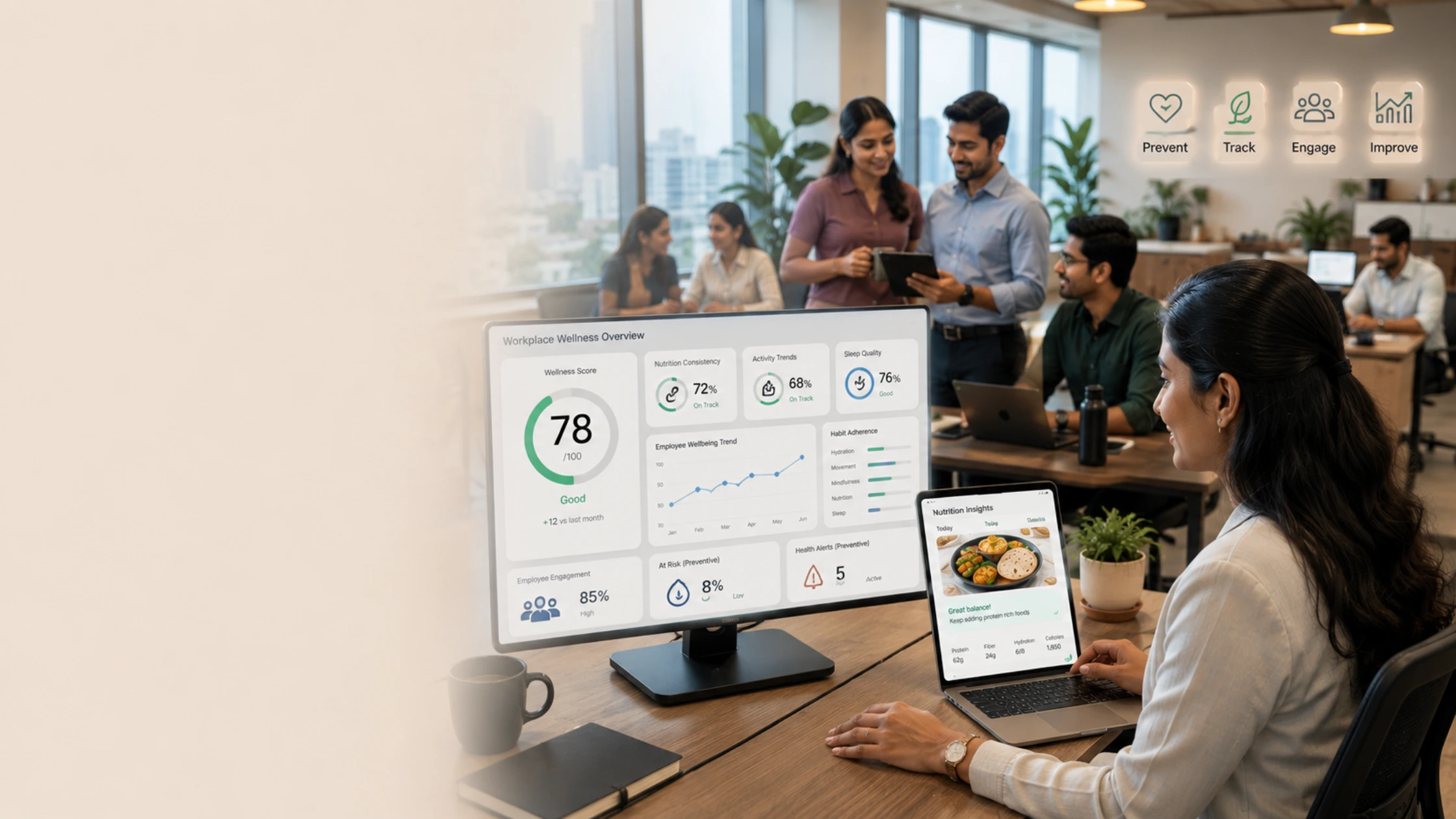
What Should an Employee Health Dashboard Track?
Written by Pradnya Ganorkar · Updated 23 October 2026
An employee health dashboard should track signals that help predict future health, such as nutrition consistency, activity habits, sleep awareness, habit adherence and health risk trends. It should show these as group-level trends, not as a count of who turned up. Attendance and participation numbers show presence and activity. They do not show whether people are becoming healthier.
This guide is written for HR leaders and wellness teams in India who want a dashboard that supports decisions instead of just filling a report.
What should an employee health dashboard actually track?
Most organisations already collect a lot of employee data. Attendance records, participation rates, health camp registrations, step challenge numbers, insurance claims and annual health assessments are all common. Yet many teams still struggle to answer one basic question: are employees actually becoming healthier?
Effective health dashboards track indicators that can predict future health outcomes. In plain terms, that means looking at daily habits, such as what people eat, how consistently they move and how well they sleep, instead of waiting for a problem to show up in a yearly report.
The sections below cover why dashboards fail, the indicators worth tracking, how to build one people will use, and the mistakes to avoid.
Why do most employee health dashboards fail?
Dashboards often focus on vanity metrics instead of actionable insights, generating reports without improving actual employee outcomes. A vanity metric is a number that looks good in a presentation but does not tell you whether anything has changed for the people involved.
Many dashboards look impressive. Few are useful. The problem is rarely the technology. It is relevance.
Too much data, too little insight
Many organisations track health camp attendance, webinar participation, step challenge registrations and insurance utilisation. These numbers have some value, but they rarely explain whether employees are becoming healthier. A useful dashboard should help you answer questions like these:
- Are people eating better?
- Are healthy habits improving?
- Are risk factors increasing?
- Is engagement sustained?
Without answers to these, the dashboard becomes a reporting tool instead of a decision-making tool.
Annual reports create delayed visibility
Many companies rely on annual health assessments. The issue is timing. If an employee slips into unhealthy habits early in the year, finding out at a screening many months later is too late to help. Workplace health tracking is shifting towards regular, daily engagement and awareness rather than relying on annual health reporting.
Activity does not equal outcomes
Participation rates can mislead. A company can have strong wellness challenge participation, good webinar attendance and busy campaigns, while employees still sleep poorly, move little and eat badly. That gap is one reason many wellness analytics programmes fail to deliver meaningful results.
Attendance is not a health metric
Treating attendance as a health metric is a common mistake, as attendance measures presence rather than actual wellbeing.
Think of an employee who never misses work, meets every deadline and attends every meeting. On paper, everything looks positive. They may also sleep too little, skip meals, rely heavily on caffeine and carry constant stress. An attendance dashboard would show success. A dashboard built on daily habits could reveal a risk worth a supportive conversation.
Which daily behaviours matter most for employee health?
Lifestyle habits build up slowly, and small daily patterns add up over months and years. That is why preventive tracking looks at behaviour signals instead of waiting for clinical problems to appear. Four areas come up again and again: nutrition, activity, sleep and consistency.
Nutrition. Many employees struggle with frequent food ordering, irregular meal timing, excessive snacking and eating on business trips. Tracking these patterns creates awareness. It matters in India, where food choices vary widely across regions and lifestyles.
Activity. Sedentary office work is a real challenge. Someone who exercises regularly may still spend most of the day sitting, so movement across the day matters, not just workouts.
Sleep. Sleep is easy to overlook, and a dashboard that ignores it misses part of the picture.
Consistency. Steady habits matter more for the long term than short bursts of effort. That is why good engagement tools reward adherence, not perfection.
Which indicators should HR teams monitor?
Here is a practical set to start with. Each one is meant to be read as a trend across groups of employees, not as a judgement on one person.
1. Nutrition consistency
Track daily eating patterns across the workforce. This does not need obsessive calorie counting. Simple food logging is often enough to create awareness. Overlooking nutrition while emphasising physical activity provides an incomplete picture of employee health.
2. Activity levels
Step counts alone are not enough. Look at weekly activity consistency, exercise frequency, movement habits and sedentary behaviour. The goal is activity that people can keep up.
3. Sleep quality awareness
Awareness of sleep routines gives useful context for energy, stress and recovery. Keep it voluntary and report it in aggregate.
4. Habit adherence
Track habits such as meal consistency, water intake, exercise adherence and sleep routines. Habits are what a wellness programme can actually influence, so they often give you more to act on than outcomes alone.
5. Health risk trends
Look for group-level trends in weight, nutrition gaps and lifestyle risk factors, so that support can start early. A dashboard points to patterns for programme planning. It does not diagnose anyone. A doctor or registered dietitian assesses an individual's health.
How can organisations build an actionable dashboard?
An actionable dashboard helps you decide what to do next. It starts with a clear purpose, not with a long list of charts.
In our experience, HR managers typically ask which metrics to track, how the data will be collected, whether the dashboard can integrate with existing systems, and how it will help them make better decisions. Those are the right questions to settle first.
Pradnya Ganorkar puts the goal this way: “I believe an effective employee health dashboard should turn reliable data into actionable wellness insights while protecting employee privacy.”
Steps to follow
- Define what you want to improve. In our experience, one common mistake is collecting large amounts of employee health data without defining what the organisation wants to improve or explaining how that data will be protected and used.
- Focus on trends. Track changes over time instead of isolated numbers. Ask whether habits are improving, whether risk factors are falling and which departments need support.
- Segment employee groups. Remote employees, shift workers, field teams and office staff face different challenges. Looking at them separately leads to better support.
- Create a simple health score. A personalised score can combine activity, nutrition, sleep and consistency into one easy view of overall wellbeing.
- Enable daily visibility. Workplace health tracking is shifting towards regular, daily engagement and awareness rather than relying on annual health reporting.
- Protect privacy from day one. “I recommend starting with clear objectives, voluntary participation where appropriate, transparent consent, strong access controls, and aggregated reporting that protects individual privacy,” says Pradnya Ganorkar. The focus should be on supporting employees and improving wellness programmes, not on monitoring or judging individuals.
What a dashboard can change
A practical example is an organisation that runs wellness initiatives but judges them with scattered spreadsheets and participation reports. A single dashboard can bring programme participation, engagement trends and available wellness indicators into one view. That helps HR teams spot gaps, compare programmes and plan more targeted initiatives.
Results should be judged by measurable indicators such as participation, engagement and employee feedback, rather than by assuming that a dashboard alone improves health outcomes.
What are the common dashboard mistakes to avoid?
- Tracking everything. More data does not mean more value. Focus on metrics that influence decisions.
- Prioritising vanity metrics. Dashboards often focus on vanity metrics instead of actionable insights, generating reports without improving actual employee outcomes. App downloads, webinar attendance and challenge sign-ups are typical examples. They do not necessarily predict health outcomes.
- Ignoring nutrition. Many programmes emphasise activity and overlook food, which leaves the picture incomplete.
- Creating complex screens. The simplest dashboards work best. People should understand the key insight at a glance.
- Skipping follow-up. Data without action has limited value. A dashboard should lead to coaching, support and personalised recommendations.
- Collecting data without a privacy plan. Explain what is collected, why, who can see it and how it is protected.
Employee health dashboard checklist
Use this list when you evaluate a dashboard:
- Tracks nutrition patterns
- Measures activity consistency
- Includes sleep awareness
- Tracks habit adherence
- Identifies group-level risk trends
- Provides insights you can act on
- Enables department-level analysis
- Protects privacy with consent and aggregated reporting
- Encourages ongoing engagement
- Keeps decisions simple
Where does FitVia fit in?
FitVia provides a white-label platform with fitness technology for gyms, including branded digital experiences and member-management capabilities. If you want to see how the team approaches tracking and engagement, start at our home page.
The aim of any dashboard stays the same: create visibility, build consistency and support healthier habits.
Frequently asked questions
Is attendance a good measure of employee health?
No. Treating attendance as a health metric is a common mistake, as attendance measures presence rather than actual wellbeing. An employee can attend every day and still be under strain from poor sleep, skipped meals or stress. Habit and trend data gives a fuller picture of how people are doing.
How often should employee health data be reviewed?
Workplace health tracking is shifting towards regular, daily engagement and awareness rather than relying on annual health reporting. A practical approach is to give employees ongoing visibility of their own habits and to review group trends regularly, instead of waiting for a yearly assessment.
This article is general information, not medical advice. Speak to a doctor or registered dietitian about your own needs.