 Pradnya Ganorkar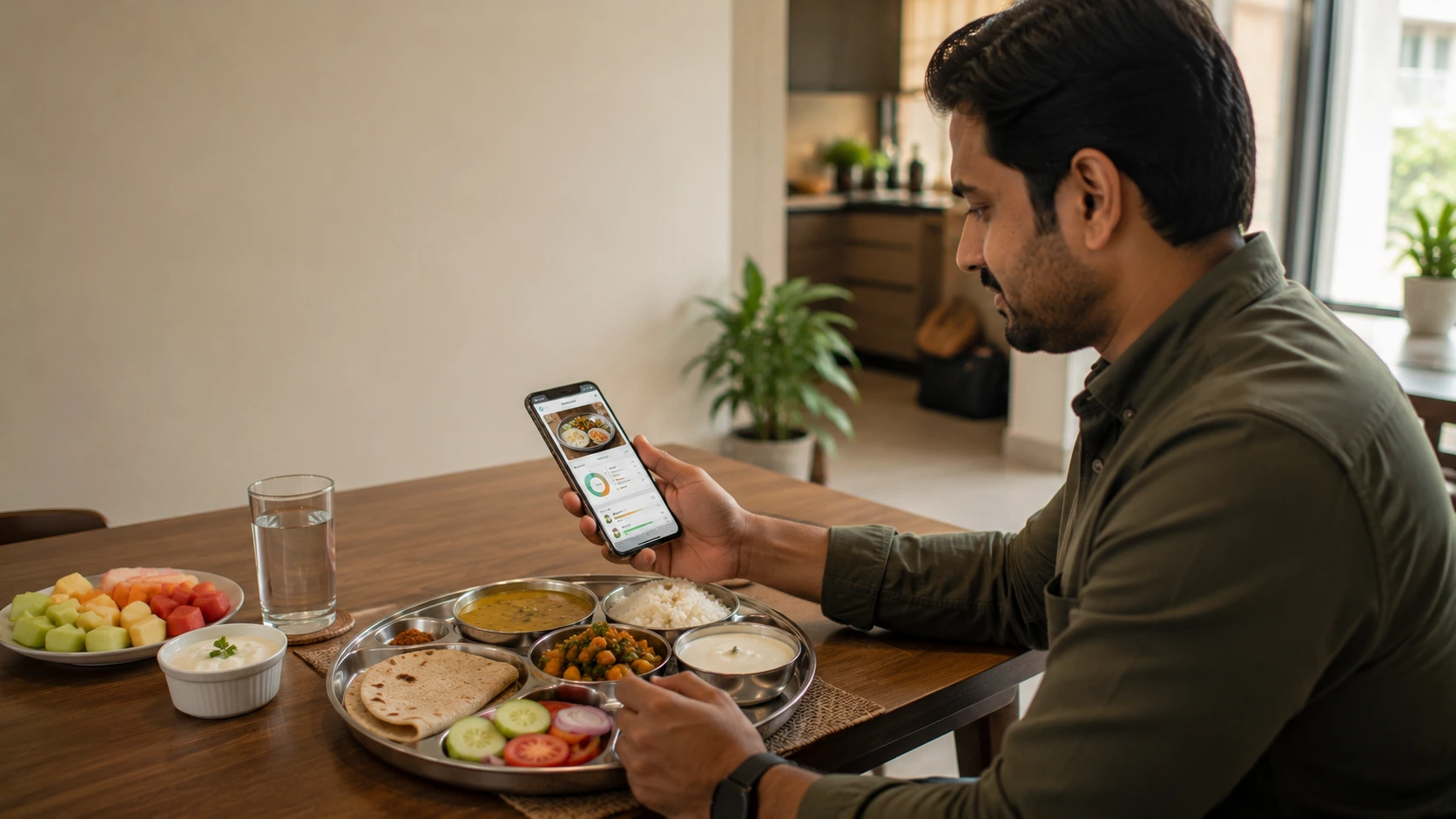
Choosing an indian calorie counter app is not simply about finding an app that displays calories. For Indian users, the real question is whether the app understands the food they actually eat.
A meal of roti, dal, sabzi, rice and curd is very different from a standard Western meal database entry. Mixed dishes, regional recipes, homemade portions and changing preparation methods can make meal tracking difficult when an app depends heavily on generic food entries.
That is why an app’s Indian food database, ease of logging and ability to handle familiar Indian meals should matter more than having the longest feature list.
The right nutrition app india users choose should make tracking easier, not turn every meal into a calculation exercise.
This is a buyer’s guide for people comparing nutrition and calorie-tracking apps before downloading one. The objective is not to identify a single “best” app, but to understand which capabilities make an app genuinely useful for Indian eating patterns.
Why Most Calorie Counter Apps Struggle With Indian Food
Many calorie-tracking apps are built around individual food items.
That works reasonably well when someone eats a packaged food with a clear nutrition label or a simple ingredient such as an apple.
Indian meals are often more complicated.
Consider a typical home-cooked lunch:
- 2 rotis
- Dal
- Aloo-gobi
- Rice
- Curd
- Salad
The nutritional value can change depending on portion size, cooking oil, ingredients and preparation method.
A restaurant version of the same dish can also differ substantially from a homemade version.
This is why simply having thousands of foods in a database does not automatically create accurate or useful Indian food and health tracking.
The Indian Council of Medical Research’s National Institute of Nutrition provides the IFCT 2017 Indian Food Composition Tables, demonstrating the importance of Indian-specific food composition data when evaluating the nutritional characteristics of local foods.
For consumers, the practical lesson is simple: food database depth matters more than database size alone.
What to Check Before Downloading Any Calorie App
Before choosing an app, evaluate it against the way you actually eat.
1. Does it understand Indian food?
Search for foods you eat regularly.
Try:
- Poha
- Upma
- Idli
- Dosa
- Dal
- Rajma
- Paneer
- Roti
- Sabzi
- Biryani
- Namkeen
- Regional dishes
If basic Indian meals are difficult to find, you may eventually stop using the app.
2. Can you track mixed meals?
An app should make it reasonably easy to record a complete meal rather than forcing you to enter every ingredient manually.
This becomes especially important for home-cooked dishes.
3. Does it handle realistic portions?
“One serving” is often too vague.
Indian users naturally think in terms such as:
- One roti
- One katori dal
- Half a plate rice
- Two idlis
- One bowl poha
A useful meal tracker app should accommodate familiar ways of describing portions.
4. Is daily logging fast?
The best tracking system is often the one you will still use three months later.
If every meal takes several minutes to enter, tracking can become another task competing with work, commuting and family responsibilities.
5. Can it show more than calories?
Calories can be useful, but they are only one part of nutrition.
Look for visibility into relevant nutrients and eating patterns rather than focusing exclusively on a single number.
A healthy diet is based on adequacy, balance, moderation and diversity, rather than calories alone.
Features That Matter for Indian Users Specifically
The most useful features are those that reduce friction around everyday Indian meals.
Indian food recognition
A strong Indian food system should recognise common dishes and ingredients without requiring users to translate their meals into unfamiliar database terminology.
Photo logging
Photo logging can make tracking more practical.
Instead of manually searching for every component of a thali, a user can capture a meal and receive an estimate.
This does not mean a photo can perfectly determine nutritional values. Portion size, ingredients and preparation methods can still create uncertainty.
The benefit is convenience.
Familiar portion references
Katori, roti, bowl and plate-based measurements can be easier for Indian users than grams for every meal.
Packaged food support
For packaged foods, barcode scanning can reduce manual entry where the product is supported.
However, barcode scanning should complement Indian food coverage rather than replace it.
Nutrition context
A useful app should help users understand patterns.
For example, someone may discover that their breakfast is consistently low in protein or that evening snacks contribute more energy than expected.
That insight is more actionable than simply seeing a daily calorie number.
Features That Look Good but Rarely Get Used
More features do not necessarily mean better results.
Some capabilities sound impressive but can become irrelevant if they add friction.
| Feature | Why it sounds useful | What to ask |
| Huge food database | More choices | Does it contain the foods I actually eat? |
| Complex macro dashboards | Detailed information | Will I understand and use them? |
| Extensive meal plans | Lots of guidance | Can I follow them with my routine? |
| Manual ingredient tracking | High detail | Will I realistically enter every ingredient? |
| Frequent notifications | More reminders | Are they helpful or annoying? |
| Gamification | More motivation | Does it improve consistency? |
| Barcode scanning | Fast packaged-food logging | Does it cover the products I buy? |
The biggest mistake is choosing an app based on its feature list instead of its everyday usability.
If tracking becomes tedious, people often return to estimating meals mentally.
That defeats the purpose of using a tracking tool.
A Comparison Checklist Before You Choose
Before downloading an app, score it against the following checklist.
Indian food
- Does it contain common Indian foods?
- Does it support regional dishes?
- Can it handle mixed meals?
- Does it provide useful portion options?
Tracking
- Can meals be logged quickly?
- Does it support photo logging?
- Is barcode scanning available where useful?
- Can snacks be recorded as easily as main meals?
Nutrition
- Does it show relevant nutritional information?
- Can you identify patterns rather than just calories?
- Is the information presented clearly?
Consistency
- Can you use it during busy workdays?
- Does it work with home-cooked meals?
- Does tracking feel manageable rather than restrictive?
Indian relevance
- Can it handle a typical Indian thali?
- Can it recognise foods from your region?
- Does it fit normal Indian eating habits?
This last category is particularly important.
An app can be technically sophisticated and still be a poor choice if it does not fit your lifestyle.
Choosing an App You’ll Actually Keep Using
The best Best Weight Loss app or calorie tracker is not necessarily the one with the most advanced technology.
It is the one that helps you build a sustainable habit.
For someone with a busy office schedule, tracking breakfast, lunch, dinner and snacks should not require constant manual calculations.
For someone going to the gym, the app should make it easier to connect food awareness with their broader fitness diet and healthy lifestyle goals.
For a family, it should work with ordinary home meals rather than requiring a separate diet for every person.
This is where Nutrimate takes a different approach. Rather than making users manually enter every component of an Indian meal, its Indian-first approach combines food intelligence with convenient, WhatsApp-first logging. A user can capture a meal and use that information to build greater awareness without turning tracking into a lengthy administrative task.
That approach also supports the broader principle of food tracking without calorie counting as the only objective. The purpose of tracking is to understand eating patterns and make better decisions, not to create anxiety around every meal.
A useful best food tracking app should therefore answer three practical questions:
Can it understand my food?
Can I log it easily?
Will I still use it next month?
If the answer to all three is yes, the app has a much better chance of becoming part of your routine.
The strongest technology is ultimately the technology that fits real life. For Indian consumers, that means recognising Indian meals, respecting familiar eating patterns and making meal tracking simple enough to maintain consistently.
References
- ICMR National Institute of Nutrition: Indian Food Composition Tables 2017
- World Health Organization: Healthy Diet
FAQs
The most suitable app is one with strong Indian food coverage, practical portion options, mixed-meal support and a simple logging process. There is no single app that is automatically best for every Indian user.
Not necessarily, but an app with strong Indian food coverage can make tracking considerably easier. Indian meals often involve mixed dishes, regional foods and home-cooked recipes that generic databases may not represent well.
Look for Indian food coverage, realistic portion tracking, quick meal logging, useful nutrition information, photo or barcode support where relevant and an interface simple enough to use consistently.
Read Nutrimate Wellness first on Google