 Pradnya Ganorkar
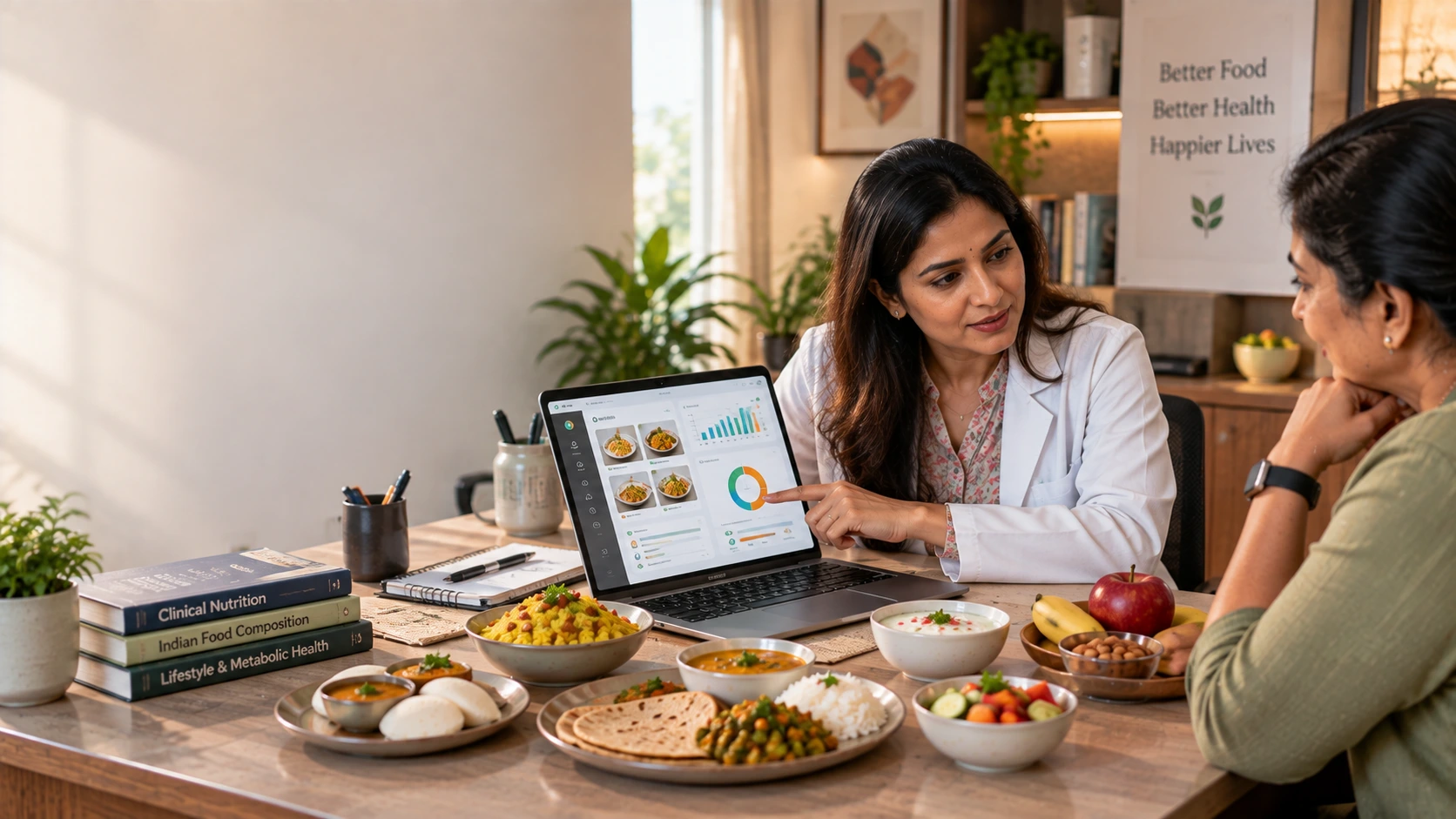
For an Indian nutritionist, recommending a best food tracking app is not simply about choosing an application with a large food database. The real question is whether patients can find and log the meals they actually eat.
A patient may regularly eat poha, idli sambar, dal rice, chapati sabzi, khichdi or a regional home-cooked meal. If these foods are difficult to find or require complicated manual entry, tracking quickly becomes another task patients abandon.
The right nutrition app india solution should combine relevant Indian food data, simple logging and practical patient nutrition tracking without requiring patients to become nutrition experts. The goal is not perfect data entry. It is consistent information that helps clinicians understand real eating patterns.
Why Most Nutritionists Struggle to Recommend a Tracking App to Indian Patients
The common failure is often mistaken for a motivation problem.
A nutritionist recommends an app. The patient downloads it, searches for their regular breakfast, cannot find the exact preparation, and starts selecting generic alternatives. Within a few days, the information becomes incomplete or the patient stops logging altogether.
This is particularly relevant in India because meals vary considerably by region, household and cooking method.
A patient in Maharashtra may log poha and bhakri, while another may regularly eat dosa, sambar and curd in Tamil Nadu. A Bengali patient may eat rice with maacher jhol, while a Rajasthani household may rely on dal baati or regional preparations.
The tracking experience therefore needs to reflect Indian eating patterns rather than assume that every meal can be represented through generic international food entries.
Research on dietary self-monitoring has consistently found an association between self-monitoring and weight loss, although the strength of evidence varies across studies. The practical implication for clinicians is straightforward: the usefulness of tracking depends not only on whether patients can record food, but whether they continue doing it.
What a Food Tracking App Must Do for Indian Patients
A useful best food tracking app for Indian patients should reduce three types of friction:
- Food recognition friction: Patients should be able to identify familiar Indian foods without excessive searching.
- Logging friction: Recording a meal should take seconds rather than several minutes.
- Interpretation friction: Patients should not need advanced knowledge of calories and nutrients to understand their eating patterns.
For clinicians, the ideal experience is slightly different. The platform should turn individual meal entries into information that can support consultations and follow-up.
A practical nutrition tracking app should therefore support:
- Indian meal recognition
- Regional food variations
- Nutritional information relevant to Indian meals
- Simple meal logging
- Consistent patient records
- Progress summaries
- Clinician visibility where appropriate
This is where an indian calorie counter app can be more useful when it is designed around Indian food behaviour rather than simply translating an international database.
The reference point for Indian food composition should also matter. The National Institute of Nutrition’s Indian Food Composition Tables (IFCT 2017) provide an important Indian nutritional reference and are published by the ICMR-National Institute of Nutrition. ICMR-National Institute of Nutrition: Indian Food Composition Tables
Evaluating Indian Food Database Depth in Tracking Apps
Database depth should be tested before recommending any platform.
A simple clinical test is to select 10 foods or dishes commonly consumed by your patient population. Include different regions and preparation styles.
For example:
- Poha
- Idli sambar
- Dal baati
- Sattu paratha
- Dal rice
- Bhakri
- Khichdi
- Maacher jhol with rice
- Regional vegetable preparations
- Common packaged snacks
Then examine how the application responds.
Does it recognise the specific dish, or does it provide a generic entry?
Does it account for preparation differences?
Can patients find a home-cooked version?
Does the system provide meaningful nutritional information?
This matters because even familiar food categories can vary substantially depending on ingredients, oil, portion size and cooking method.
A clinically useful indian food database should therefore be evaluated for relevance, not just the number of entries displayed in marketing material.
For example, a search result for “namkeen” is less useful if a patient needs to understand the difference between different preparations and serving quantities. Questions around 100 gm namkeen calories or calories in namkeen should be handled with enough context to avoid creating false precision.
Ease of Use for Non-Technical Patients
The best nutritional information is of limited value if patients do not use the tool.
This becomes particularly important for patients who are uncomfortable with complex applications, older adults, or people who already feel overwhelmed by dietary instructions.
A meal logging india experience should feel closer to describing what someone ate than completing a technical nutrition form.
Simple options include:
- Photographing a meal
- Sending a meal through a familiar messaging interface
- Logging meals using straightforward descriptions
- Reviewing simple nutritional summaries
For many patients, the important behaviour is not “calculate everything perfectly.” It is “record enough consistently for the clinician to see the pattern.”
Nutrimate approaches this problem through an Indian-first, WhatsApp-based experience designed to make meal logging familiar and low friction. Its role is to make health tracking easier to sustain rather than turn the patient into a calorie-counting expert.
This principle also aligns with broader evidence. A systematic review of digital dietary self-monitoring found that both lower- and higher-intensity approaches can support weight loss, while adherence remains an important consideration. PubMed: Dietary Self-Monitoring and Weight Loss Review
Features That Improve Clinical Utility
A tracking app becomes significantly more useful to clinicians when it moves beyond individual meal entries.
The important question is:
What can the clinician learn from the patient’s tracking data?
Useful clinical features can include:
- Consistent meal records
- Nutritional summaries
- Identification of recurring dietary patterns
- Patient progress information
- Weekly summaries
- Relevant health score information
- Visibility into adherence patterns
- Tools that support preventive health discussions
For example, if a patient repeatedly logs meals with low protein intake, the clinician can address that pattern during the next consultation rather than relying entirely on memory.
Similarly, recurring snack patterns, irregular meals or consistently low dietary variety can become discussion points.
The objective is not surveillance. It is better information.
For practitioners working with diabetes, obesity, fitness or broader lifestyle management, a system supporting diabetes diet tracking india and structured patient nutrition tracking can make follow-up conversations more specific.
For larger wellness operations, similar principles can extend into corporate health dashboard and workplace health tracking, where aggregated information can support broader wellness programmes without replacing professional judgement.
How to Introduce a Tracking App in Your Clinical Practice
Introducing technology should not become another complicated part of the consultation.
The simplest approach is to start small.
Week 1: Track one meal per day
Do not ask a patient who has never tracked food to record every meal immediately.
Start with one meal they can reliably remember and log.
Week 2: Increase consistency
Once the patient is comfortable, expand tracking gradually.
The objective is to establish a routine before increasing the amount of information collected.
Every consultation: Review the data
Tracking becomes meaningful when patients see that their information affects the conversation.
Instead of saying, “You need to eat better,” the clinician can identify specific patterns and discuss realistic changes.
Keep the focus on patterns
A single meal rarely tells the whole story.
Repeated behaviour is more valuable than one perfectly logged day.
This makes health tracking tools useful as behavioural feedback systems rather than simply calorie calculators.
For fitness businesses and professionals who need a broader ecosystem, FitVia extends this approach into a B2B setting for gym owners, fitness trainers, influencers and dietitians, combining trainer dashboards, Indian food-based nutrition tracking, member engagement and progress reporting.
Building a Recommendation Framework for Your Practice
Before recommending any food diary app india or clinical nutrition app, evaluate it against five questions:
1. Is the food database Indian enough?
Test real meals from your patient population rather than relying only on the number of foods claimed by the provider.
2. Can a patient log without nutrition expertise?
If patients need to understand calorie databases before they can use the system, adoption may suffer.
3. Does it reduce friction?
A good system should make regular logging easier, not add another administrative task.
4. Does the information help clinical conversations?
The value increases when tracking produces patterns and summaries that can support follow-up.
5. Can patients sustain the behaviour?
The most sophisticated system is ineffective if patients stop using it.
A useful recommendation framework is therefore:
Indian food relevance + simplicity + consistency + useful insights + clinical applicability.
For clinicians, this is a more practical way to evaluate the best food tracking app than comparing feature lists alone.
Nutrimate fits this model by combining Indian-first food intelligence with simple WhatsApp-based logging. The broader principle is simple: technology should remove barriers between patients and the information clinicians need, rather than create another layer of complexity.
FAQs
The best food tracking app for Indian patients combines a comprehensive Indian food database, simple logging through WhatsApp, accurate nutritional analysis, and a clinician-facing dashboard.
Start with one meal per day, choose a tool with minimal friction, and review tracking data in every clinical session to reinforce the value of the habit.
Yes. Platforms like Nutrimate are built on validated Indian food databases including IFCT 2017 data and designed around Indian meal patterns and WhatsApp interaction.
Absolutely. When paired with a clinician dashboard, patient tracking apps convert into a clinical data collection and analysis system.