 Pradnya Ganorkar
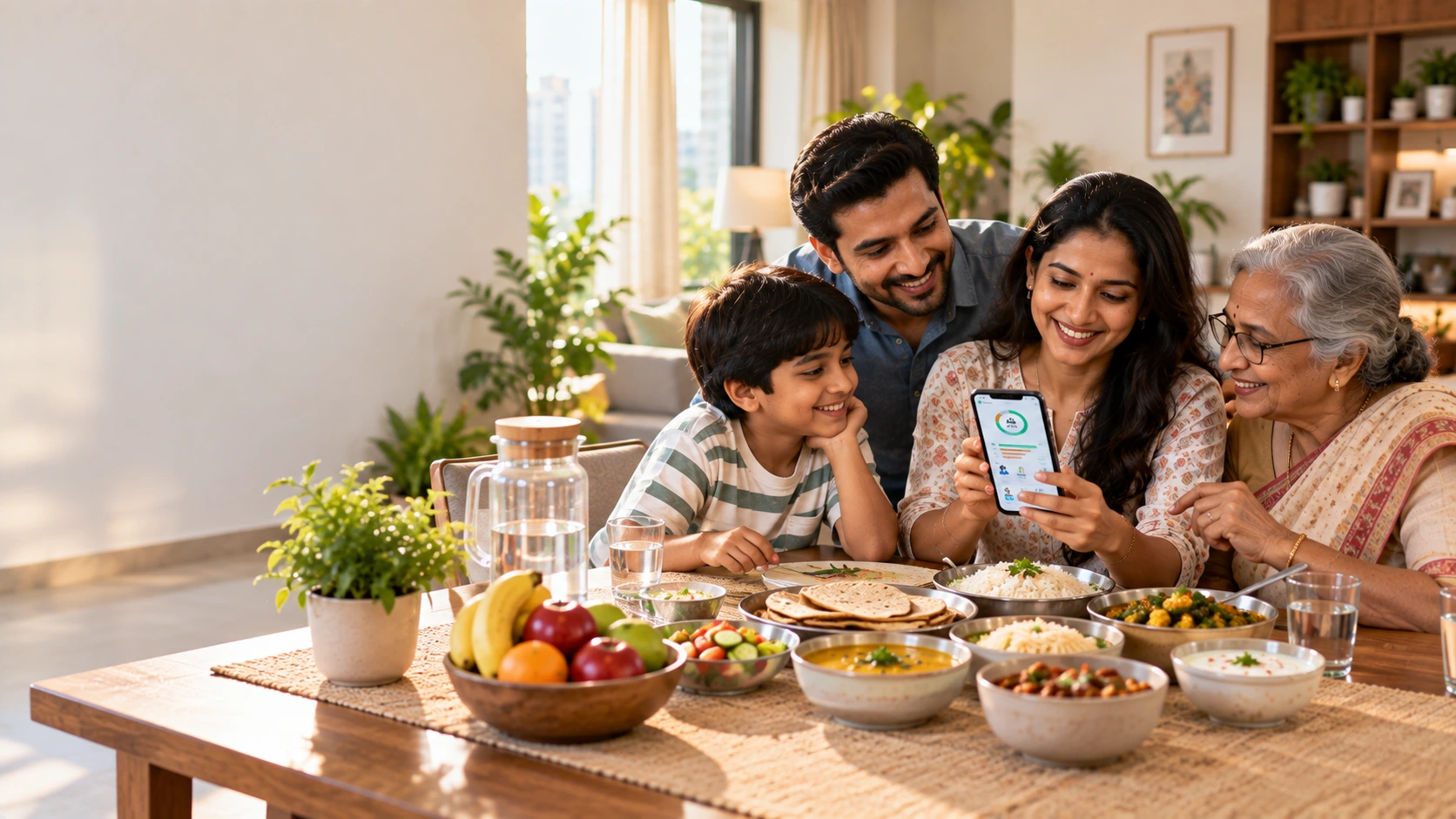
Choosing a family health tracking app sounds straightforward until one app needs to work for a working parent, a school-age child and an elderly grandparent. Most families do not need another complicated dashboard. They need a practical way to understand family health, maintain health tracking for parents, and build stress free living into ordinary Indian routines.
The challenge is particularly relevant in India because family meals, health responsibilities and caregiving often overlap. One household may include different dietary preferences, fitness goals, medical needs and levels of comfort with technology.
A useful family health platform therefore needs to do more than count calories or record steps. It should make everyday meal tracking, nutrition awareness and preventive health habits easier without creating another responsibility for the person managing the household.
The right choice comes down to seven questions: Can it track multiple people? Does it understand Indian food? Is it simple enough for older family members? Can each person maintain an individual profile? Can parents get useful family-level visibility without taking control away from other adults? Does it make daily logging easy? And can the family actually continue using it after the first few weeks?
Why Generic Health Apps Do Not Work for Indian Families
Many health applications are designed around an individual user. That model works reasonably well when one person wants to count calories, record workouts or monitor weight.
Family health is different.
An Indian household may have a father trying to improve his fitness, a mother managing nutrition around a busy work schedule, children with different food preferences and grandparents who need more attention around everyday health habits. A single household can therefore contain several different health journeys.
Generic apps also tend to create friction around food.
Consider a normal Indian dinner. It could include two rotis, dal, mixed sabzi, curd and rice. The exact nutritional profile depends on preparation, portion size and household recipe. Searching separately for every item can quickly make meal tracking feel like administrative work.
This is one reason simple meal tracking for Indian food matters. A useful system should recognise the way people actually eat rather than expecting families to translate every meal into a Western food database.
The ICMR-National Institute of Nutrition’s 2024 Dietary Guidelines for Indians specifically address healthy eating in the context of Indian households, including food variety, hydration, physical activity, healthy weight management and food labelling.
For families, the lesson is practical: the technology should adapt to the household’s food habits, not the other way around.
A useful family health app india should therefore reduce three common sources of friction:
- Too much manual data entry
- Poor understanding of Indian meals
- Separate systems for every family member
The objective is not perfect data. It is sustainable awareness.
What an Indian Family Health App Must Be Able to Do
The first requirement is simple: the platform must understand that a family is a group of individuals, not one account shared by everyone.
A strong family nutrition app should provide individual profiles while allowing appropriate family-level visibility. A parent may need to see whether an elderly family member is maintaining basic nutrition habits, while an adult child should still control their own health information.
The second requirement is Indian food relevance.
A useful platform should support everyday foods such as:
- Roti and paratha
- Dal and rajma
- Idli and dosa
- Poha and upma
- Paneer and curd
- Rice-based meals
- Regional vegetables and curries
- Indian snacks and beverages
This matters because Indian food and health cannot be separated from the way Indian families actually eat.
The third requirement is accessibility.
A technically sophisticated app is of limited value if a parent or grandparent struggles to understand how to use it. Familiar interfaces can reduce that barrier. For example, a WhatsApp-first workflow can make logging more approachable because the user does not have to learn an entirely new interaction model.
This is particularly important when considering health tracking for parents. The family member who needs the most support may also be the least comfortable with complex applications.
The fourth requirement is continuity.
The platform should help families observe patterns rather than create anxiety around individual meals. A missed entry should not feel like failure. The objective should be consistency over perfection.
Multi-Member Tracking: The Feature That Makes It a Family App
A genuine family platform needs multi-member tracking at its core.
Imagine a household with four members:
- Father: strength training and weight management
- Mother: balanced nutrition and daily activity
- Daughter: school-age nutrition and healthy routines
- Grandmother: maintaining regular meals and hydration
A single shared profile cannot represent these needs accurately.
Individual profiles allow each person to record their own meals and activities while the family can maintain an appropriate level of shared awareness.
This distinction is important. Family tracking should not become family surveillance.
For adults, health information should remain under the individual’s control. Parents or caregivers may need additional visibility in specific situations, but the platform should make permissions and boundaries clear.
A good family health tracking app should therefore answer two separate questions:
What can each person track?
Meals, activity, hydration, weight trends or other relevant daily habits.
What can another family member see?
Only information that the user has intentionally made available through the platform’s family or caregiver functionality.
This structure makes family health management more practical without removing personal autonomy.
It is also where caregiver health tools india become particularly relevant. Caregiving is often handled informally within Indian families. A simple digital system can reduce the need to remember every health-related detail manually.
The goal is not to turn family members into health administrators. It is to make important information easier to organise.
Indian Food Database Requirements for Family Use
Food is one of the most important differences between a generic health application and a genuinely useful Indian platform.
An indian food database needs breadth, but breadth alone is not enough. It also needs contextual relevance.
For example, “dal” is not one universal food. Preparation, ingredients, portion size and cooking methods can vary substantially. The same applies to sabzi, pulao, paratha, dosa and regional dishes.
For family use, the database should therefore make everyday foods easy to identify without forcing users to manually construct every recipe.
This is particularly important for parent nutrition india because older adults may eat traditional household meals rather than packaged foods with easily searchable nutritional labels.
The same principle applies to children. Children nutrition india requires practical recognition of family foods, because children often eat what the household prepares.
A useful platform should also help users understand food rather than simply display numbers.
For example, instead of treating a meal as a collection of isolated calories, the system can help users notice whether their meals regularly include protein sources, vegetables, fruits and other components of a balanced diet.
The ICMR-NIN Dietary Guidelines for Indians 2024 emphasise variety across food groups and provide practical guidance specifically intended for individuals, families and communities.
This supports an important principle for digital nutrition: tracking should improve understanding, not replace it.
The best food tracking app is therefore not necessarily the one with the most numbers. It is the one that makes the numbers meaningful enough to influence everyday decisions.
Features That Work for Both Parents and Children
A family platform needs to accommodate different ages without making the experience unnecessarily complicated.
Parents may care about:
- Meal regularity
- Household nutrition
- Physical activity
- Weight management
- Preventive health
- Supporting ageing parents
Children require a different approach. The emphasis should generally be on healthy routines and positive food habits rather than making calorie counting the centre of their experience.
This is where preventive family health becomes more useful than reactive tracking.
Instead of waiting for a health problem to become obvious, families can establish simple habits around:
- Regular meals
- Adequate hydration
- Everyday movement
- Consistent sleep
- Balanced home-cooked meals
- Reduced dependence on highly processed snacks
- Regular family meals
WHO describes healthy diets using principles including adequacy, balance, moderation and diversity, while also noting that healthy dietary patterns vary according to individual characteristics, cultural context, available foods and dietary customs.
That context matters in India. A healthy routine does not need to remove traditional foods. It needs to make the overall pattern more balanced and sustainable.
For working parents, this could mean preparing a simple breakfast before school and office hours. For grandparents, it could mean maintaining regular meal timing. For children, it could mean making nutritious food part of the household norm rather than presenting it as a separate “diet.”
This is the practical role of indian family wellness.
Technology should support the routine that already exists instead of forcing the family to reorganise its life around an application.
The Simplicity Threshold: Why Most Apps Get Deleted
The biggest threat to any health app is not lack of features. It is lack of continued use.
A family may download an application because everyone is motivated on day one. Two weeks later, manual logging becomes inconvenient, one family member forgets the password and another finds the interface confusing.
The app gradually disappears from everyone’s routine.
This is why the simplicity threshold matters.
A family health application should make common actions extremely easy:
- Open the platform.
- Log the relevant activity or meal.
- Understand the result.
- Move on with the day.
The fewer steps involved, the more likely the behaviour is to survive busy periods.
This matters particularly for busy lifestyles in india, where parents may be managing work, school schedules, commuting, household responsibilities and caregiving simultaneously.
The same principle applies to older family members.
Before choosing an app, test it with the least technology-comfortable person in the household. If an elderly grandparent cannot understand the basic logging process without repeated assistance, the platform may create more work for the family rather than less.
A WhatsApp-first approach can help here. Nutrimate is built around Indian-first food intelligence and simple health tracking, including India’s #1 whatsapp meal logging feature and Unique Caregiver feature, designed around the reality that familiar communication behaviour can reduce the friction associated with health logging.
The important point is not the technology itself. It is whether the technology makes a healthy behaviour easier to repeat.
A practical evaluation test is the “three-minute rule”:
Can a new family member understand the basic experience within three minutes?
If the answer is no, complexity may become a long-term adoption problem.
How to Introduce a Health Tracking App to Your Whole Family
Even the right family health tracking app can fail if the family introduces it as another obligation.
Start with one shared problem.
For example:
“Let’s make it easier to understand what we are eating during the week.”
That is more approachable than:
“Everyone needs to track their health every day.”
The first framing reduces pressure. The second can make family members feel monitored.
Step 1: Start with two people
Choose the family members who are most willing to try the system.
Use the first week to understand whether logging feels natural and whether the food database reflects your household meals.
Step 2: Add other members gradually
Once the basic routine works, introduce other family members.
Do not require everyone to track everything.
One person may care about meals. Another may care about activity. Another may simply need caregiver-supported visibility.
Step 3: Focus on patterns
Avoid judging individual meals.
Instead, ask questions such as:
- Are breakfasts becoming more consistent?
- Are vegetables appearing regularly?
- Are family dinners happening at a predictable time?
- Are parents remembering important daily habits?
- Is everyone getting enough movement?
This changes the purpose of tracking from surveillance to awareness.
Step 4: Make family meals the anchor
A regular shared meal can become the centre of the household’s wellness routine.
It creates an opportunity to improve nutrition, conversation and consistency at the same time.
WHO notes that healthy dietary patterns are influenced by cultural context and dietary customs, which reinforces why practical family routines should be built around foods and behaviours people can realistically sustain.
Step 5: Use technology only where it reduces effort
If manually entering every detail becomes tiring, simplify.
This is where Nutrimate’s Indian-first, WhatsApp-first approach can be useful. Instead of making the family learn a complicated tracking process, the aim is to make everyday health information easier to record.
The broader principle is simple:
The best family health technology is the technology the family continues to use.
A platform may have dozens of features, but if recording a normal Indian meal takes too much effort, those features have limited practical value.
For families considering a meal tracker app, health tracking for parents, or broader family health monitoring, the decision should therefore be based on behaviour, not feature count.
Look for five things:
- Indian food relevance
- Individual profiles for different family members
- Appropriate family or caregiver visibility
- Familiar and accessible logging
- Enough simplicity to support long-term use
The goal is not to create a perfect digital record of every family member’s life. It is to create enough visibility to make healthier everyday decisions easier.
Reference
- ICMR-NIN Dietary Guidelines for Indians 2024
- WHO Healthy Diet Guidance
FAQs
The best family health tracking app enables multi-member tracking with individual profiles, has a comprehensive Indian food database, works through a familiar interface like WhatsApp, and is simple enough for all family members including elderly grandparents to use.
Yes. Apps with multi-member family profiles allow a parent to monitor multiple family members from a single dashboard while each member logs their own meals and activities independently.
Multi-member profiles, a validated Indian food database covering regional dishes, WhatsApp-based logging option, simple interface for elderly users, and family-level nutrition insights are the key requirements.
Platforms like Nutrimate are built specifically for the Indian market with an Indian food database, WhatsApp-first logging, and family tracking features that address the real structure of Indian households.