 Pradnya Ganorkar
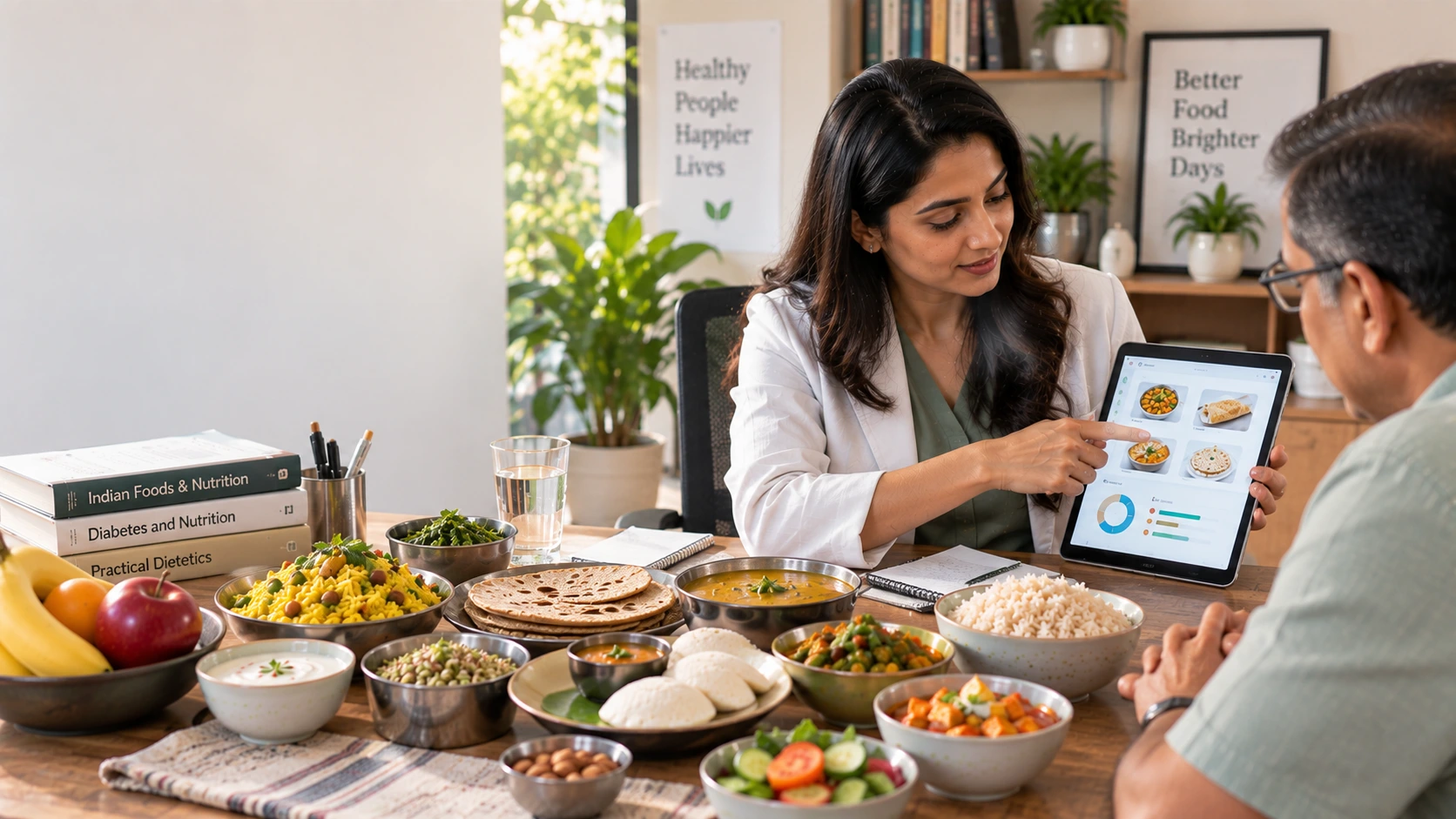
Diabetes management in India is not simply a question of telling patients to “eat less sugar.” Effective dietary management requires understanding what people actually eat, how those foods are prepared, and how consistently dietary recommendations are followed. This is where patient nutrition tracking, an accurate indian food database, and a practical nutrition app india can become valuable parts of clinical care.
The ICMR-INDIAB study has documented diabetes prevalence across 30 states and Union Territories, highlighting the scale and regional variation of diabetes in India. For nutrition professionals, the challenge is therefore not only creating a diet plan, but helping patients follow it within familiar Indian eating patterns.
The Scale of Diabetes in India and Why Diet Management Is Critical
The scale of diabetes makes sustained dietary management particularly important. Indian patients may eat rice, wheat-based rotis, poha, idli, dosa, dal, regional preparations, packaged snacks, and restaurant foods within the same week.
A generic instruction such as “reduce carbohydrates” does not explain how those foods fit into an individual’s overall dietary pattern.
Effective diabetes diet tracking india therefore needs to move from broad restrictions to practical food awareness. A useful system should help professionals understand:
- What the patient actually eats
- Portion sizes and meal timing
- Frequency of higher-carbohydrate foods
- Protein intake
- Snack patterns
- Regional and household cooking practices
- Consistency across weekdays and weekends
ICMR’s research also highlights dietary changes as an important component of diabetes management.
Why Indian Diabetic Patients Struggle With Standard Diet Advice
Many patients receive technically correct advice that is difficult to apply to everyday Indian meals.
For example, telling someone to choose lower-glycaemic foods does not automatically answer whether their usual breakfast of poha, idli, or dosa fits their dietary plan. Similarly, a patient may understand that portion control matters but still struggle to estimate the nutritional difference between homemade rice, restaurant rice, and a mixed rice preparation.
This is where patient nutrition tracking can make dietary counselling more practical.
Instead of relying entirely on a patient’s memory during a fortnightly consultation, professionals can examine recurring patterns. A patient’s meals may reveal that the primary issue is not one particular food, but repeated oversized portions, frequent snacks, inconsistent meal timing, or insufficient protein.
The goal is not to make food tracking complicated. It is to make dietary recommendations relevant to the foods patients already eat.
Glycaemic Index of Common Indian Foods: What Clinicians Need
Glycaemic index can provide useful context when discussing carbohydrate-containing foods, but it should not be treated as the only measure of a meal’s nutritional impact.
The supplied reference data identifies approximate GI values for several familiar Indian foods:
| Indian food | Approximate GI |
| Rice | 72 to 84 |
| Bajra roti | 55 |
| Idli | 68 to 77 |
| Sprouted legumes | 25 to 35 |
These values illustrate why food selection needs context. A meal is not simply a collection of isolated GI numbers. Portion size, preparation method, accompanying protein, fibre, fats, and the overall meal composition all matter.
For clinicians, an accurate indian food database is therefore more useful than a generic international database that may not represent common Indian dishes accurately.
Patients should also be taught how to read nutrition labels in india, particularly when packaged foods become part of their routine. Looking at serving size, carbohydrate, sugars, fibre, protein, and sodium can help patients make more informed choices.
Building a Daily Tracking System for Diabetic Patients
A practical tracking system should be simple enough to maintain every day.
For a newly diagnosed patient, a useful workflow can include:
- Log meals consistently: Record breakfast, lunch, dinner, and snacks.
- Capture portions: Note whether a food was a small, moderate, or large serving.
- Record familiar Indian foods: Include regional dishes rather than forcing patients to select generic substitutes.
- Review patterns weekly: Look for recurring dietary behaviours instead of reacting to one meal.
- Adjust clinically: Use the information alongside appropriate medical and nutritional assessment.
This is where a nutrition tracking app can reduce the administrative burden of dietary recall.
For older patients, the interface matters as much as the nutritional database. A complicated app can become another reason for patients to stop tracking. A familiar communication channel can make daily logging easier.
Nutrimate approaches this problem through an Indian-first, WhatsApp-first model that allows meals to be logged without requiring patients to navigate a complex nutrition application.
Using Patient Data to Improve Clinical Decisions
The value of tracking is not the quantity of data collected. It is the quality of the decisions that the data enables.
Consider a patient who reports during a consultation that they “mostly follow the diet.” A week’s meal records may show a different pattern: consistent breakfast and lunch, but frequent evening snacks and larger weekend meals.
That information changes the conversation.
Instead of repeating general dietary advice, the nutrition professional can focus on the specific behaviour creating difficulty. This makes patient nutrition tracking a tool for more focused counselling rather than another administrative task.
A structured system can also help professionals identify:
- Repeated high-carbohydrate meals
- Low-protein patterns
- Frequent packaged snacks
- Inconsistent meal timing
- Changes in food choices
- Weekend versus weekday differences
For clinics handling multiple patients, this type of information can make follow-up discussions more structured and evidence-informed.
Technology That Works for Indian Diabetic Patients
Technology should reduce friction rather than create another task.
A useful nutrition app india should account for Indian food habits, regional dishes, familiar communication behaviour, and different levels of digital literacy.
This is particularly important for older adults. A 60-year-old patient may not want to learn a complex application simply to record what they ate for breakfast.
WhatsApp-based logging can address part of this problem because the interaction is familiar. Instead of navigating multiple screens, a patient can share a meal through a simple message or photograph.
Nutrimate’s approach combines this WhatsApp-first convenience with Indian food intelligence, making meal tracking more closely aligned with everyday Indian eating behaviour.
For professionals working with fitness clients alongside nutrition goals, FitVia extends this ecosystem into a B2B setting with trainer dashboards, WhatsApp nutrition tracking, Health Score, progress reporting, and an Indian food database designed around fitness coaching workflows.
Implementing Diabetes Diet Tracking in Your Clinical Practice
A practical implementation does not require changing the entire consultation process at once.
Start with a small workflow:
Step 1: Select the patients who will benefit most.
Prioritise patients who struggle with dietary consistency, portion awareness, or accurate food recall.
Step 2: Define what needs to be tracked.
Focus on meals, snacks, portions, protein intake, and recurring dietary patterns rather than collecting unnecessary information.
Step 3: Make logging simple.
A patient should be able to record food without learning a complicated system.
Step 4: Review patterns rather than isolated meals.
Look for behaviours repeated over several days.
Step 5: Connect tracking with professional guidance.
Technology should support the nutritionist or clinician, not replace clinical judgement.
A good patient nutrition tracking workflow should ultimately answer a practical question: “What is this patient doing consistently, and what specific change is most useful now?”
For Indian diabetes care, that shift from generic dietary advice to real-world dietary visibility can make nutrition counselling more practical, measurable, and sustainable.
Reference:
- ICMR: Advancing Biomedical Research and INDIAB diabetes data
- ICMR Annual Report 2023-24: Diabetes Research
FAQs
Personalised carbohydrate targets, GI-aware food choices within Indian cuisine, and a simple daily logging tool through familiar channels like WhatsApp achieves the highest patient compliance.
Jowar, bajra, ragi rotis, sprouted legumes, low-GI vegetables, curd, eggs, and small portions of rice cooked and cooled are all appropriate. An accurate indian food database is essential for precise guidance.
Daily tracking in early stages is ideal. As patients build awareness, three to four days per week including one weekend day provides sufficient data for clinical review.
Yes, when they include accurate Indian food data, GI information, and simple logging interfaces integrated with clinical oversight.