 Pradnya Ganorkar
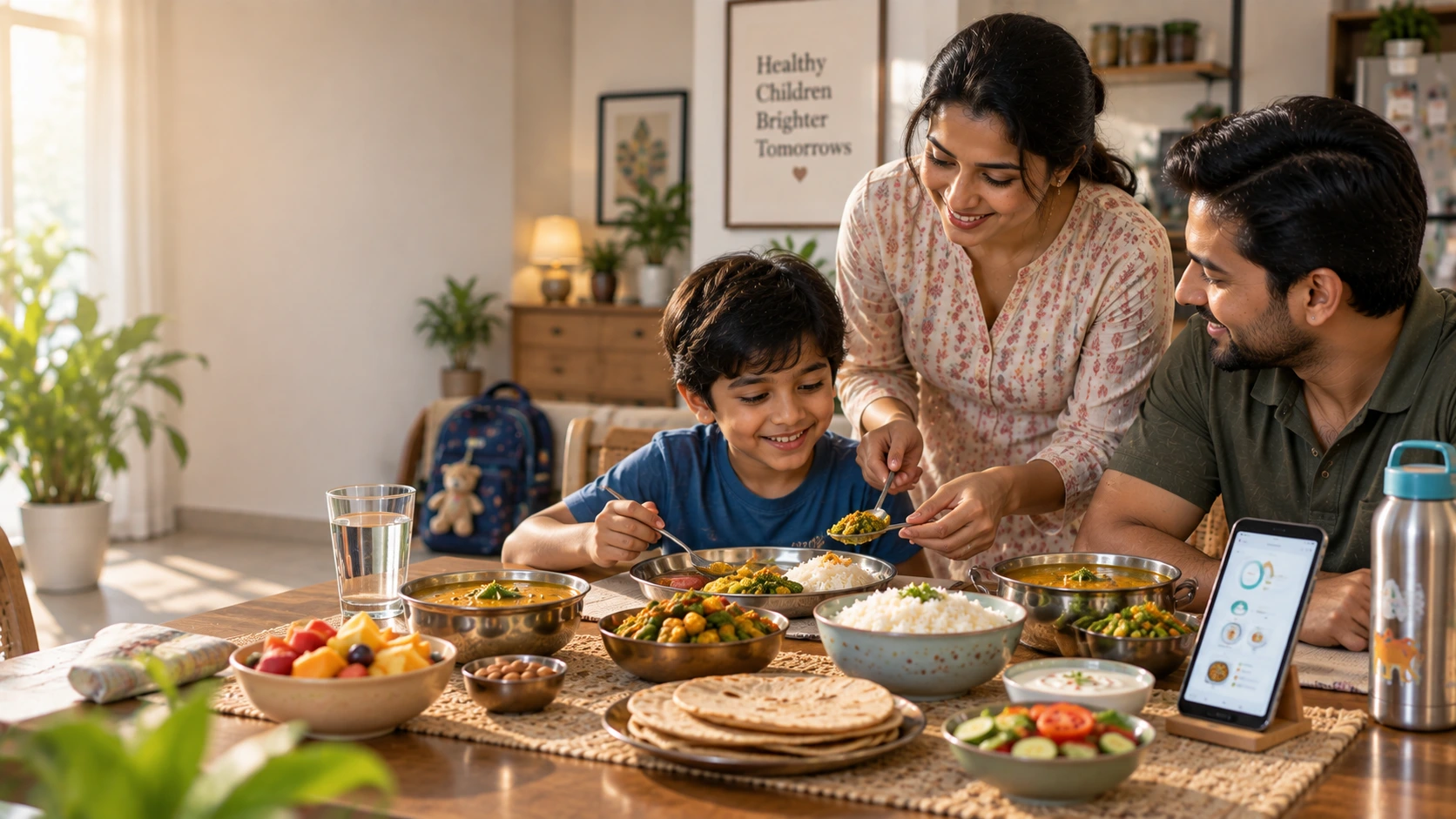
For many Indian parents, family health begins with a simple question: “Is my child eating well enough?” The answer is rarely about one perfect meal. It depends on the overall pattern of child nutrition india, food variety, protein intake, micronutrients, activity, sleep, and consistency.
Modern Indian households face a practical challenge. Parents may understand what healthy food looks like, but busy mornings, school schedules, tuition, screen time, picky eating, and packaged snacks can make balanced eating difficult. Good nutrition therefore needs to work within real family routines.
For family health, the goal should not be creating a perfect diet for children. It should be building sustainable eating habits around familiar Indian foods.
Why Children Nutrition in Indian Households Is Often Misunderstood
A common mistake in children diet india is judging nutrition by how much a child eats rather than what the overall diet provides.
A child may eat enough food but still have a limited intake of protein, iron, calcium, fruits, vegetables, or other important nutrients. Conversely, a child who eats less at one meal may still have an adequate overall diet if meals and snacks across the day are reasonably varied.
This is why kids nutrition india should be viewed across the entire day and week rather than through individual meals.
Indian families also face conflicting advice. One person may recommend avoiding rice, another may insist on milk, while social media promotes different diets for growing children. The result can be unnecessary confusion.
A better framework is:
- Include a protein source regularly.
- Offer different vegetables and fruits across the week.
- Include calcium-rich foods.
- Use familiar grains, pulses, and other staple foods.
- Keep highly processed, high-sugar and high-salt foods occasional rather than routine.
- Pay attention to the overall eating pattern rather than one “bad” meal.
WHO guidance similarly emphasizes adequacy, balance, moderation, and dietary diversity as foundations of a healthy diet.
For Indian families, this makes nutrition less about replacing traditional food and more about improving how familiar food is combined.
Age-Specific Nutritional Needs: From Toddlers to Teenagers
Children’s nutritional requirements change as they grow. A toddler, a school-age child, and a teenager cannot be expected to have identical dietary needs.
For parents, the practical priority is to understand the broad difference between stages rather than attempting to calculate every nutrient manually.
For school-age children, protein is particularly important because growth and development require an adequate supply of nutrients. Children aged 6 to 12 need approximately 0.95 to 1.1g of protein per kg of bodyweight.
For example, a 30kg child would need approximately 28 to 33g of protein daily. This can be approached through familiar foods such as dal, eggs and curd rather than relying exclusively on packaged protein products.
A simple Indian meal pattern could include:
- Breakfast: dosa with curd or an egg
- Lunch: roti or rice with dal and vegetables
- Evening: fruit with nuts or another suitable snack
- Dinner: roti with paneer, dal or another protein-rich preparation
The exact requirements of an individual child can vary based on age, growth, activity, health status and other factors. Parents should seek professional advice when there are concerns about growth, appetite, deficiencies or specific medical conditions.
For indian family wellness, consistency matters more than creating a complicated nutritional plan that the household cannot maintain.
The School Lunch Problem: What Most Indian Children Eat vs What They Need
School food creates one of the biggest practical gaps in indian child health.
Parents may prepare a nutritious breakfast and dinner, but the school-day routine can include biscuits, packaged snacks, sugary drinks, fried foods, or a lunch that contains plenty of carbohydrates but relatively little protein and vegetables.
The solution is not to make lunchboxes unnecessarily complicated.
A practical school lunch can combine familiar foods with one or two nutritional improvements:
| Familiar option | Simple improvement |
| Roti | Add paneer, dal or egg alongside it |
| Paratha | Include vegetables in the filling and serve with curd |
| Idli | Pair with sambar rather than eating it alone |
| Poha | Add peanuts, vegetables or another protein source |
| Rice | Combine with dal, rajma, curd or vegetables |
| Dosa | Serve with sambar and a suitable side |
School food environments also matter because children spend a substantial part of their day at school. WHO recommends improving school food environments so that healthier foods are more available and unhealthy options are limited.
Parents therefore do not need to solve every nutrition issue at home. Creating reasonable choices at home, discussing food positively, and coordinating where possible with school routines can make healthy eating easier.
Protein for Growing Indian Children: Practical Sources
Protein often becomes confusing because parents associate it with expensive foods or fitness products.
For children, familiar Indian foods can provide useful protein without turning meals into a bodybuilding diet.
Practical sources include:
- Dal
- Paneer
- Eggs
- Curd
- Milk
- Rajma and other beans
- Chana
- Peanuts and nuts
- Ragi-based preparations
- Fish or meat for families that consume them
For vegetarian households, combining different protein sources across the day can make meals more nutritionally complete.
For example, dal at lunch, curd with a meal, paneer at dinner and nuts as a snack can contribute to daily protein intake without dramatically changing the family’s food habits.
Parents should also look beyond individual foods. The question is not simply “How much protein in average indian meal?” It is whether the child’s overall daily pattern provides sufficient nutrition.
This approach is much more practical than trying to turn every meal into a numerical calculation.
Iron and Calcium: The Two Most Commonly Deficient Nutrients in Indian Children
Iron and calcium deserve particular attention because they support important aspects of growth and development.
Iron is involved in processes including oxygen transport and normal cognitive development. Calcium is essential for developing and maintaining bones and teeth.
Indian meals already contain several useful sources.
For iron, families can regularly include:
- Green leafy vegetables
- Dal
- Chana
- Rajma
- Other pulses
- Nuts and seeds
- Fortified foods where appropriate
For calcium, useful familiar choices include:
- Curd
- Milk
- Paneer
- Ragi
- Certain leafy vegetables
- Other calcium-containing foods
Food variety is important because no single ingredient supplies every nutrient a growing child needs. WHO notes that micronutrients such as iron, calcium and other vitamins and minerals are essential for growth and health, while dietary diversity improves the likelihood of meeting nutritional requirements.
Parents should not automatically assume that tiredness, poor appetite or other symptoms mean a child has a deficiency. Persistent concerns should be discussed with a paediatrician rather than addressed through self-prescribed supplements.
Building Healthy Eating Habits in Children Without Creating Food Anxiety
Good family health is not only about what children eat. It is also about their relationship with food.
Constantly labelling foods as “good,” “bad,” “fattening,” or “forbidden” can make everyday eating unnecessarily stressful.
Instead, parents can teach children simple principles:
- Eat a variety of foods.
- Try new foods without pressure.
- Include fruits and vegetables regularly.
- Eat slowly and notice hunger and fullness.
- Keep treats occasional without turning them into forbidden foods.
- Eat meals together when possible.
- Let children participate in choosing and preparing age-appropriate foods.
Vegetables are a common challenge. Instead of serving vegetables only as a separate side dish, incorporate them into familiar preparations.
Spinach can be added to dal. Vegetables can go into parathas. Carrots, peas and beans can be added to pulao. Vegetables can be incorporated into dosa or khichdi.
This is especially useful for stress free living because parents do not have to prepare an entirely separate “healthy meal” for the child.
The larger objective is sustainable health habits, not dietary perfection.
How to Track Your Child Nutrition Without Becoming Obsessive
Nutrition tracking can help parents identify patterns, but it should not become another source of stress.
A useful approach is to track broad patterns rather than obsessively measuring every ingredient.
For example, parents can periodically ask:
- Did my child get a protein source today?
- Were vegetables or fruit included?
- Were calcium-rich foods included?
- Was the child’s food reasonably varied?
- Are packaged snacks replacing proper meals too often?
- Is the child eating differently on school days compared with weekends?
This makes health tracking for parents more practical. The purpose is to identify patterns that may need attention, not to judge every meal.
For families managing multiple people, a family health tracking app can make this process easier by bringing relevant information into one place. This can be particularly useful for parents who are also managing their own healthy lifestyle, work commitments, exercise and household responsibilities.
Nutrimate approaches this through simple family-level tracking, allowing parents to monitor children’s nutrition alongside other household wellness needs through its multi-member interface accessible through WhatsApp. This supports the broader idea behind preventive family health: noticing everyday patterns early rather than waiting until tracking becomes necessary because of a problem.
Its broader approach also includes India’s #1 whatsapp meal logging feature and Unique Caregiver feature, designed around the reality that health tracking often involves more than one person in an Indian household.
The objective should remain simple: use tracking to make better decisions, not to make family meals feel like homework.
For parents balancing work and home responsibilities, this is especially relevant to indian diet for busy professionals. A practical system should reduce effort rather than add another complicated routine.
A sustainable approach to family health can be as simple as understanding what the family eats regularly, identifying nutritional gaps, and making small improvements that can actually continue.
References
FAQs
Children aged 6 to 12 need approximately 0.95 to 1.1g of protein per kg of bodyweight. For a 30kg child, that is 28 to 33g of protein daily, achievable through two servings of dal, one egg, and a serving of curd.
Dal, paneer, eggs, curd, ragi roti, green leafy vegetables, seasonal fruits, and nuts provide the most concentrated nutrition for Indian children within familiar food preferences.
Supplements are not a substitute for a varied diet. Before supplementing, track your child actual intake for two weeks through a family health app to identify specific deficiencies. Consult a paediatrician before starting supplements.
Incorporating vegetables into familiar preparations like dal, khichdi, parathas, and dosas is more effective than presenting vegetables as standalone dishes.