 Pradnya Ganorkar
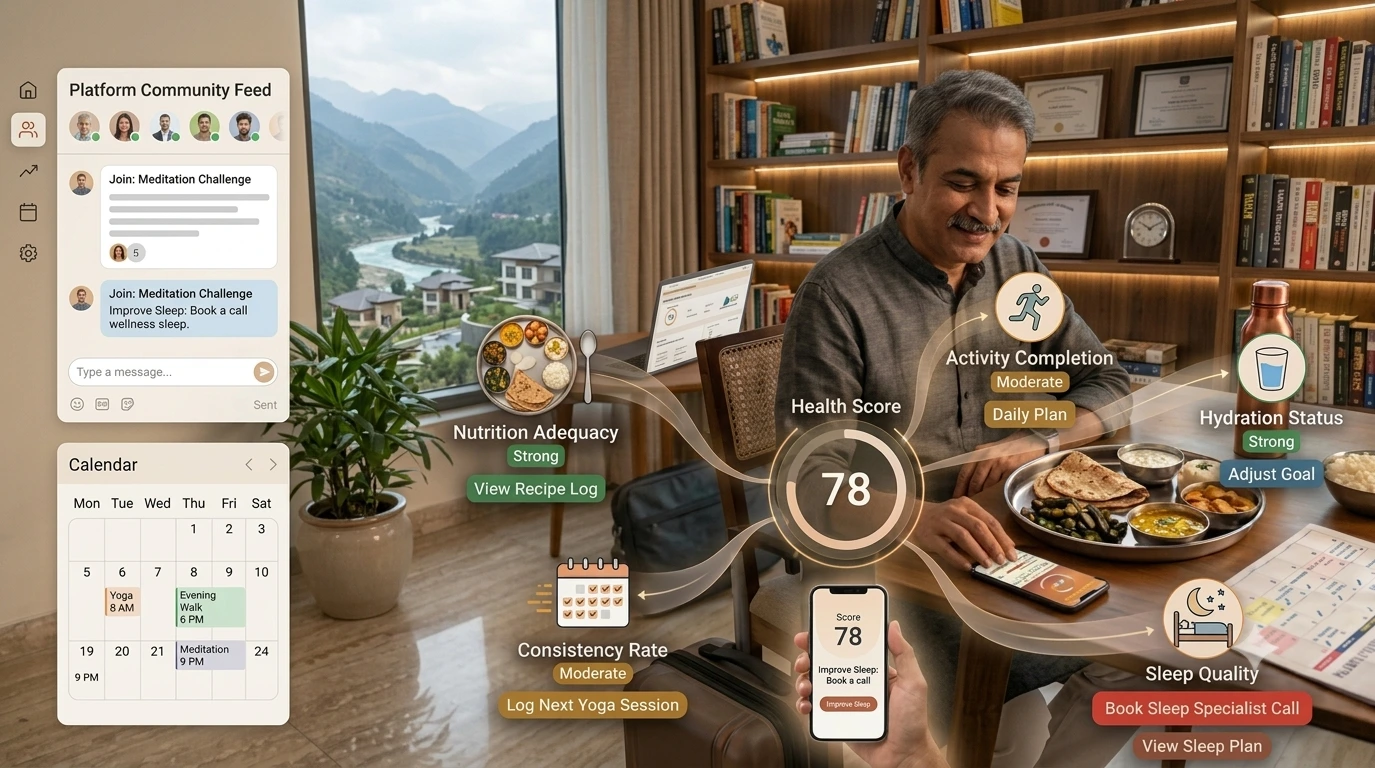
Most wellness platforms are good at collecting data. They can record meals, workouts, steps, sleep, hydration and other daily behaviours. The challenge begins when users have to interpret all those numbers themselves.
A health score addresses this problem by turning multiple daily behaviours into a single, easy-to-understand indicator. Instead of asking a user to interpret five separate dashboards, it provides a quick view of how consistently they are following important health behaviours.
For a nutrition tracking app, fitness platform, clinical nutrition service or corporate wellness programme, the value is not simply having another number. A well-designed score can connect data with behaviour, helping users understand progress and giving organisations a clearer way to measure engagement.
Why Single-Metric Health Tracking Is No Longer Enough
Health is multidimensional.
Someone may exercise regularly but have poor nutrition. Another person may eat well but sleep for only five hours. A third may have strong weekday routines but struggle with consistency every weekend.
Looking at only one metric can therefore create an incomplete picture.
For example, step count can tell a platform how much someone moved, but it cannot explain whether the person is eating adequately, staying hydrated or recovering through sufficient sleep.
This is why a composite health metric can be more useful than isolated measurements. It brings several relevant behaviours into one view while still allowing the underlying data to remain available for deeper analysis.
The concept also fits the way people actually use digital products. WHO’s digital health framework recognises personal health tracking, active data capture, self-monitoring and longitudinal health tracking as distinct digital health functions.
The important distinction is that a score should simplify information, not hide it.
What a Health Score Should Measure
A useful score should measure behaviours that are relevant, understandable and capable of being tracked consistently.
For a general wellness platform, five dimensions provide a practical starting point:
- Nutrition adequacy
- Activity completion
- Hydration
- Sleep quality
- Consistency rate
These dimensions can be combined into a daily score, while users should still be able to see what contributed to the result.
For example, a user might see:
- Overall score: 78
- Nutrition: strong
- Activity: moderate
- Hydration: strong
- Sleep: needs attention
- Consistency: moderate
This is more actionable than simply telling the user that their health data has been recorded.
For an employee health dashboard, the same principle can provide a high-level view of behavioural engagement without requiring HR teams to interpret dozens of individual metrics.
The score should also be transparent. Users should understand what is being measured and why.
The Five Dimensions of a Useful Composite Health Score
1. Nutrition adequacy
Nutrition should evaluate meaningful dietary behaviours rather than simply rewarding users for eating fewer calories.
Depending on the platform and use case, this could include protein adequacy, meal regularity, dietary diversity or other relevant nutrition indicators.
For Indian users, this becomes especially important because food tracking needs to account for meals such as roti, rice, dal, poha, dosa, idli, sabzi, paneer and regional dishes.
An indian food database can make the underlying tracking more relevant, while a nutrition app india audience may benefit from seeing familiar foods represented accurately.
2. Activity completion
Activity can include planned workouts, daily movement or completion of an exercise target.
For a gym member, this might mean completing a scheduled workout. For a professional, it could include achieving a daily movement target.
For a fitness business, this information can become part of a broader fitness engagement platform, helping trainers understand whether members are consistently participating rather than simply remaining enrolled.
3. Hydration
Hydration is another behaviour that is simple to understand but easy to overlook.
A score can encourage users to pay attention to hydration without requiring them to interpret complicated measurements.
However, the platform should avoid treating a single target as universally appropriate. Individual needs vary based on factors such as activity, environment and health circumstances.
4. Sleep quality
Sleep provides an important recovery dimension.
A user who completes every workout but consistently sleeps poorly may receive a misleading impression if activity is the only measure being tracked.
Including sleep creates a more balanced view of everyday wellness.
5. Consistency rate
Consistency connects the other dimensions.
A user does not need a perfect day every day. What matters is whether healthy behaviours are being maintained over time.
This is where behaviour score tracking can become particularly useful. A score can reward repeated healthy actions and make progress visible before major physical changes become obvious.
That visibility can support the psychological reward loop that helps users continue a routine.
How Health Scores Drive Behaviour Change in Users
Tracking alone does not necessarily change behaviour.
The user needs feedback that is understandable enough to act on.
Imagine someone logs meals, workouts, sleep and hydration but receives four separate charts. They may understand each number individually but still not know whether they are progressing overall.
A daily score creates a simpler feedback loop:
Action → Score → Feedback → Adjustment → Repeated action
For example, if a user’s score falls because activity and sleep have declined for several days, the platform can make those patterns visible.
The objective should not be to make users anxious about their score.
Instead, the score should answer a practical question:
What can I improve today?
This is particularly relevant to products such as an indian calorie counter app, where users may otherwise become overly focused on calorie numbers instead of broader behavioural patterns.
Nutrimate applies this principle through its wellness tracking approach, using a daily health score alongside Indian meal intelligence and simple tracking. Its India’s #1 whatsapp meal logging feature and Unique Caregiver feature also extends the idea of simple tracking to everyday family wellness.
Implementing Health Scores in Wellness Platforms: Technical Considerations
The difficult part of building a score is not displaying a number. It is deciding what that number should actually represent.
A platform needs a clear scoring methodology.
At minimum, product teams should define:
- Which behaviours contribute to the score
- How much each dimension contributes
- What counts as completion
- How missing data is treated
- How frequently the score is recalculated
- How users can understand their score
- Which outcomes the score is intended to support
The methodology should also distinguish between a wellness indicator and a clinical measure.
A wellness score should not automatically be presented as a medical diagnosis or prediction.
Validation is therefore critical. WHO’s guidance on digital health emphasises systematic monitoring and evaluation of digital interventions, including assessing whether the intervention produces its intended impact.
For product teams, this means a health index platform should not assume that a visually attractive score is automatically a meaningful one. The scoring model needs testing, monitoring and refinement.
How Corporate Wellness Programmes Use Health Scores
Corporate wellness programmes often struggle with measurement.
Participation rate can tell HR that employees joined a programme, but it does not necessarily show whether employees are consistently engaging with healthy behaviours.
A corporate health report can become more useful when it includes aggregated behavioural indicators such as activity, nutrition engagement, sleep and consistency.
For example, an employee health dashboard could show:
- Overall engagement trend
- Average wellness score
- Nutrition tracking participation
- Activity completion
- Consistency trends
- Programme engagement over time
The key is aggregation and privacy. Corporate reporting should focus on appropriate programme-level insights rather than exposing sensitive individual health information without proper consent and governance.
This can help organisations move from asking:
“How many employees joined?”
to:
“Are employees consistently engaging with the programme?”
For gym owners and fitness professionals, the same principle can be applied at the member level.
FitVia, Nutrimate’s B2B fitness platform for gym owners, fitness trainers, influencers and dietitians, combines Health Score capabilities with member engagement, nutrition tracking, trainer dashboards and fitness management tools. This gives fitness businesses a broader behavioural view rather than relying only on attendance.
Health Score Design Pitfalls to Avoid
A health score can create problems when simplicity becomes oversimplification.
Over-rewarding easily gameable behaviours
If users can increase their score simply by completing easy actions while ignoring more meaningful behaviours, the score becomes a game rather than a useful health indicator.
Under-representing clinically important variables
Not every health behaviour carries the same significance.
A scoring model should avoid implying that a high number of minor positive behaviours automatically offsets an important health concern.
Creating anxiety instead of motivation
A score should encourage useful action, not make users feel that every imperfect day represents failure.
This is particularly important for people already struggling with consistency or rigid approaches to health.
Hiding the underlying data
Users should be able to understand why their score changed.
A score of 72 is far more useful when the platform explains that sleep declined, activity was completed, and nutrition consistency improved.
Treating the score as a diagnosis
A wellness score is an indicator of tracked behaviours. It should not automatically be interpreted as a medical assessment.
The best approach is therefore to use the score as a navigation tool: it highlights patterns, encourages consistency and tells users where to look more closely.
The future of health tracking tools is not necessarily about collecting more data. It is about making existing data easier to understand and act upon.
A well-designed health score can connect nutrition, movement, hydration, sleep and consistency into one practical daily feedback system, provided the methodology remains transparent, meaningful and appropriately validated.