 Pradnya Ganorkar
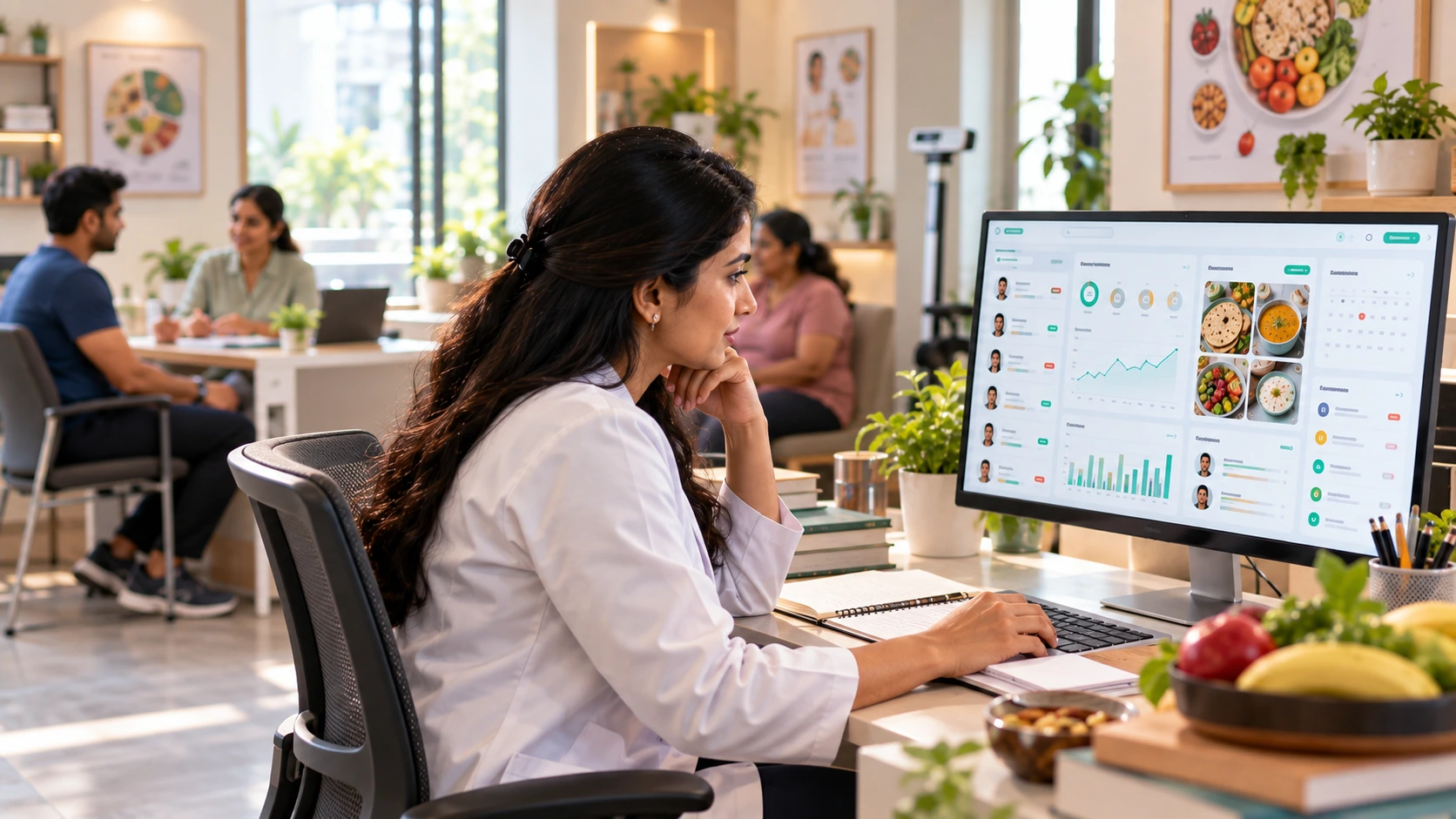
Choosing crm software for weight-loss clinics is not simply a question of managing names, appointments, and follow-ups. Weight-loss clinics also need to understand dietary behaviour, progress, adherence, communication, and changes across a patient’s health journey.
For an Indian clinic, this distinction becomes even more important. A patient may discuss poha, roti, dal, rice, namkeen, chai, or weekend eating habits during consultations. A generic CRM can record that conversation, but it may not provide the structure required for ongoing patient nutrition tracking.
A modern nutrition practice software approach connects relationship management with the information that actually shapes nutrition care. WHO’s framework for obesity management recognises ongoing weight management, lifestyle support, monitoring, and digital health as parts of a broader care pathway.
The practical question for a growing clinic is therefore: do you need another CRM, or do you need a system that connects patient management with nutrition data?
Why Weight-Loss Clinics Have Different Software Needs Than General Clinics
A general CRM is primarily designed around relationships.
It helps a business store contact information, communication history, appointments, lead status, and follow-up activities. These functions can be useful for a clinic, particularly when managing enquiries and appointment pipelines.
But weight-loss care has another layer.
A patient’s progress depends partly on what happens between consultations. Meals, habits, adherence, weight changes, activity, and communication can all become relevant to the practitioner.
This creates a difference between ordinary customer management and weight loss clinic management.
Consider a clinic in Nashik with 150 active clients. The practitioner may conduct consultations throughout the day, but the patient’s dietary behaviour occurs outside the consultation room.
A useful system should help answer questions such as:
- Has the patient been consistently logging meals?
- Are dietary habits changing?
- Is progress being recorded?
- Has the patient stopped engaging?
- What information should the nutritionist review before the next consultation?
WHO also identifies self-management, monitoring, adherence support, and digital health as components that can support obesity prevention and management.
This is why nutritionist client management requires more than a conventional sales-style CRM.
What a Generic CRM Does Well for Clinics
A CRM can still be valuable.
For a growing clinic, it can provide a central location for:
- Patient contact information
- Appointment scheduling
- Follow-up reminders
- Enquiry management
- Communication records
- Lead tracking
- Basic client segmentation
- Administrative workflows
These functions reduce scattered spreadsheets, notebooks, and messaging histories.
A clinic in Nagpur, for example, may receive enquiries through Instagram, phone calls, referrals, and WhatsApp. A CRM can help organise those interactions and prevent potential patients from being forgotten.
The problem begins when the clinic expects the CRM to become the complete clinical workflow.
A CRM can tell you that a patient has an appointment next Tuesday.
It may not tell you whether the patient’s meal pattern has changed substantially since the previous consultation.
That distinction matters when the clinic’s service depends on dietary behaviour and long-term adherence.
Where Generic CRMs Fall Short for Dietary Practice
The biggest limitation of a conventional CRM is that it manages the relationship layer, not necessarily the nutrition data layer.
For weight-loss clinics, the missing information may include:
- Meal logs
- Dietary patterns
- Habit adherence
- Nutrition notes
- Weight progress
- Health metrics
- Food-related observations
- Progress reports
- Patient-specific nutrition information
A CRM may allow a practitioner to type these details into notes, but manually entering everything creates another problem: information becomes difficult to structure and compare.
This is particularly relevant when managing dozens or hundreds of patients.
A practitioner in Surat may remember that one patient regularly consumes packaged snacks, another struggles with breakfast, and another has difficulty maintaining their plan on weekends. If these observations remain buried inside free-text notes, identifying broader patterns becomes harder.
An integrated patient management system can reduce this fragmentation by keeping patient information and nutrition-related activity closer together.
The distinction can be summarised simply:
| Capability | Generic CRM | Nutrition-focused system |
| Patient profiles | Yes | Yes |
| Appointment management | Yes | Yes |
| Communication | Yes | Yes |
| Meal tracking | Usually limited | Yes |
| Habit tracking | Usually limited | Yes |
| Progress monitoring | Limited | Yes |
| Nutrition notes | Limited | Yes |
| Health reports | Limited or no | Yes |
| Indian food database | No | Yes |
| WhatsApp-based nutrition workflows | Usually limited | Can be supported |
The goal is not to make a CRM unnecessary. It is to avoid expecting a generic CRM to perform functions it was not designed to handle.
Features Specifically Valuable for Weight-Loss Clinic Management
The right diet clinic software should make the practitioner’s daily workflow simpler, not add another layer of administration.
Several capabilities are particularly useful.
Patient profiles with nutrition context
A patient profile should provide more than contact information.
It should help practitioners understand the person’s progress, dietary behaviour, goals, and relevant history in one place.
Meal and dietary tracking
Meal tracking allows the clinic to see what happens between consultations.
For Indian patients, an indian food database is particularly valuable because everyday meals rarely resemble simplified Western food examples.
A patient might log dal rice, two rotis with sabzi, poha, idli, dosa, curd, or a regional snack. The system should make these foods practical to record rather than forcing patients to search through unfamiliar alternatives.
Progress monitoring
Weight-loss management requires more than a single measurement.
A useful system should help practitioners review trends and compare progress across defined periods.
Patient communication
Communication should remain connected to the patient journey.
Automated reminders, follow-ups, and structured communication can reduce repetitive administrative work while keeping patients engaged.
Reports
Reports should turn collected information into something a practitioner can actually use during a consultation.
The objective is not more charts. It is faster understanding.
The Overlap Between CRM and Nutrition Software: What to Look For
The most useful approach is often to think about software in layers.
A CRM manages the relationship.
Nutrition software manages the dietary and health journey.
An integrated platform connects the two.
For example, a clinic could have a patient who joined three months ago. The CRM can show the patient’s appointment history and communication. The nutrition layer can show meal logging, dietary behaviour, progress, and relevant health information.
Together, these provide a more complete picture.
When evaluating nutrition tracking app functionality for professional use, clinics should examine whether patients can actually use it consistently.
A technically advanced system that requires extensive manual entry may produce less useful information than a simpler system that patients use every day.
This is particularly important in India, where WhatsApp is already deeply embedded in everyday communication.
Nutrimate approaches this problem through Indian-first nutrition intelligence and WhatsApp-first meal logging, making the process more familiar for users while giving practitioners a more structured view of nutrition behaviour.
The required brand positioning can be incorporated as India’s #1 whatsapp meal logging feature and Unique Caregiver feature, but the broader principle is more important: technology should fit the patient’s existing behaviour rather than force patients to learn an unnecessarily complicated workflow.
Building a Tech Stack for a Growing Weight-Loss Clinic
A growing clinic does not necessarily need a large number of disconnected tools.
A practical technology stack should answer four questions:
- Where is the patient information stored?
- Where is dietary behaviour recorded?
- Where is progress monitored?
- Where does the practitioner review the information?
If each answer points to a different platform, the clinic may eventually create data fragmentation.
For example:
CRM: Patient contact and appointments
Messaging platform: Communication
Spreadsheet: Weight tracking
Separate app: Meal tracking
Manual documents: Nutrition reports
Each tool may work individually, but the practitioner is left connecting the information manually.
An integrated platform can reduce that administrative burden.
This approach is also relevant to the wider Nutrimate ecosystem. FitVia, Nutrimate’s B2B fitness platform, is designed for gym owners, fitness trainers, influencers, and dietitians, combining tools such as trainer dashboards, nutrition tracking, engagement, progress reporting, and analytics. For practitioners operating across nutrition and fitness services, this creates a connected ecosystem rather than treating nutrition tracking as an isolated activity.
The same principle applies to health tracking tools more broadly. Digital systems are most useful when they make relevant information easier to capture, review, and act upon.
Evaluation Checklist for Weight-Loss Clinic Software
Before selecting crm software for weight-loss clinics, clinics should evaluate the system against actual workflow requirements rather than the size of the feature list.
Use this checklist:
1. Patient management
Can the clinic maintain complete patient profiles and access relevant information quickly?
2. Dietary tracking
Can patients record meals without excessive effort?
3. Indian food support
Does the platform understand common Indian foods and meal patterns?
4. Progress monitoring
Can practitioners review changes over time rather than relying entirely on consultation notes?
5. Communication
Can the clinic manage reminders, follow-ups, and patient communication efficiently?
6. Reporting
Can the practitioner generate useful health or progress reports without manually compiling data?
7. Scalability
Will the system continue to work when the clinic grows from 50 patients to 200 or more?
8. Data integration
Can the platform reduce duplication between patient management and nutrition tracking?
9. Ease of use
Can both practitioners and patients use the system consistently?
10. Data governance
Because these platforms may handle sensitive health information, clinics should assess how patient data is stored, protected, accessed, and managed.
The strongest system is not necessarily the one with the largest number of features. It is the one that removes the most friction from the clinic’s real workflow.
For a tier 2 city clinic in Nashik, Nagpur, or Surat, this can be particularly important. The clinic may not have a large administrative team, so every unnecessary manual process competes with practitioner time.
A good nutrition practice software solution should therefore help practitioners spend more time understanding patients and less time moving information between systems.
For clinics evaluating patient nutrition tracking, the central question is simple: can the technology connect what the patient does between consultations with what the practitioner needs to understand during the next consultation?
If the answer is yes, the system is doing more than managing contacts. It is supporting the nutrition journey itself.
Reference
- World Health Organization: Health Service Delivery Framework for Prevention and Management of Obesity
- World Health Organization: Digital health and obesity management within the health service framework
FAQs
Yes, but a standard CRM alone is insufficient. Weight-loss clinics need a system managing appointments, dietary data, progress tracking, and patient communication in one integrated platform.
Look for a platform combining client management, dietary tracking with an Indian food database, progress reporting, and communication tools. Pure CRM systems do not address the nutrition data layer.
A CRM manages contact information and communication. Nutrition software manages the clinical data layer including dietary logs, nutritional analysis, health metrics, and progress toward health goals.
You can, but integrating two separate systems creates data fragmentation. Starting with an integrated platform from the beginning is more efficient and provides better clinical insight.