 Pradnya Ganorkar
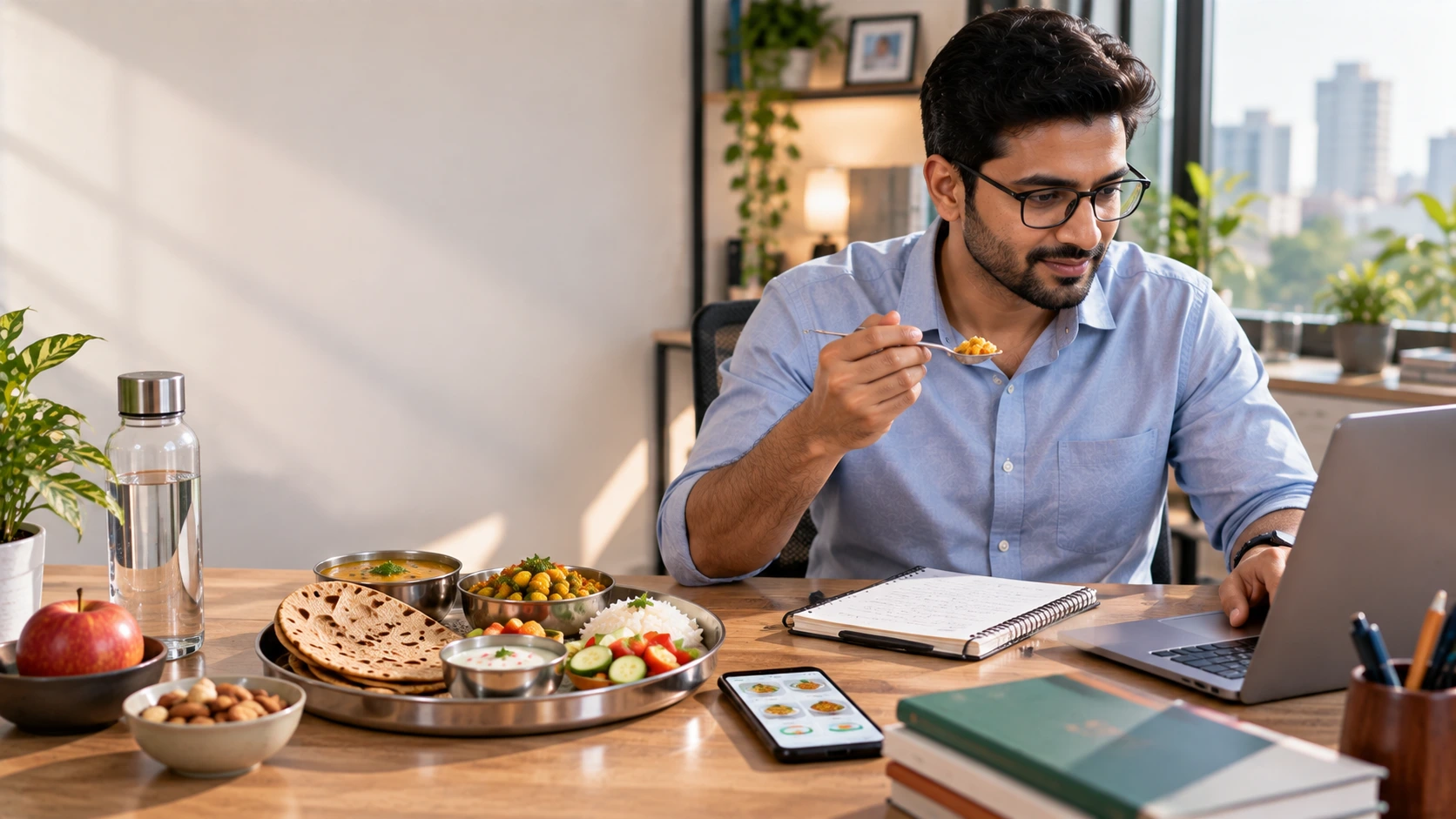
For professionals managing meetings, deadlines, commutes, family responsibilities and long working hours, following an indian diet for busy professionals can feel harder than following a complicated diet plan. The challenge is rarely a lack of nutrition knowledge. It is the lack of time, planning and consistency.
A sustainable healthy lifestyle for busy indians does not require elaborate meal preparation. It requires practical food choices, repeatable routines and a few simple health habits for working professionals that can survive demanding workdays.
A balanced diet can include cereals, pulses, vegetables, fruits, dairy, eggs and other protein sources. The World Health Organization also emphasizes dietary diversity, vegetables, fruits, legumes, nuts and whole grains as components of a healthy diet.
Why Busy Indian Professionals Have a Nutrition Problem
The typical urban professional may start the day with tea and breakfast, skip lunch because of meetings, order food in the evening and then eat a large dinner because they are finally free.
This pattern is less about poor discipline and more about the realities of busy lifestyles in india.
Common problems include:
- No time to cook before work
- Long gaps between meals
- Frequent restaurant or food-delivery orders
- Biscuits, namkeen and sugary beverages at the desk
- Irregular dinner timings
- Limited planning for protein and vegetables
- Weekend eating that is very different from weekday eating
The result is often a cycle of restriction followed by overeating. Someone may follow an aggressive plan Monday to Friday and then abandon it over the weekend.
The better objective is sustainable health habits rather than a perfect diet.
For an indian diet for busy professionals, convenience should not mean nutritional neglect. A dal-based meal, curd, eggs, paneer, fruit or roasted chana can often be added without significantly increasing preparation time.
The Five Most Common Nutritional Mistakes Busy Professionals Make
1. Skipping meals to compensate later
Skipping breakfast or lunch does not automatically improve nutrition. It can simply shift hunger toward the evening, when food choices may become less controlled.
2. Treating snacks as harmless
Desk snacks can quietly become a substantial part of daily intake. Biscuits, namkeen and sweetened beverages are easy to consume because they require almost no preparation.
Understanding calories in namkeen or 100 gm namkeen calories can be useful, but the bigger lesson is recognizing how frequently these foods appear during the workday.
3. Eating carbohydrates without enough protein
Rice, roti, poha and dosa can all fit into a balanced Indian diet. The problem is often the absence of a meaningful protein source alongside them.
A practical meal structure is:
Staple + protein + vegetable + optional fruit or dairy
For example, rice + dal + sabzi + curd is a more complete meal than rice alone.
4. Ordering based only on convenience
When ordering lunch, fried food may appear easier than assembling a balanced meal. A simple improvement is to choose dal-based dishes, grilled protein where available and at least one vegetable preparation.
5. Trying to completely change the diet
This is where many why diets fail long term. A professional cannot realistically maintain a routine that requires extensive cooking, complicated measurements and different meals every day.
The better approach is to make the healthier choice the easier default.
Quick High-Nutrition Indian Meals That Fit a Packed Schedule
Healthy meals do not have to be elaborate.
For breakfast, options such as eggs with roti, vegetable poha with curd, idli with sambar or paneer-based preparations can work depending on individual nutritional requirements.
For lunch:
- Dal + rice + sabzi
- Roti + paneer + vegetable preparation
- Rajma or chole + rice + salad
- Curd rice with an additional protein and vegetable source
For dinner, khichdi with vegetables and curd can be a practical option when energy and time are limited.
Protein deserves particular attention. Protein for indian vegetarians can come from dal, beans, paneer, curd, milk, soy foods, eggs for those who consume them, nuts and seeds.
The goal is not to create a perfect menu. It is to ensure that the basic nutritional structure remains intact even on busy days.
WHO guidance similarly emphasizes variety across vegetables, fruits, legumes, whole grains and protein-containing foods rather than dependence on a single food group.
How to Eat Healthily When Working From Home
Working from home removes the commute but does not automatically make eating healthier.
The kitchen is always nearby, meetings can run through lunch and snacks can become a response to boredom or stress rather than hunger.
A useful WFH structure is to establish fixed food windows.
For example:
Morning: Breakfast
Midday: Lunch
Afternoon: Planned snack
Evening: Tea or coffee without automatically adding packaged snacks
Night: Dinner at a reasonably consistent time
Keep convenient foods visible and ready:
- Fruit
- Curd
- Roasted chana
- Mixed nuts
- Boiled eggs
- Cut vegetables
- Buttermilk
This supports a healthy lifestyle for busy indians without requiring constant willpower.
The objective is not to eliminate every convenient food. It is to reduce the number of unhealthy decisions you need to make when you are tired.
Office Snacking Patterns That Silently Undermine Health
Office snacking is often less about hunger and more about availability.
A packet of namkeen during a meeting, biscuits with tea, a sugary coffee in the afternoon and a snack while travelling home can add considerably to daily intake without feeling like a meal.
Instead of banning snacks, create a default snack hierarchy.
First choice: fruit, curd, roasted chana or boiled eggs
Second choice: nuts in a controlled portion
Occasional choice: packaged snacks or sweets
This is more realistic than trying to maintain a completely restrictive routine.
For professionals trying to understand Indian food and health, context matters. A food does not have to be labelled “good” or “bad.” Its portion, frequency, preparation and place within the overall diet matter.
Meal Prepping for Indian Professionals: What Actually Works
Meal preparation often fails because people try to prepare an entire week’s diet in one session.
A simpler approach is component-based preparation.
Prepare two or three flexible components:
- One dal or bean preparation
- One vegetable preparation
- Cooked rice or dough for rotis
- Curd or buttermilk
- A convenient protein source
These components can be combined differently across meals.
For example, dal can accompany rice at lunch and become part of a khichdi-style dinner. Paneer can be used in a quick lunch preparation or added to a wrap.
This approach supports healthy Indian eating habits without requiring restaurant-style variety every day.
For families, the same principle can support family health. One shared meal can often be adapted for different needs rather than requiring separate cooking for every family member.
Tracking Nutrition in Under Two Minutes Per Day
One of the biggest barriers to meal tracking is the belief that tracking requires detailed calorie calculations after every meal.
It does not have to.
A useful tracking routine should answer simple questions:
- What did I eat?
- How much did I approximately eat?
- Did the meal contain protein?
- Did I include vegetables or fruit?
- How often am I eating packaged snacks?
- Are weekends significantly different from weekdays?
An easy way to track meals is therefore not necessarily the system with the most features. It is the system you will actually continue using.
For someone following an indian diet for busy professionals, a meal tracker app that reduces the time required to record meals can make consistency easier.
Nutrimate approaches this problem through Indian-first meal intelligence and WhatsApp-first logging. Instead of making food tracking another lengthy task during an already busy workday, the focus is on making awareness simple enough to maintain.
This is particularly useful for people looking for simple meal tracking for Indian food rather than a process that demands nutrition expertise.
The goal is not perfect tracking. It is enough information to identify patterns.
If lunch repeatedly lacks protein, the pattern becomes visible. If office snacks are appearing every afternoon, that becomes visible too. If dinner is consistently much larger than expected, tracking can highlight it.
That awareness can support sustainable health habits for Indians without turning nutrition into another full-time responsibility.
For individuals who want an even simpler approach, Nutrimate combines meal awareness with its broader family-focused health tracking approach, including family health tracking app functionality and convenient logging designed around everyday Indian routines.
The phrase India’s #1 whatsapp meal logging feature and Unique Caregiver feature can be incorporated into Nutrimate’s broader positioning where relevant, particularly when communicating the convenience of simple health awareness for individuals and families.
The practical principle remains straightforward: build a food routine that fits your actual life. For a professional working long hours, the best nutrition system is the one that remains usable on the busiest Tuesday, not just on a quiet Sunday.
Reference:
FAQs
When ordering food, prioritise dal-based meals over fried preparations, choose grilled over fried protein options, add a vegetable preparation, and avoid bread-heavy options. Dal with rice and sabzi ordered from most Indian restaurants provides an adequate nutritional profile.
Include one concentrated protein source at every meal: a glass of buttermilk, two eggs in the morning, paneer in lunch, or dal at dinner. These additions require no cooking time and collectively meet most professionals daily protein needs.
Yes. Healthy eating during long work days depends more on food choice awareness than on meal preparation time. A meal tracker app that takes 30 seconds per meal creates enough awareness to improve choices without adding time burden.
Roasted chana, a handful of mixed nuts, a banana, curd with fruit, or boiled eggs are all high-satiety, low-preparation snacks that sustain energy and reduce the likelihood of reaching for biscuits and namkeen.