 Pradnya Ganorkar
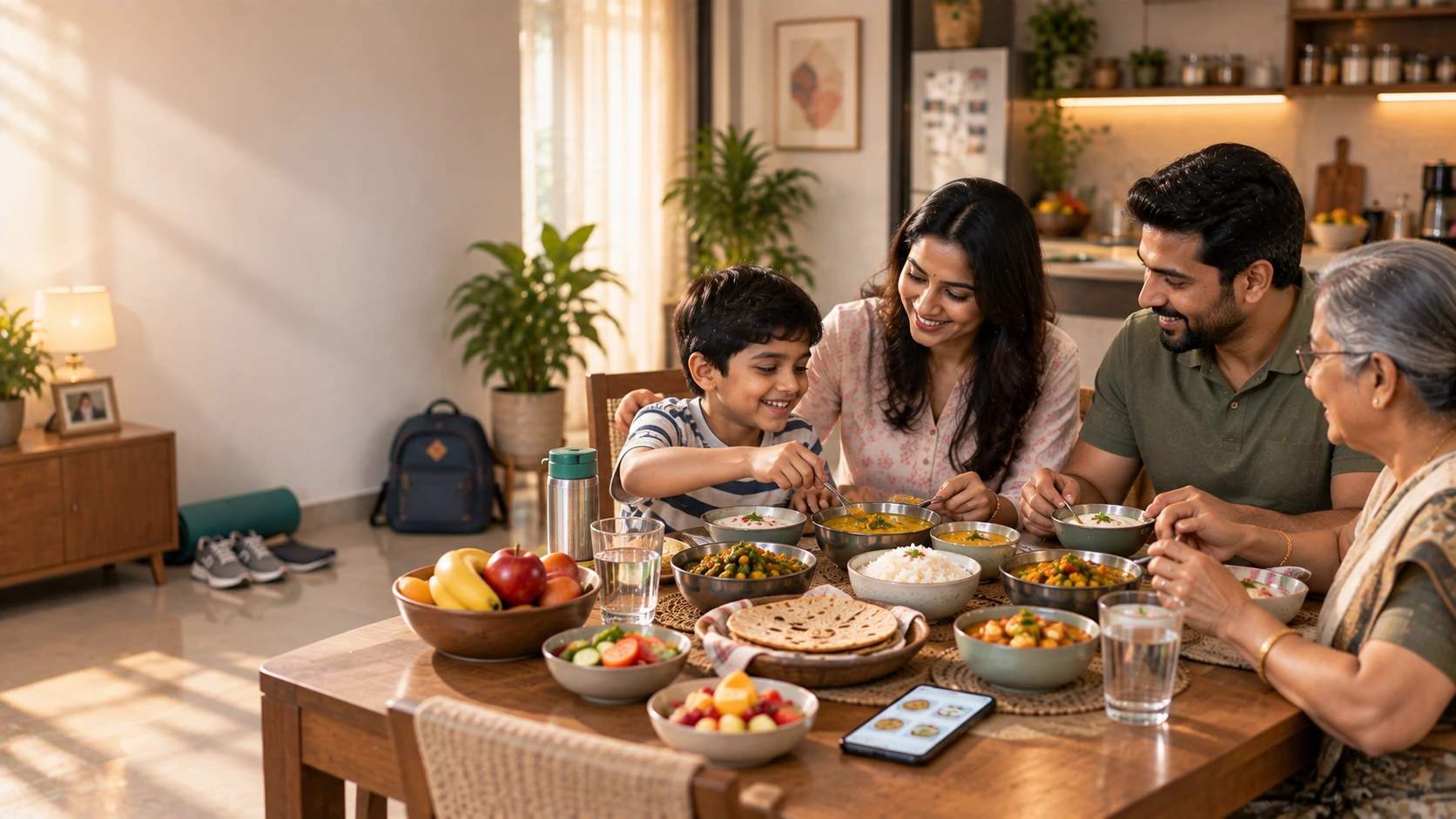
For many Indian families, achieving stress free living does not require a complicated wellness programme. The real challenge is making family health manageable alongside work, school, household responsibilities, commuting and changing schedules.
A sustainable healthy lifestyle is usually built through small routines that the family can repeat. WHO also identifies healthy eating, physical activity, adequate sleep and connection with others as important components of self-care. World Health Organization
The goal is therefore not to make every meal perfect or track every health metric. It is to create sustainable health habits that reduce daily decision-making and make healthier choices easier.
Why Indian Families Are More Stressed About Health Than Ever
Health decisions increasingly compete with the rest of family life.
A working parent may leave home early, manage meetings throughout the day, arrange school activities, care for ageing parents and still be expected to prepare or organise dinner. Children may have different food preferences, while grandparents may have specific dietary requirements.
This creates a common problem: everyone knows health matters, but nobody has enough mental bandwidth to manage it perfectly.
The result can be inconsistent eating, skipped activity, late dinners and dependence on packaged snacks during busy days. These patterns can make family health feel like another responsibility instead of something that supports the family.
A better approach is to reduce the number of decisions.
For example:
- Keep dal, curd and seasonal vegetables available as default meal components.
- Establish a regular family walking routine.
- Keep packaged snacks as occasional options rather than everyday defaults.
- Eat at least one meal together when schedules allow.
- Use simple health habits that everyone understands.
Physical activity does not have to mean formal gym sessions. WHO recommends that adults accumulate at least 150 minutes of moderate physical activity per week, while also emphasising that some activity is better than none. World Health Organization
For an Indian family, that could include walking after dinner, cycling, active household work or planned exercise.
The Paradox of Health Information Overload
The modern Indian family has access to more health information than ever.
There are diet plans, fitness influencers, calorie calculators, supplement recommendations, fasting protocols and thousands of opinions about Indian food.
The problem is not lack of information. It is knowing what deserves attention.
One week, carbohydrates may be presented as the problem. The next, a particular supplement may be promoted as essential. This constant stream of information can make healthy eating unnecessarily complicated.
A useful family health filter is:
Does this recommendation make our everyday routine easier to sustain?
If a plan requires separate meals for every family member, complicated preparation or constant measurement, it may become difficult to maintain.
Instead, focus on fundamentals:
- Regular meals.
- Adequate protein.
- Vegetables and fruits.
- Appropriate portions.
- Regular movement.
- Consistent sleep.
- Time for family connection.
WHO describes a healthy diet through the principles of adequacy, balance, moderation and diversity. The exact food pattern can vary according to culture, availability and dietary customs. World Health Organization
That flexibility matters in India because a healthy household can include idli, poha, dal, roti, rice, sabzi, curd, eggs, paneer and many regional foods.
Simplifying Family Health to Five Daily Habits
The most practical sustainable health habits for Indians are often simple enough to repeat without much planning.
1. Build one balanced family meal
A regular meal containing a protein source, vegetables and a familiar carbohydrate can create a dependable nutritional foundation.
Dal with rice and vegetables, roti with paneer or sabzi and curd, or khichdi with vegetables are examples of meals that can fit naturally into an Indian household.
2. Create a shared movement habit
A 20-minute family walk after dinner can be easier to maintain than an ambitious exercise programme.
The objective is consistency, not intensity.
3. Make healthier food the default
If fruit, curd, nuts or homemade snacks are easily available, they require less decision-making than ordering something during a busy evening.
This is particularly useful for busy lifestyles in India, where convenience often determines what gets eaten.
4. Protect sleep routines
Late-night work, screens and irregular schedules can make family routines unpredictable.
A consistent bedtime, especially for children, can be more useful than trying to compensate for poor sleep with another health intervention.
5. Track only what creates useful awareness
Tracking should answer practical questions.
Are meals becoming more consistent? Are vegetables appearing regularly? Is protein being included? Is the family moving enough?
A family health tracking app can be useful when it reduces guesswork rather than creating another task.
How to Build a Healthy Morning Routine That Works for the Whole Family
Morning routines often fail because they are too ambitious.
A family does not need a 10-step wellness routine before leaving for school and work.
A practical routine could look like:
Wake up → hydrate → normal breakfast → prepare for the day → short movement where possible.
Breakfast does not need to be complicated. Options such as poha with a protein source, idli with sambar, eggs with roti, vegetable upma or a familiar homemade meal can work within different household preferences.
The important principle is creating a predictable start to the day.
For working adults, this supports a healthy lifestyle for busy Indians because fewer morning decisions mean less friction.
For children, predictable routines can also make meals and school preparation easier.
The same principle applies to health tracking for parents. If tracking becomes part of an existing routine instead of an additional activity, consistency becomes easier.
Managing the Evening: The Most Important Health Window for Indian Families
Evenings often determine whether a family maintains its health routine.
After work and school, energy levels are lower. This is when ordering food, skipping activity or relying on packaged snacks can become the easiest option.
A simple evening system can help.
Before dinner
Use a short walk, household activity or another shared movement routine.
During dinner
Prioritise a regular home-cooked meal where practical. Include a protein source and vegetables alongside familiar Indian staples.
After dinner
Avoid turning the evening into another productivity session. Give the family time to talk, relax and prepare for sleep.
WHO notes that maintaining daily routines, regular meals, physical activity, adequate sleep and social connection can support stress management. World Health Organization
This is why stress management India family strategies do not always need to be complicated. Sometimes the most useful intervention is simply having a predictable evening.
Weekends as Reset Days Rather Than Indulgence Days
Weekends do not need to become either strict diet days or unrestricted indulgence days.
The better approach is to use weekends to restore routine.
For example:
- Prepare basic ingredients for the coming week.
- Shop for vegetables, fruits and protein sources.
- Take a family walk.
- Cook one meal together.
- Review what worked during the week.
- Allow room for social meals without treating them as failure.
This approach supports healthy family habits without creating an all-or-nothing mindset.
The objective is not to compensate for every weekday choice. It is to make the following week easier.
For families managing Indian family wellness, this distinction matters because celebrations, restaurant meals and family gatherings are normal parts of life.
A sustainable routine needs enough flexibility to accommodate them.
When Good Enough Health Tracking Is Better Than Perfect Tracking
Perfect tracking sounds useful but can become difficult to maintain.
A parent may not have time to weigh every ingredient. A child may eat a school lunch that cannot be measured. A working professional may have an unplanned dinner.
That does not make tracking useless.
The better question is whether tracking provides enough information to identify patterns.
Simple meal tracking can reveal:
- How often vegetables appear.
- Whether protein is regularly included.
- How frequently packaged snacks are consumed.
- Whether meals become irregular during stressful weeks.
- Whether family routines are becoming more consistent.
This is where technology should remain an enabler.
Nutrimate approaches health awareness through simple, WhatsApp-first logging designed around familiar Indian meals. Instead of turning family wellness into another complicated application workflow, the objective is to make everyday information easier to capture.
For households that want greater visibility across members, family health tracking app functionality can help create a shared picture without requiring everyone to become a nutrition expert.
The important principle is consistency over perfection.
A two-minute habit repeated regularly is often more useful than an elaborate tracking system used for three days.
The broader goal of stress free living is not to remove every health challenge from family life. It is to build simple systems that continue working when life becomes busy.
References
- World Health Organization, Self-care for health and well-being. WHO: Self-care for health and well-being
- World Health Organization, Healthy diet. WHO: Healthy diet
FAQs
Start with one habit for the whole family rather than a comprehensive system. A shared 20-minute evening walk or a daily family meal with more dal and fewer packaged snacks creates momentum without overwhelming anyone.
A regular family dinner that includes adequate protein, vegetables, and home-cooked preparation is the single most impactful family health habit. It addresses nutrition, connection, and routine simultaneously.
Build systems that operate on autopilot. Default healthy meals that require no decision-making, a standard activity that happens regardless of workload, and simple tracking that takes under two minutes reduce the cognitive burden during high-stress periods.
Yes. The most consistently healthy Indian families share a common characteristic: simple systems rather than complex programmes. They eat regular home-cooked meals, stay active in everyday ways, and sleep consistently, without pursuing perfection.