 Pradnya Ganorkar
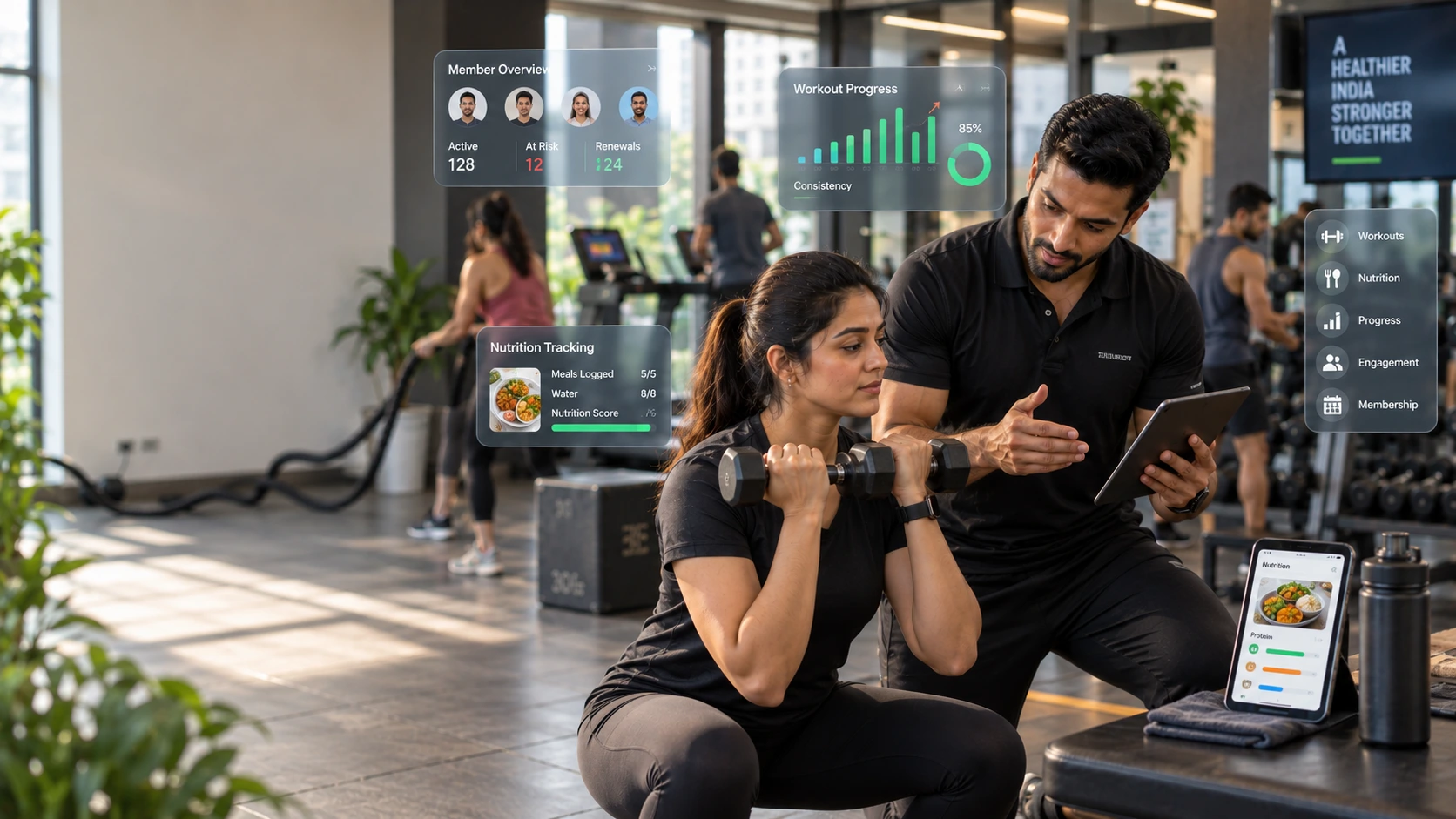
Choosing the best saas for gyms india is no longer simply about finding software that records memberships and payments. Indian gym owners increasingly need systems that connect operations, member communication, engagement, nutrition and retention in one workflow.
For a gym with 100 members, the technology decision may look straightforward. For a growing facility with multiple trainers, recurring memberships, WhatsApp communication and nutrition support, the wrong platform can create more work rather than less.
This guide explains what gym SaaS means, which capabilities matter most, how to compare gym management software india options, and what Indian gym owners should evaluate before committing to a platform.
Why Indian Gyms Are Moving to SaaS
SaaS means Software as a Service. Instead of purchasing software once and installing it on a local computer, a gym subscribes to a cloud-based platform that is maintained and updated by the provider.
For gym owners, the practical difference is significant. Staff can access the system from supported devices, information can be centralised, and new capabilities can be introduced without rebuilding the entire operational setup.
The shift also reflects a broader move toward digital fitness in India. Digital fitness platforms are increasingly being used for activity tracking, personalised support and engagement, while smartphone-based wellness is making fitness less dependent on physical gym attendance alone.
For an Indian gym, SaaS can address several everyday problems:
- Membership information scattered across spreadsheets and WhatsApp
- Missed renewal follow-ups
- Trainers maintaining separate client records
- Limited visibility into member engagement
- Manual progress reporting
- Difficulty maintaining nutrition accountability
- Communication that depends entirely on individual trainers
- No central view of which members may be disengaging
The objective should not be “more technology.” It should be less operational friction.
A good SaaS platform should help the owner answer three questions quickly:
- Who is active?
- Who needs attention?
- What can the team do next?
That is where gym software india becomes a strategic decision rather than merely an administrative purchase.
What SaaS Means for Gym Operations
A useful way to evaluate SaaS is to think of it as the operating layer connecting the gym’s people, members and information.
| Gym requirement | Traditional approach | SaaS approach |
| Membership | Spreadsheet or register | Central member database |
| Renewals | Manual calls | Automated workflows and reminders |
| Trainer management | Individual records | Trainer dashboards |
| Member engagement | WhatsApp messages | Structured engagement |
| Nutrition | Separate tools or paper plans | Integrated tracking |
| Progress | Manual reporting | Digital progress reports |
| Analytics | Limited visibility | Central performance data |
| Branding | Gym website/social pages | Potential branded member experience |
The strongest fitness management platform india options should therefore support both operational efficiency and member experience.
This distinction matters because a gym does not grow simply by collecting memberships. It grows when members stay engaged, trainers can coach efficiently, and the business can consistently demonstrate value.
A cloud platform can also reduce duplicate data entry. The U.S. Small Business Administration recommends looking for business software that integrates with other systems, scales with the business and allows hands-on evaluation before making a long-term commitment.
For a small gym, this might mean replacing three spreadsheets. For a larger gym, it can mean creating one operating system across memberships, trainers, communication and engagement.
Key Features Every Gym SaaS Must Have
Not every feature deserves equal weight. A platform should be evaluated according to the problems it solves.
1. Membership and operational management
The foundation should include:
- Member profiles
- Membership plans
- Renewal tracking
- Attendance
- Trainer allocation
- Scheduling
- Payment information
- Basic reporting
If these fundamentals are unreliable, advanced features will not compensate.
2. Member engagement
Retention is not created at the point of renewal. It is influenced by the member’s experience throughout the membership period.
Look for gym member retention tools that help trainers and owners understand whether members are participating, progressing and interacting.
Useful capabilities can include:
- Engagement tracking
- Progress updates
- Challenges
- Leaderboards
- Reminders
- Member communication
- Goal tracking
3. Nutrition tracking
Nutrition is particularly important for Indian gyms because members often ask questions about foods that generic international databases may not represent well.
A platform offering nutrition tracking for gym members should make common Indian foods easy to identify and record.
This is where capabilities such as whatsapp nutrition, Indian food recognition and simple meal logging can reduce friction.
Members may not want to manually search for every serving of poha, idli, dal, roti or sabzi. They want practical accountability that fits their existing routine.
4. Trainer dashboards
A trainer needs a different view from the gym owner.
A useful personal trainer software solution should allow coaches to see relevant information about their clients without forcing them to maintain multiple systems.
A trainer nutrition tracking dashboard can bring together:
- Meal records
- Workout information
- Progress
- Goals
- Engagement
- Client notes
The value is not the dashboard itself. The value is helping trainers spend less time organising information and more time coaching.
5. White-label capability
As a gym grows, its digital identity becomes increasingly important.
A white label fitness app india solution can allow a business to provide members with a branded digital experience rather than directing them to a generic third-party environment.
This can support a broader shift from “local gym” to recognisable fitness brand.
6. Reporting and analytics
Data should lead to decisions.
A gym owner should be able to identify:
- Membership trends
- Attendance patterns
- Engagement
- Trainer activity
- Nutrition adherence
- Member progress
- Potential retention risks
More data is not automatically better. The best system converts data into something the team can act on.
The Indian Gym SaaS Market: What Is Available
The market now includes everything from basic membership management tools to broader fitness ecosystems.
That creates an important distinction when comparing the best fitness software india options.
Category 1: Basic gym management
These platforms typically focus on:
- Memberships
- Attendance
- Payments
- Renewals
They can be appropriate for smaller gyms that primarily need operational digitisation.
Category 2: Fitness management platforms
These go further by combining gym operations with trainer management, scheduling, communication and analytics.
They are better suited to businesses trying to create a more structured member experience.
Category 3: Engagement and coaching platforms
These focus heavily on the relationship between the trainer and member.
Features may include:
- Nutrition tracking
- Workout libraries
- Progress reporting
- Coaching dashboards
- Engagement tools
Category 4: Integrated fitness ecosystems
The most comprehensive platforms attempt to connect operations, coaching, nutrition, engagement and branding.
For a gym owner evaluating the best saas for gyms india, this category may offer greater long-term potential, but only if the additional capabilities are actually used.
The right choice depends on business maturity.
| Gym situation | Priority |
| New or small gym | Membership, payments, attendance |
| Growing single-location gym | Operations + engagement |
| Personal training-heavy gym | Trainer + client management |
| Premium fitness brand | Branding + coaching + analytics |
| Multi-location business | Centralised data + reporting |
| Coaching-led business | Nutrition + workouts + accountability |
One important consideration is Indian relevance. A system built primarily for another market may not reflect local payment behaviour, food habits, communication preferences or member expectations.
How to Evaluate Any Gym SaaS Before Signing
Do not begin with the feature list. Begin with the business problem.
Ask:
What currently takes too much staff time?
Where are members dropping out?
What information do trainers lack?
Which processes are still being managed manually?
What should the owner know every morning?
Then score each platform against those needs.
Gym SaaS evaluation checklist
| Evaluation area | Questions to ask |
| Operations | Does it simplify membership and attendance? |
| Member experience | Does it improve daily engagement? |
| Trainers | Can trainers manage clients efficiently? |
| Nutrition | Does it support Indian food and practical tracking? |
| Communication | Does it work with channels members already use? |
| Branding | Can the experience reflect the gym’s identity? |
| Analytics | Can owners identify trends and risks? |
| Integrations | Can it connect with existing systems? |
| Scalability | Can it support more members and locations? |
| Support | Is implementation assistance available? |
Compare workflow, not screenshots
Two platforms may both advertise “trainer dashboards.” That does not mean they solve the same problem.
Ask the vendor to demonstrate a real scenario:
A member joins the gym, gets assigned a trainer, receives a nutrition plan, logs meals, completes workouts, misses several sessions and approaches renewal.
Then ask the platform to show exactly what happens.
This reveals much more than a feature presentation.
A free trial or demonstration is especially valuable because the practical usability of software can differ considerably from its marketing claims.
Total Cost of Ownership: What Hidden Costs to Watch
The monthly subscription is only one component of the cost.
A gym should evaluate total cost of ownership across:
- Subscription
- Setup
- Data migration
- Staff training
- Payment processing
- Additional users
- Additional locations
- Branded app charges
- Integrations
- Support
- Customisation
For example, a platform costing less initially may require staff to manually export reports, update multiple systems or maintain separate nutrition tools.
A slightly higher subscription can sometimes create better economics if it removes several manual processes.
The question is therefore not:
“Which platform is cheapest?”
It is:
“Which platform delivers the required operational value with the least unnecessary complexity?”
The pricing ranges provided in this buyer brief illustrate the broad difference between entry-level and enterprise-style solutions. Entry-level gym SaaS can start around Rs. 3,000 to Rs. 8,000 per month, while enterprise platforms with broader capabilities and white-label apps can reach Rs. 20,000 to Rs. 50,000 per month.
These figures should be treated as indicative ranges rather than universal market prices. Actual pricing depends on members, modules, users, locations, branding and vendor terms.
Implementation and Support: The Difference Maker
Even the best gym software in india can fail if the team does not adopt it.
Implementation should therefore be treated as a business change project.
Phase 1: Map current workflows
Document how the gym currently handles:
- New memberships
- Renewals
- Attendance
- Trainer assignments
- Member communication
- Nutrition
- Progress reports
Phase 2: Remove unnecessary complexity
Do not digitise every existing process simply because it exists.
Ask whether each workflow actually needs to continue.
Phase 3: Train the team
Trainers should understand only the workflows relevant to them.
Owners need a different level of visibility.
Front-desk staff need operational clarity.
Phase 4: Introduce member-facing features
Once the internal process is stable, introduce member tools gradually.
This can include:
- App access
- Nutrition tracking
- Workout plans
- Progress reports
- Challenges
- Communication
Phase 5: Review adoption
After implementation, monitor whether the software is actually being used.
Track:
- Active trainers
- Active members
- Meal logging
- Workout completion
- Engagement
- Renewals
- Report usage
A platform should not become another dashboard that nobody checks.
Where FitVia fits
FitVia by Nutrimate is an example of the Indian gym SaaS approach described above. It combines a white-label member app, trainer dashboards, WhatsApp nutrition tracking, Health Score, member engagement tools, an Indian food database, workout resources, meal planning, progress reporting and analytics.
For gym owners, trainers, influencers and dietitians, the broader value is connecting coaching and member engagement rather than treating gym management, workouts and nutrition as completely separate activities.
This reflects the direction of India’s increasingly digital fitness ecosystem, where technology is being used not only for exercise tracking but also for personalisation, engagement and ongoing wellness support.
For a gym evaluating Best SAAS for Gyms India, the strongest choice is ultimately not the platform with the longest feature list. It is the one that fits the business model, member behaviour and growth stage.
A useful decision rule is simple:
Choose the system that removes the most important friction from your member journey without creating new operational complexity.
That is the difference between buying software and building a scalable fitness business.
References
- U.S. Small Business Administration: Checklist for Choosing Business Software
- India Brand Equity Foundation: How Fitness Apps Are Reshaping Health and Wellness Habits in India
FAQs
A gym SaaS is a cloud-based software subscription that manages all aspects of gym operations including membership, scheduling, trainer management, member engagement, and analytics from a single platform.
Pricing varies significantly. Entry-level platforms start at around Rs. 3,000 to 8,000 per month. Enterprise platforms with full feature sets including white-label apps can cost Rs. 20,000 to 50,000 per month.
An Indian gym management software india platform should include a validated Indian food database for nutrition tracking, white-label member app, trainer dashboards, member leaderboards, and local payment gateway integration.
Yes. Many platforms offer tiered pricing based on member count. A gym with under 200 members can typically access core SaaS features at an affordable monthly cost with clear ROI through improved retention.