 Pradnya Ganorkar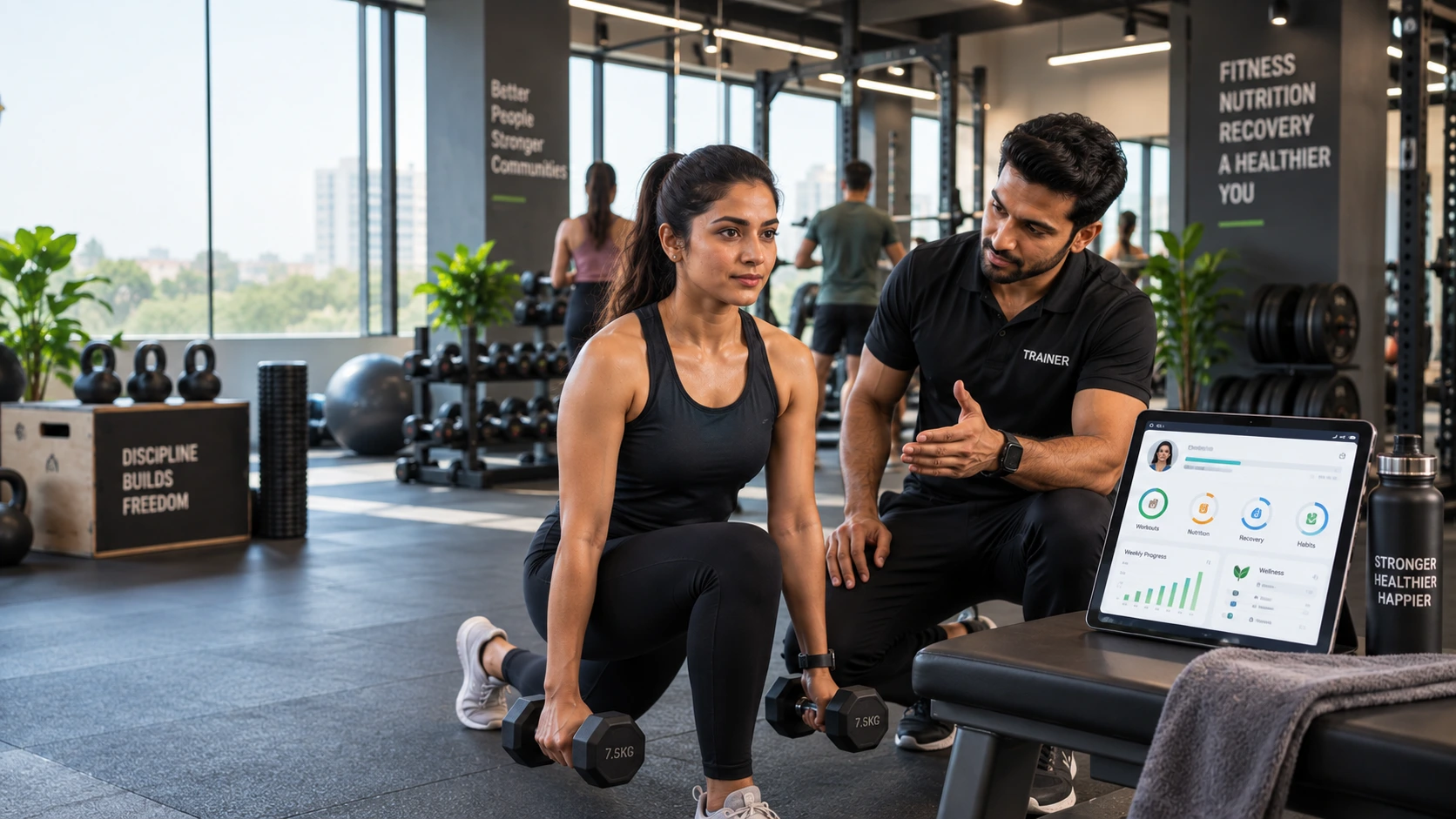
Personal training in India is moving beyond sets, reps and weekly workout plans. Clients increasingly want help with nutrition, consistency, recovery and everyday habits, making fitness coach client management software more relevant to the modern coaching business.
The shift is not about replacing trainers with technology. It is about giving trainers better visibility into what happens between sessions. A client may train three times a week but struggle with meals, sleep or consistency for the other 165 hours. The future of personal training will increasingly address that wider picture through health coaching, practical accountability and continuous support.
For Indian trainers managing multiple clients, the opportunity is to move from workout delivery to a more complete coaching relationship without creating more administrative work.
People searching for fitness coach client management software are often trying to understand how coaching businesses can scale without losing personal attention.
Trainers are asking:
- How can I manage more clients without spending hours on administration?
- How can I monitor nutrition between training sessions?
- Can technology improve client engagement?
- How can I personalise coaching without creating a separate system for every client?
- What role should AI play in modern coaching?
- Can a digital platform help improve retention and consistency?
The broader question is about evolution, not automation for its own sake.
A modern coaching system should help trainers spend less time collecting information and more time interpreting it, motivating clients and making better decisions.
Why Workout-Only Coaching Is No Longer Enough
A workout plan is important, but it represents only one part of a client’s health journey.
Consider a client who trains with a personal trainer every Monday, Wednesday and Friday. During those sessions, the trainer can correct form, adjust exercises and provide motivation.
But what happens on Tuesday?
If the client eats inconsistently, skips meals, struggles with nutrition tracking, sleeps poorly or loses motivation, the trainer may not know until the next session.
This creates a visibility gap.
The problem becomes more significant as trainers grow their businesses. Managing 5 clients manually may be manageable. Managing 30 or 50 clients through WhatsApp messages, spreadsheets and memory becomes increasingly difficult.
This is where personal trainer software can provide practical value.
A useful system can organise:
- Client profiles
- Workout programmes
- Attendance and progress
- Nutrition information
- Follow-ups
- Reports
- Engagement indicators
The objective is not to turn trainers into administrators.
It is to reduce administration so they can focus on coaching.
The shift also reflects a broader understanding of fitness. Clients are not only purchasing exercise instruction. They are looking for health habits, accountability and support that fit around Indian work schedules, family responsibilities and everyday food choices.
The Shift Toward Holistic Health Coaching
Holistic coaching means looking beyond exercise to understand the behaviours that influence a client’s results.
For an Indian professional trying to lose weight, the challenge may not be the workout itself.
It could be:
- Long office hours
- Irregular meals
- Frequent eating outside
- Low protein intake
- Weekend overeating
- Poor sleep
- Stress
- Lack of accountability
A trainer who understands these patterns can provide more useful guidance.
This does not mean a fitness trainer should diagnose medical conditions or replace qualified nutrition and healthcare professionals. It means the coaching relationship can become more informed.
For example, a trainer may notice that a client consistently misses meal logs on working days. Instead of immediately changing the workout plan, the trainer can ask what makes weekday tracking difficult.
The solution might simply be a faster logging method.
That is where client meal tracking for trainers becomes useful. It creates visibility without requiring the trainer to ask the same questions every day.
Similarly, a diet tracking tool for fitness coaches can help identify patterns that are worth discussing during a coaching session.
The goal is continuous care, not continuous surveillance.
The Role of AI in Supporting (Not Replacing) Trainers
The most useful application of AI in coaching is assistance.
AI can help process routine information, identify patterns and reduce repetitive tasks. It can support trainers by making client information easier to interpret.
It should not replace professional judgement.
For example, AI may identify that a client has consistently reduced workout attendance and meal logging. That information can prompt the trainer to start a conversation.
The trainer then determines what is actually happening.
Perhaps the client has changed jobs. Perhaps travel has increased. Perhaps the programme feels too difficult. Perhaps motivation has fallen.
The technology can identify the signal. The trainer provides the human response.
This distinction is especially important in nutrition.
A trainer nutrition tracking dashboard can help organise meal information and make trends visible, but personalised nutrition advice should remain appropriate to the trainer’s qualifications and the client’s needs.
The same principle applies across adjacent wellness businesses. Patient nutrition tracking, a patient diet tracking tool, and nutrition tracking for clinics require appropriate professional oversight, especially where medical conditions are involved.
Technology should support qualified professionals rather than encourage one-size-fits-all health advice.
Nutrimate’s broader ecosystem reflects this approach. Its B2B platform, FitVia, is designed for gym owners, fitness trainers, influencers and dietitians, bringing together trainer dashboards, WhatsApp nutrition tracking, Health Score, meal planning, progress reports, analytics and workout resources.
The value is not simply having more data. It is helping professionals turn relevant information into better conversations with clients.
What Clients Will Expect From Trainers in the Next Five Years
Client expectations are likely to move from isolated sessions toward connected coaching experiences.
1. More personalisation
Clients will increasingly expect programmes to reflect their goals, schedules and actual progress.
A generic workout PDF is unlikely to feel sufficient when clients can access personalised digital services in other areas of their lives.
2. Nutrition support
Exercise and food are closely connected to many fitness goals.
Clients may expect easier whatsapp nutrition, meal logging and practical guidance around everyday Indian food.
This is particularly relevant for people who do not want complicated calorie calculations but still want to understand their eating patterns.
3. Progress visibility
Clients want to know whether their effort is producing meaningful progress.
A health score can potentially combine relevant behavioural indicators into a simple progress view, provided the underlying measures are transparent and appropriately interpreted.
4. Faster communication
Clients increasingly expect convenient digital communication.
For trainers, this creates an opportunity and a challenge. Being available does not mean answering every message manually.
Structured digital workflows can help maintain client engagement without making the trainer permanently tied to their phone.
5. Continuous accountability
The relationship between trainer and client will increasingly extend beyond the gym floor.
A client may need a reminder, progress check or simple nudge between sessions.
The best systems will support that continuity while keeping the trainer at the centre of the relationship.
Preparing Your Coaching Practice for This Shift
Trainers do not need to digitise everything at once.
Start with the areas creating the most friction.
Step 1: Identify repetitive work
List the tasks you perform every week:
- Attendance updates
- Progress reports
- Meal follow-ups
- Programme sharing
- Client reminders
- Data entry
Choose the tasks that consume time without requiring significant professional judgement.
Step 2: Create one source of client information
Scattered information makes coaching harder.
If workouts are in one place, meals in WhatsApp and progress data in spreadsheets, the trainer has to reconstruct the client’s story manually.
A connected system can make relevant information easier to access.
Step 3: Make nutrition tracking easier
Do not assume clients will maintain complicated food diaries.
For many Indian users, convenience determines consistency.
A simple nutrition tracking app or WhatsApp-based workflow can reduce the friction involved in recording everyday meals.
Step 4: Use data to start conversations
Do not treat metrics as final answers.
If attendance falls, ask why.
If nutrition logging declines, understand the barrier.
If progress stalls, review the complete context.
Technology should improve the quality of the trainer’s questions.
Step 5: Protect the human relationship
The most valuable parts of personal training remain human:
- Motivation
- Form correction
- Accountability
- Empathy
- Context
- Judgement
- Adaptation
Automation should create more time for these activities, not remove them.
A Future-Readiness Checklist
Trainers preparing for the next stage of the industry can ask:
Client management
- Can I manage all client information in one place?
- Can I monitor progress without maintaining multiple spreadsheets?
- Can I follow up consistently as my client base grows?
Nutrition
- Can clients record meals easily?
- Can I see relevant nutrition patterns?
- Is the system suitable for Indian food habits?
- Can I use client meal tracking for trainers without creating extra administrative work?
Coaching
- Can technology help me personalise programmes?
- Can I identify changes in engagement early?
- Does the platform give me information that improves coaching conversations?
Business growth
- Can I serve more clients without proportionally increasing administrative work?
- Can I improve retention through better engagement?
- Can I create a consistent digital experience for clients?
Professional boundaries
- Am I using technology to support, rather than replace, professional judgement?
- Are health and nutrition recommendations appropriate to my qualifications?
- Am I treating sensitive client information responsibly?
For trainers evaluating the best SAAS for fitness trainer india, Best Fitness Software For Fitness Trainers, or Best Coaching Platform, the strongest choice is unlikely to be the platform with the most features.
It is the one that removes the right friction.
The next generation of personal training will be defined less by how many workouts a trainer can prescribe and more by how effectively they can support clients between sessions.
AI can organise information. Automation can reduce repetitive work. Nutrition tracking can improve visibility.
But motivation, trust and professional judgement remain the trainer’s greatest assets.
That is what makes the transition toward complete health coaching an opportunity rather than a threat.
Reference:
- American College of Sports Medicine, 2025 Worldwide Fitness Trends: The report highlights technology-related developments such as wearable technology, mobile exercise applications and data-driven training as important trends shaping fitness. ACSM: Top Fitness Trends for 2025
- ICMR-NIN, Dietary Guidelines for Indians 2024: The guidelines provide an evidence-based Indian framework for balanced diets, food choices and healthy eating practices, supporting the broader shift toward contextually relevant nutrition guidance. ICMR-NIN: Dietary Guidelines for Indians 2024
FAQs
No. AI is more likely to support personal trainers than replace them. It can assist with administrative work, information organisation, nutrition tracking, progress reporting and identifying patterns. Trainers remain essential for motivation, exercise form, professional judgement, personal relationships and adapting coaching to individual circumstances.
Personal training is expanding from workout-focused services toward more complete health coaching. Clients increasingly expect support with nutrition, accountability, progress tracking and digital communication alongside exercise programming. Technology can help trainers deliver this broader service more efficiently.
Trainers should prepare for greater demand for personalised coaching, digital communication, nutrition support, progress visibility and continuous accountability. They should also become comfortable using fitness coach client management software, while maintaining strong professional judgement and human connection at the centre of coaching.
Read Nutrimate Wellness first on Google