 Pradnya Ganorkar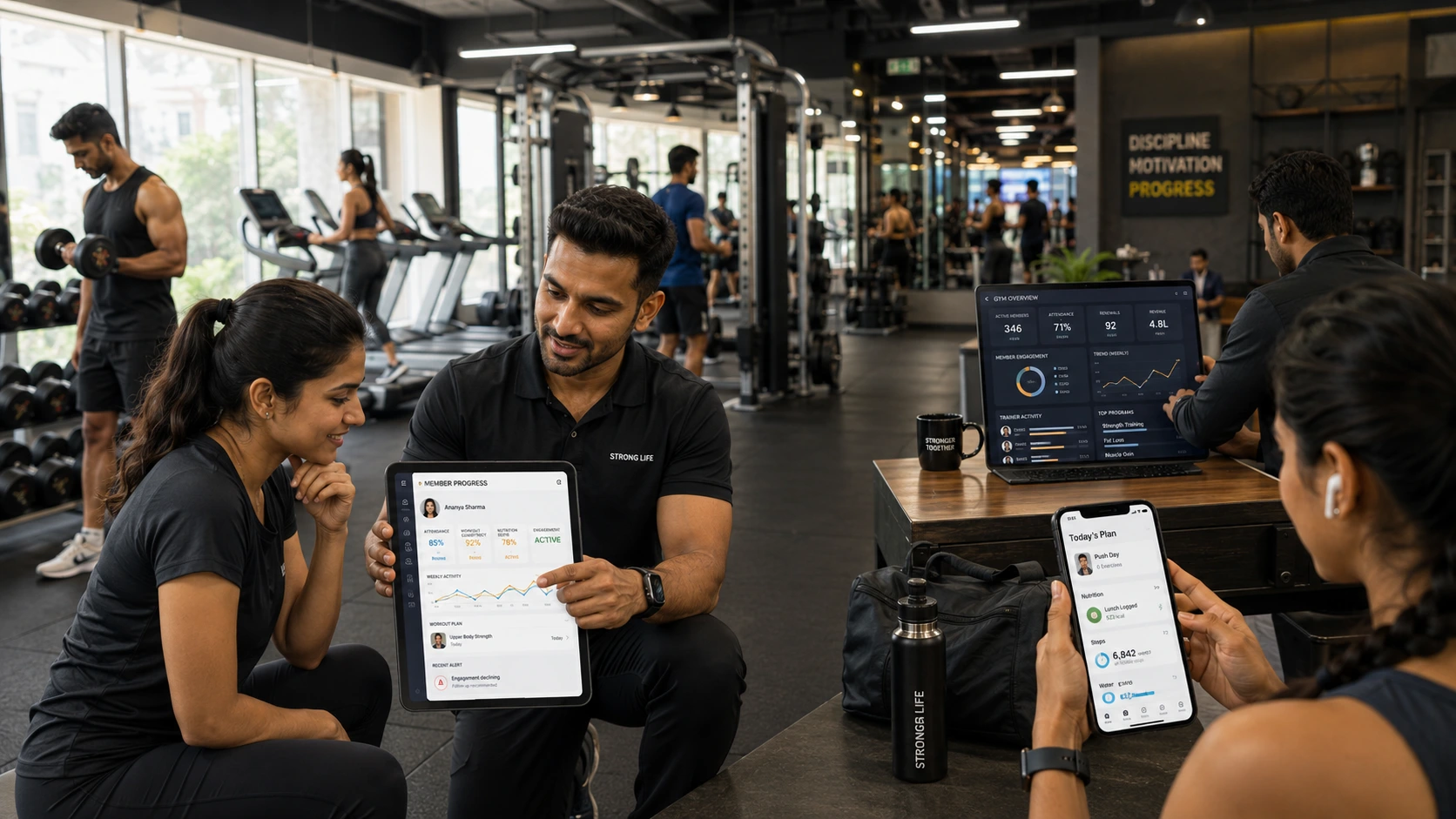
The Indian fitness industry is moving beyond treadmills, weights and membership cards. As members become more comfortable with digital services, gym owners are increasingly evaluating gym software india solutions that can simplify operations while improving member engagement.
The shift is not simply about adding AI to a gym. It is about removing everyday friction: missed follow-ups, manual attendance records, inconsistent nutrition tracking, poor communication and members quietly losing motivation.
A modern digital gym combines human coaching with better systems. The trainer still builds trust and understands the member. Technology handles repetitive work, organises information and makes it easier to act on what is happening.
That distinction will shape the next phase of fitness businesses in India.
People searching for gym management software india are increasingly trying to understand what a modern fitness business should look like, rather than simply looking for billing software.
Gym owners want to know how technology can help them:
- Reduce repetitive administrative work
- Improve member communication
- Increase retention
- Give trainers better visibility
- Support nutrition and workout adherence
- Build stronger digital relationships with members
- Make decisions using actual member data
The underlying question is simple: How can technology help a gym deliver a better experience without making the business more complicated?
That question becomes increasingly important as India’s fitness market expands. Deloitte and the Health & Fitness Association estimate that India’s fitness market could grow from approximately INR 16,200 crore in 2024 to INR 37,700 crore by 2030, with technology integration, hybrid fitness models and personalised services among the forces shaping the sector.
Why Fitness Businesses Are Under More Pressure to Modernise
Running a gym manually becomes harder as the member base grows.
A small gym with 50 members may manage attendance, renewals and trainer communication through registers, spreadsheets and WhatsApp conversations. At 500 members, the same approach can create missed follow-ups, scattered information and inconsistent service.
The problem is not that gym owners lack effort. It is that manual systems depend heavily on memory.
A member who stops attending for two weeks may not receive a timely check-in. A trainer may know that a client is struggling with nutrition but have no organised way to track the pattern. An owner may see membership numbers but lack a clear picture of engagement.
This is where gym member retention tools become important.
Retention is rarely solved by sending more promotional messages. Members are more likely to stay when they feel noticed, supported and able to see progress.
A stronger technology system can help businesses identify:
- Members whose attendance is declining
- Clients who are not following their programmes
- Nutrition adherence patterns
- Upcoming renewals
- Trainer workload
- Engagement trends
Technology therefore becomes an operational layer behind better human interaction.
From Manual Registers to Fully Digital Operations
The evolution of gym management can be viewed in three stages.
Stage 1: Administrative digitisation
The first step is replacing paper processes with digital records.
This includes:
- Membership records
- Attendance
- Billing
- Renewals
- Class schedules
- Basic member communication
An app for gym membership can make routine interactions easier for both members and staff.
Stage 2: Member engagement
The next step is connecting operational information with the member experience.
Instead of simply knowing that someone has a membership, the gym can understand whether that person is actually engaging.
This is where a fitness engagement platform becomes valuable.
Members may receive workout plans, progress updates, reminders or nutrition support without requiring the trainer to manually manage every interaction.
Stage 3: Intelligent decision support
The third stage uses data to identify patterns.
For example:
Attendance falling + nutrition adherence falling + no recent trainer interaction = member potentially at risk of disengagement.
The technology does not decide what the trainer should do. It makes the relevant information easier to see.
This is the practical future of fitness software: fewer administrative tasks and better visibility for people responsible for member outcomes.
The Role of AI in Member Engagement and Nutrition
AI in fitness should not be treated as a replacement for trainers.
Its strongest near-term role is assistance.
A trainer may have 40 clients but only a limited number of hours each day. Reviewing every meal, answering repetitive questions and manually preparing reports can consume time that could otherwise be spent coaching.
AI can help organise and interpret routine information.
For example, whatsapp nutrition can make meal logging more accessible for members who do not want to open another complicated application every time they eat.
This matters in India because food is highly varied. A member may eat poha for breakfast, dal-rice for lunch, roti and sabzi for dinner and snacks between meals. A useful nutrition tracking app needs to work with those everyday habits rather than forcing users into an unfamiliar system.
The same principle applies to trainers.
A trainer nutrition tracking dashboard can help a coach see whether a client is consistently logging meals, where adherence is falling and what conversations may need attention.
FitVia, Nutrimate Wellness’s B2B fitness platform, brings these capabilities together for gym owners, fitness trainers, influencers and dietitians through features such as trainer dashboards, whatsapp nutrition, Health Score, member engagement, meal planning, progress reports and a large Indian food database.
The goal is not to automate coaching. It is to give coaches better information so that human coaching becomes more focused.
What Members Will Expect From Gyms in the Next Five Years
Member expectations are changing alongside technology.
The future member may not see the gym as a place they visit for one hour. They may expect their fitness relationship to continue between visits.
Several expectations are likely to become increasingly important.
1. Convenience
Members already use smartphones for banking, shopping, communication and entertainment. Fitness experiences will increasingly be expected to fit naturally into the same digital lifestyle.
2. Personalisation
Generic workout sheets and identical diet plans are becoming less compelling.
Members want guidance that reflects their goals, schedule, fitness level and eating habits.
3. Visibility of progress
A simple health score or progress view can help members understand more than just their body weight.
Progress may include attendance, workouts completed, nutrition consistency and other relevant behavioural indicators.
4. Nutrition support
Exercise without sustainable nutrition can leave members frustrated.
Gyms that connect training with nutrition tracking can provide a more complete member experience, especially for people pursuing weight loss, muscle gain or general wellness.
5. Digital continuity
The relationship should not disappear when the member leaves the gym.
A branded member experience can extend support into everyday life through workouts, meal tracking, reminders and progress updates.
This is where my own branded fitness app becomes more than a branding exercise. The real value is creating a consistent digital touchpoint between the business, trainer and member.
Technology is already becoming a major part of fitness delivery globally. The American College of Sports Medicine’s 2025 fitness trends ranked wearable technology first, mobile exercise applications second and data-driven training technology seventh, showing how digital tools are increasingly integrated into fitness experiences.
Preparing Your Gym for a Digital-First Future
Going digital does not mean buying every new tool.
The better approach is to identify the biggest friction points in the current member journey.
Start with four questions.
Where does the team waste time?
If trainers repeatedly enter the same information, answer identical questions or manually prepare reports, automation may help.
Where do members lose engagement?
If people disappear after joining, look at what happens between registration and dropout.
Where is important information scattered?
If attendance sits in one system, nutrition in WhatsApp chats and progress reports in spreadsheets, decision-making becomes difficult.
What should remain human?
Motivation, judgement, relationship building, exercise correction and meaningful coaching should remain firmly connected to trained professionals.
A practical gym software india strategy should therefore combine automation with human accountability.
For example:
Technology: identifies declining engagement.
Trainer: contacts the member.
Technology: records the interaction and tracks future engagement.
Trainer: adjusts the programme based on the member’s situation.
That is a much more useful model than expecting software to coach everyone automatically.
For businesses looking at Best SAAS for Gyms India or Best Fitness Software India, the evaluation should therefore focus less on the longest feature list and more on whether the system connects operations, trainers, members and actionable information.
A Forward-Looking Readiness Checklist
Before investing in a digital fitness platform, gym owners can use this checklist:
Operations
- Are memberships, attendance and renewals digitally organised?
- Can staff access information without maintaining multiple spreadsheets?
- Can repetitive follow-ups be automated?
Member experience
- Can members access their workouts easily?
- Is communication simple?
- Can the gym maintain engagement outside physical visits?
Nutrition
- Can members log meals conveniently?
- Does the system work with Indian food?
- Can trainers monitor client meal tracking for trainers without creating unnecessary administrative work?
Trainer productivity
- Can trainers manage multiple clients efficiently?
- Is there a useful personal trainer software layer?
- Can trainers see progress without manually compiling information?
Retention
- Can the business identify declining engagement?
- Are there useful gym member retention tools?
- Can the team act before a member decides to leave?
Business intelligence
- Can owners understand engagement patterns?
- Are reports easy to interpret?
- Can data support better decisions rather than simply creating more dashboards?
Brand experience
- Does the platform allow the business to create a consistent member journey?
- Can it support a branded digital experience?
- Does it strengthen the gym’s relationship with members instead of sending them to disconnected tools?
The next generation of Indian fitness businesses will not necessarily be the gyms with the most technology. They will be the businesses that use technology to make coaching, communication and member experiences simpler.
A digital-first gym is ultimately still a people business.
AI can reduce repetitive work. Automation can improve consistency. Digital platforms can connect information. Nutrition tracking can extend support beyond the gym floor.
But trust, motivation and coaching remain human.
The opportunity is to build systems where technology handles more of the background work, allowing trainers and gym owners to spend more time doing the work members actually value.
Reference
- Deloitte India and Health & Fitness Association, India Fitness Market Report 2025: market growth, hybrid models, technology integration and personalised fitness experiences. Deloitte: India’s Emerging Fitness Economy
- American College of Sports Medicine, 2025 Worldwide Fitness Trends: wearable technology, mobile exercise apps and data-driven training technology among leading fitness trends. ACSM: Top Fitness Trends for 2025
FAQs
No. AI is more likely to assist gym trainers than replace them. It can help with administrative tasks, member data, routine nutrition tracking, progress reporting and identifying engagement patterns. Human trainers remain important for judgement, motivation, exercise technique, relationship building and adapting guidance to individual circumstances.
Technology is helping Indian fitness businesses move from manual administration toward connected member experiences. Gym management software india, mobile apps, nutrition tracking, automation, data-driven training and digital communication can improve operational efficiency while helping businesses maintain stronger member engagement.
Gyms should prepare for higher expectations around convenience, personalisation, digital communication, nutrition support, progress visibility and continuous engagement outside the physical gym. They should also build the ability to use member data responsibly while keeping human coaching at the centre of the experience.
Read Nutrimate Wellness first on Google