 Pradnya Ganorkar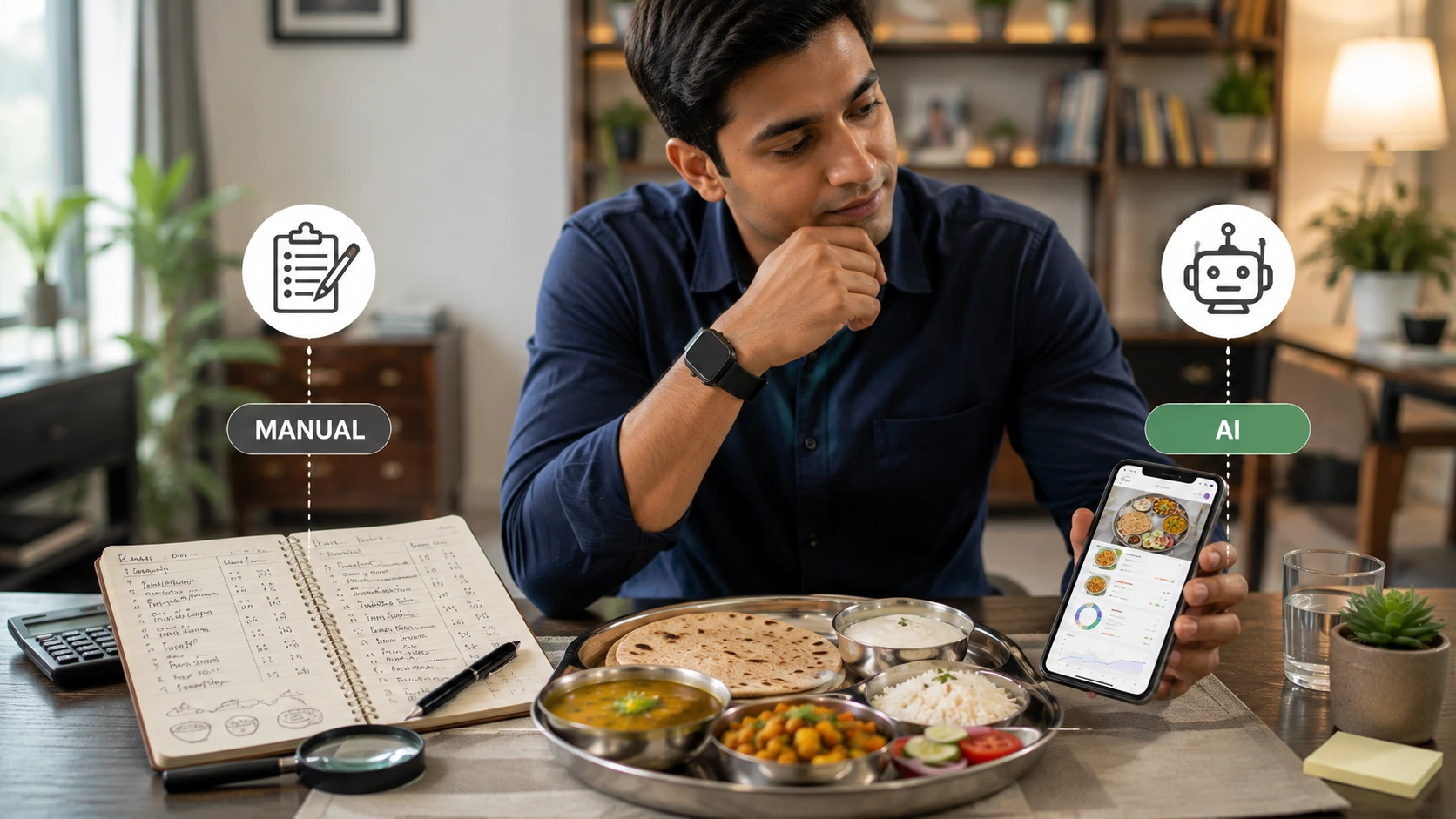
Choosing between a traditional food diary and an AI meal tracker is not really a question of which technology is more advanced. The more important question is which method a person can continue using when life becomes busy, meals become unpredictable and motivation drops.
For someone comparing a meal tracker app, the difference becomes particularly relevant in India. A typical day may include poha for breakfast, dal and roti for lunch, tea and namkeen in the evening, and rice, sabzi and curd at dinner. Recording every ingredient manually can provide useful nutrition awareness, but it can also become tiring.
An indian calorie counter app or photo-based system approaches the same problem differently. Instead of asking the user to describe every ingredient, it can reduce the effort involved in recording a meal.
Neither approach is automatically better for everyone. Manual logging can teach people how portions, ingredients and food composition work. AI-assisted logging can make tracking easier to maintain. The most useful method is the one that provides enough information to support better decisions without becoming another daily obligation.
This article helps consumers compare manual food diaries with AI-based meal logging before choosing a tracking method or meal tracker app.
The comparison is especially relevant for people who have previously started tracking their food but stopped after a few days or weeks. It also considers the needs of Indian consumers dealing with homemade meals, mixed dishes, regional foods and busy lifestyles in india.
The central question is simple:
Does the tracking method provide enough useful information while remaining easy enough to continue?
That question matters because consistency is one of the biggest challenges in any form of nutrition tracking. Research on dietary self-monitoring has repeatedly found an association between more consistent monitoring and better weight-management outcomes, although the evidence has limitations and does not establish that one specific tracking method works for everyone.
Why Most People Abandon Manual Food Diaries Within Weeks
Manual food diaries have an obvious strength: they make the person actively think about what they are eating.
But that same characteristic can become their biggest weakness.
Imagine someone beginning a weight-management routine on Monday.
Breakfast is two homemade rotis with sabzi. The person needs to identify the food, estimate the quantity, search for an appropriate entry and record it.
Lunch includes rice, dal, bhindi and curd. Again, several items need to be entered.
In the evening, there is tea and a handful of namkeen. The person now needs to estimate the quantity.
Dinner is a homemade mixed vegetable curry with two rotis.
The process is manageable for one day.
The problem appears on day 14.
Then day 30.
Then during a business trip.
Then during a family wedding.
This is where manual logging fatigue becomes important.
The hidden cost of detailed tracking
Manual tracking does not only require time. It requires repeated decisions.
The user has to decide:
- What food matches the meal?
- How much did I actually eat?
- Was the portion cooked or uncooked?
- Which database entry should I select?
- How should I record a mixed dish?
- What ingredients were used?
- How much oil was involved?
- Should I record the chutney, pickle or garnish?
For packaged foods, these questions can sometimes be easier because a label provides standardised information.
Homemade Indian meals are different.
A bowl of dal can vary considerably depending on preparation. A serving of sabzi can contain different quantities of vegetables and oil. A plate of poha can include peanuts, vegetables and different portion sizes.
This does not make manual tracking useless.
It simply means that the effort required can be higher than users initially expect.
Tracking can become an all-or-nothing activity
Another common problem is perfectionism.
Someone may believe that every meal needs to be recorded precisely for the tracking to be worthwhile.
If breakfast is missed, they may think:
“I have already broken the record, so I will start again tomorrow.”
That can turn one missed entry into several missed days.
A more sustainable mindset is:
An imperfect record is usually more useful than no record.
This is particularly relevant for sustainable health habits. A tracking system should help people return to the routine after a missed meal rather than making them feel that the entire process has failed.
Indian meals make the problem more obvious
The challenge is not that Indian food is inherently difficult to track.
The challenge is variety.
A household may eat idli in Chennai, poha in Pune, paratha in Delhi, dhokla in Ahmedabad, appam in Kerala or rice-based meals in many parts of the country.
Even within the same home, preparation changes from one day to another.
The ICMR-National Institute of Nutrition’s Dietary Guidelines for Indians emphasise variety across food groups and describe balanced meals in terms of vegetables, whole grains, pulses or beans, nuts or seeds, fruits and other foods.
That diversity is nutritionally valuable, but it also means a tracking system needs to work with real meals rather than assuming that people eat standardised packaged portions.
What Manual Tracking Does Well
It would be a mistake to treat manual food diaries as outdated or unnecessary.
They can be extremely useful.
For some people, the act of writing down food creates awareness that an automated system may not provide as strongly.
Manual tracking can improve nutrition literacy
Suppose a person records:
- Two rotis
- One katori dal
- One serving of sabzi
- Curd
- A banana
Over time, they begin to recognise patterns.
They may learn what a realistic portion looks like.
They may start noticing that their breakfast contains very little protein.
They may become curious about the protein in average indian meal.
They may discover that their evening snacking contributes more energy than they expected.
That learning can remain useful even after they stop tracking.
It encourages deliberate decisions
Manual tracking creates a small pause between eating and recording.
That pause can encourage questions such as:
“Am I actually hungry?”
“How much did I eat?”
“Was I eating because I was hungry or because the food was available?”
This can support mindful eating, although a food diary should not be treated as a psychological treatment or a substitute for professional guidance.
It can be valuable for specific goals
A detailed diary may be particularly useful when someone has been asked by a qualified professional to document specific dietary information.
For example, a dietitian may want a detailed record of:
- Meal timing
- Portion sizes
- Ingredients
- Snacks
- Beverages
- Preparation methods
- Symptoms or responses where clinically relevant
In those circumstances, the additional effort may be justified.
It teaches people to question assumptions
Manual tracking can also correct misconceptions.
Someone might search for 100 gm namkeen calories and discover that a large quantity of a snack can contribute substantially more energy than a casual handful feels like.
The useful lesson is not that namkeen must be eliminated.
It is that portion size matters.
Similarly, someone searching for protein for indian vegetarians may begin paying more attention to dal, beans, dairy, soy, paneer, nuts and other protein-containing foods.
The purpose of tracking is therefore not simply to create numbers.
It can create food literacy.
How AI-Based Logging Changes the Effort Required
AI-based meal logging changes the interaction.
Instead of asking the user to manually construct the meal record, the system attempts to interpret information supplied by the user.
One increasingly practical example is photo-based logging.
A person eats lunch, takes a photograph and submits it through the available tracking workflow.
The goal is not to make the photograph magically perfect.
The goal is to reduce the number of steps between eating and recording.
That difference matters.
From data entry to meal recognition
Traditional tracking often follows this sequence:
Eat → remember ingredients → search database → select foods → estimate portions → record
An AI-assisted workflow can aim for:
Eat → photograph or describe meal → review interpretation → record
The second process can be significantly less demanding.
The technology is therefore valuable not because “AI” sounds impressive, but because reducing friction can make a behaviour easier to repeat.
AI can help with mixed Indian meals
Consider a thali.
It may contain:
- Roti
- Rice
- Dal
- Sabzi
- Curd
- Salad
- Pickle
Manually recording every component takes effort.
An AI system can attempt to recognise multiple components and provide an estimated interpretation.
This is where mixed dish estimation becomes relevant.
A mixed vegetable curry is harder than identifying a packaged product because the visible appearance does not reveal every ingredient or quantity.
The same applies to dishes such as:
- Pav bhaji
- Biryani
- Khichdi
- Misal
- Upma
- Sambar
- Vegetable pulao
- Paneer-based gravies
AI can help reduce the entry burden, but users should understand that estimates remain estimates.
AI does not remove uncertainty
This is an important distinction.
If a photograph shows a bowl of dal, the system may recognise dal.
It cannot necessarily know exactly how much oil was used during cooking.
If it sees two rotis, it may estimate their size.
It cannot always determine their exact weight.
If it recognises a bowl of poha, it may identify the dish.
It may not know precisely how much peanuts or oil were included.
Therefore, the strongest use of AI meal logging is not false precision.
It is practical consistency.
The user gets a useful approximation without spending several minutes entering every ingredient.
Indian-first data matters
An AI system designed around Indian meals should be evaluated differently from one that primarily expects Western packaged foods.
An indian calorie counter app should ideally recognise the foods people actually eat.
This includes regional meals, homemade preparations and combinations that do not fit neatly into a single packaged-food database.
References such as IFCT 2017 can provide an Indian nutritional foundation for food composition, while recognition systems can add a practical layer for everyday logging.
The important distinction is between the underlying nutritional reference and the user’s real-world meal.
A database may tell us the nutrient composition of a food.
The tracking challenge is understanding what is actually on the user’s plate.
Comparison Table: Manual Diary vs AI Logging
| Factor | Manual Food Diary | AI Meal Logging |
| Initial learning | Usually higher | Usually lower |
| Manual effort | High | Lower |
| Nutrition education | Strong | Moderate |
| Portion awareness | Strong | Depends on estimation |
| Indian homemade meals | Can be detailed but time-consuming | Can reduce entry effort |
| Mixed dishes | Requires manual breakdown | AI can attempt recognition |
| Photo-based logging | Not applicable | Core use case |
| Speed | Slower | Generally faster |
| Accuracy | Depends heavily on user input | Depends on recognition and user confirmation |
| Precision | Can be very detailed | Usually estimation-based |
| Long-term convenience | Can decline with workload | Potentially easier to maintain |
| Best use | Learning and detailed records | Low-friction everyday tracking |
| Main weakness | Effort | Estimation uncertainty |
The comparison reveals an important point:
Manual tracking and AI logging solve different problems.
Manual tracking optimises for control and learning.
AI logging optimises for convenience and consistency.
The best choice depends on which of those is currently limiting the person.
When Manual Tracking Is Still the Better Choice
AI is not a universal replacement for manual tracking.
There are situations where a detailed diary may be preferable.
When nutrition education is the priority
Someone who has never thought about portion sizes or food composition may benefit from manually recording meals for a period.
The additional effort forces them to understand what they are eating.
For example, manually comparing calories in namkeen, fruit, nuts and other snacks can help someone understand how portion size changes the overall diet.
The objective is education, not fear of particular foods.
When exact ingredients matter
If a person needs highly detailed dietary documentation for a specific professional reason, manually recording ingredients and portions may provide information that an image cannot reliably determine.
In such situations, the person should follow the method recommended by their qualified healthcare or nutrition professional.
When the person enjoys journaling
Some people genuinely enjoy writing.
For them, a notebook can become part of their daily routine rather than an administrative burden.
There is no reason to replace a method that is already working.
When the user wants maximum control
A manual diary lets the user decide exactly what information is recorded.
This can be useful for people who want detailed information about:
- Ingredients
- Portion sizes
- Cooking methods
- Meal timing
- Snacks
- Beverages
- Hunger levels
The important thing is to ensure that detail remains useful rather than becoming obsessive or unsustainable.
When technology itself becomes a barrier
Not everyone wants to photograph every meal.
Some people may prefer a simple notebook.
Others may not want to use an app.
The easiest system is the one the person is comfortable using consistently.
Choosing the Right Method for Your Lifestyle
The best tracking method should match the reason you are tracking in the first place.
Choose manual tracking if you want to learn
If your biggest problem is:
“I don’t understand what is actually in my diet.”
A detailed diary can be a valuable learning tool.
Spend a few weeks recording meals carefully.
Look for patterns.
Notice portions.
Learn which foods contribute protein, fibre and other nutrients.
Pay attention to your own habits.
The goal is to eventually become more capable of making decisions without needing to record everything forever.
Choose AI logging if effort is your biggest problem
If your problem is:
“I know I should track my food, but I don’t have the time.”
A low-effort meal tracker app may make more sense.
This is especially relevant to simple health habits for working professionals.
A person travelling to work, attending meetings and managing family responsibilities may not realistically spend 10 minutes recording every meal.
A faster process has a better chance of fitting into that lifestyle.
Choose a combination if you want both learning and convenience
The two approaches do not need to compete.
A practical strategy could be:
Phase 1: Learn
Use detailed manual tracking for a limited period.
Understand portions, meal composition and recurring habits.
Phase 2: Simplify
Move toward easier tracking once you understand your patterns.
Phase 3: Maintain
Use low-effort logging to maintain awareness without making tracking the centre of your life.
This approach reflects an important principle:
Tracking should support a healthy lifestyle, not become the lifestyle.
Think about consistency before precision
Suppose Method A gives you a highly detailed record for four days before you stop.
Method B gives you a useful approximate record for six months.
For many everyday users, Method B may be more valuable.
This does not mean accuracy is unimportant.
It means accuracy must be considered alongside adherence.
A tracking system that requires too much effort may produce excellent information for a short period and almost no information afterwards.
Research reviews of dietary self-monitoring have found that both lower- and higher-intensity approaches can support weight-management interventions, while adherence varies considerably across methods.
Use tracking to identify patterns, not punish yourself
A food record should help answer questions such as:
- Am I eating enough protein?
- Are vegetables appearing regularly?
- Do I snack more when stressed?
- Are weekends very different from weekdays?
- Am I skipping breakfast because I am busy?
- Are portions larger when I eat outside?
- Am I maintaining a routine when travelling?
These questions are more actionable than simply asking:
“Did I hit the perfect calorie number today?”
This is especially important for healthy Indian eating habits.
Indian food does not need to be divided into a simplistic list of forbidden and permitted foods.
Roti, rice, dal, dosa, poha, idli, curd, vegetables, fruits, paneer and other familiar foods can all fit into varied eating patterns. The practical question is how they fit into the individual’s overall diet, portions, activity level and goals.
For people who have failed with tracking before
If you have repeatedly downloaded a best food tracking app, used it intensely for a week and then abandoned it, the problem may not be motivation.
The method itself may be too demanding.
Ask:
What caused me to stop last time?
Was it:
- Too much manual entry?
- Difficulty finding Indian foods?
- Confusing nutrition information?
- Portion estimation?
- Too many notifications?
- Feeling guilty after missing entries?
- Lack of visible progress?
- Simply not having enough time?
The answer should determine the next method you choose.
Nutrimate’s approach to lower-friction logging
Nutrimate approaches this problem through WhatsApp-first meal logging, where the goal is to make everyday food recording feel closer to a normal conversation than a detailed administrative task.
For someone who finds manual diaries difficult to maintain, a photo or simple meal interaction can reduce the number of steps involved in recording food.
The value is not that AI eliminates uncertainty.
The value is that it can make tracking easier to repeat.
That aligns with a broader food tracking without calorie counting approach, where the initial objective is to create meal awareness and consistency rather than forcing every user into detailed calorie calculations.
Nutrimate’s positioning around Indian food also matters because the usefulness of a tracking system depends heavily on whether it reflects the meals users actually eat.
The phrase India’s #1 whatsapp meal logging feature and Unique Caregiver feature should be treated as a product positioning statement rather than evidence that AI estimates are perfect. Users should still understand that food recognition and nutritional estimates have limitations.
A practical decision framework
Use this simple framework:
If your goal is learning:
Start with manual tracking.
If your goal is convenience:
Consider AI-assisted logging.
If your goal is professional dietary documentation:
Follow the recording method recommended by your doctor or registered dietitian.
If your goal is long-term awareness:
Prioritise the method you can realistically maintain.
If Indian food recognition is important:
Evaluate how well the platform handles homemade and mixed Indian meals.
If you have previously quit tracking:
Choose the method that directly removes the reason you stopped.
Ultimately, the most useful meal tracking system is not necessarily the one with the most detailed database or the most advanced technology.
It is the one that fits into real life.
A working professional should be able to record lunch without turning it into a 10-minute administrative task. A parent should not need to understand nutrition science before logging dinner. A gym member should be able to maintain awareness even when their routine changes.
Manual diaries remain valuable because they teach.
AI meal logging is valuable because it can simplify.
For many people, the strongest long-term approach may be to use each for what it does best: learn enough to understand your food, then simplify the tracking process so healthy habits remain practical.
Reference
- ICMR-NIN Dietary Guidelines for Indians 2024
- Systematic review of dietary self-monitoring and weight management, Cambridge University Press / PMC
FAQs
Not automatically. Manual diaries can be more detailed because users can enter ingredients, portions and preparation information directly. AI meal logging can reduce effort, but photo recognition and portion estimation involve uncertainty. The best system depends on the quality of the user’s information, the technology’s ability to interpret the meal and whether the user reviews or corrects the result when necessary.
People often stop because the process becomes too time-consuming, repetitive or difficult to maintain alongside work, travel, family responsibilities and changing meal routines. Indian homemade and mixed meals can add further complexity because users may need to estimate ingredients and portions manually. A simpler process can reduce this friction, although motivation and individual preferences also matter.
For many people, the easiest approach is a low-effort method that fits naturally into their routine. Photo-based or conversational AI meal tracker systems can reduce manual entry, while a simple notebook can work well for people who prefer writing. The best option is the one that can be used consistently without creating unnecessary stress or workload.
Read Nutrimate Wellness first on Google