 Pradnya Ganorkar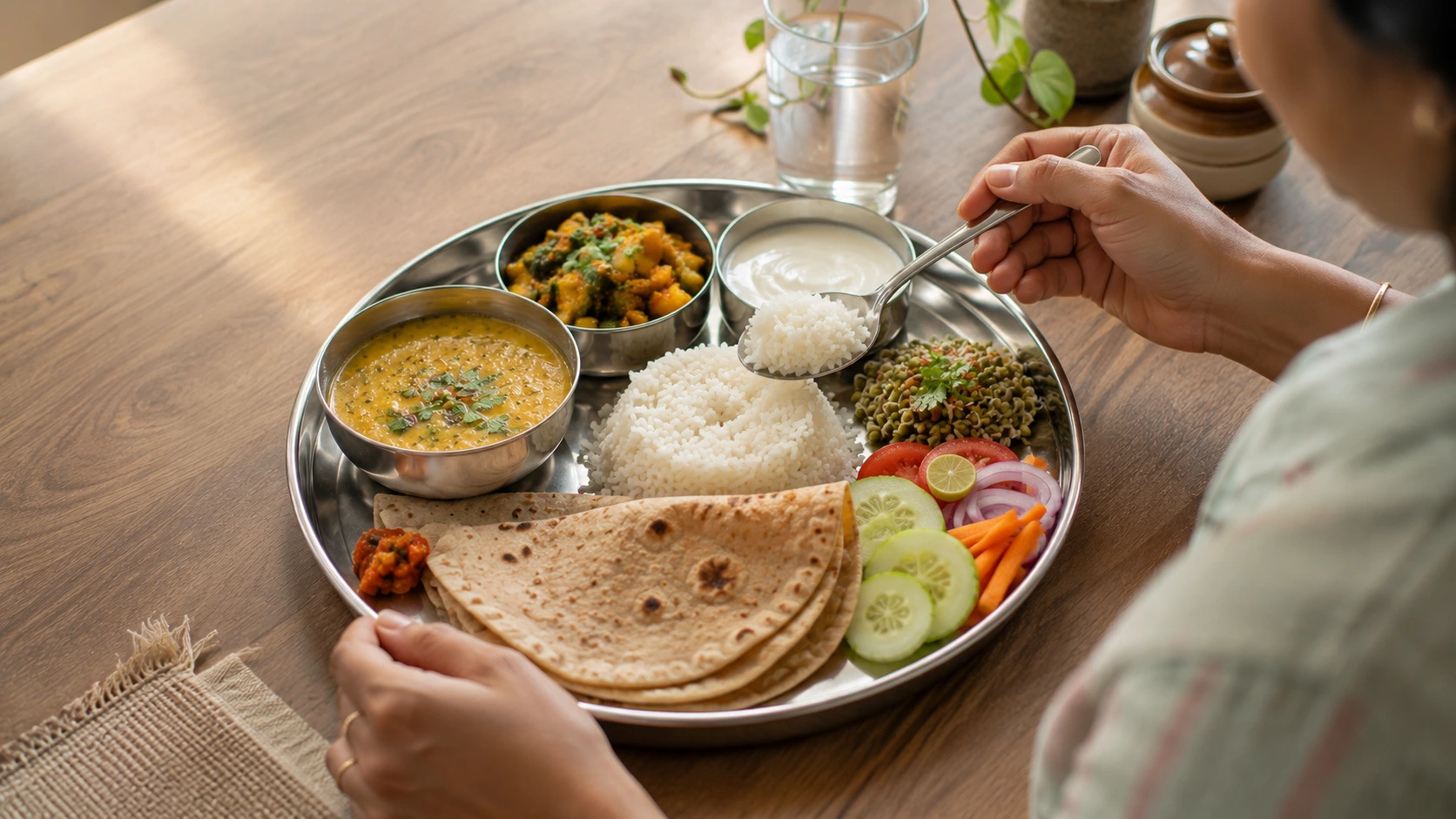
For many Indians trying to eat better, the first question is often: “Which food should I stop eating?”
Rice gets blamed. Roti gets blamed. Potatoes, dal, ghee and even mangoes can become targets.
But healthy Indian eating habits are not built around labelling individual foods as good or bad. The amount eaten, frequency, preparation method and overall meal composition matter too. This is especially relevant when thinking about Indian food and health, because traditional Indian meals often combine several foods in the same sitting.
The better question is often not “Can I eat rice?” but “How much rice fits into this meal, and what else is on my plate?”
Why ‘Good Food vs Bad Food’ Is the Wrong Question
Indian households rarely eat a single food in isolation.
A typical lunch may include rice, roti, dal, sabzi, curd, salad and perhaps a little pickle. Dinner may look similar. On weekends, snacks, sweets or restaurant meals can add another layer.
This makes food identity an incomplete way to assess a meal.
For example, rice itself is not automatically a problem. A large serving of rice accompanied by several other energy-dense foods is a different meal from a moderate serving paired with vegetables and a protein-rich food.
The same applies to roti.
The common roti rice weight gain myth oversimplifies a much bigger issue: total intake, portion size, meal composition and individual needs.
The ICMR-National Institute of Nutrition’s Dietary Guidelines for Indians place cereals and millets, pulses, vegetables, fruits, dairy, nuts and other food groups within an overall dietary pattern rather than treating one staple food as inherently off-limits.
A useful distinction is:
| Question | More useful way to think about it |
| “Is rice bad?” | How much rice am I eating and what accompanies it? |
| “Should I stop roti?” | Does my overall meal have a sensible balance? |
| “Can I eat dal?” | What role does it play in the meal? |
| “Should I avoid fats?” | How much oil or ghee is being used? |
| “Can I eat snacks?” | How frequently and in what quantity? |
This approach is more practical because it does not require eliminating familiar foods.
How Portion Size Quietly Drives Weight Gain
Portion size can be easy to underestimate because Indian meals are frequently served from shared dishes.
One extra spoon of rice may not feel significant.
A second roti may feel harmless.
Another serving of sabzi may not seem important.
A small handful of namkeen while watching television may not even feel like a meal.
But repeated additions can change total intake over a day.
This is particularly relevant for people following healthy eating habits while also managing busy schedules. When meals are eaten quickly or while distracted, hunger and fullness signals can be harder to notice.
Portion awareness does not mean weighing every ingredient.
It means becoming familiar with practical quantities.
For example:
- One katori of dal is easier to visualise than an exact gram measurement.
- Two rotis are easier to remember than calculating their weight.
- A standard plate provides a visual reference for the overall meal.
- Serving snacks into a bowl can create more awareness than eating directly from the packet.
The goal is not precision for its own sake. It is consistency.
Using the Katori and Plate as Practical Measurement Tools
Indian households already have useful measurement tools in the kitchen.
The katori is one of them.
Instead of trying to calculate every meal mathematically, use familiar household portions to create consistency.
For example:
Dal: Use one katori as a repeatable reference.
Rice: Serve a defined amount rather than repeatedly filling the plate.
Sabzi: Give vegetables meaningful space on the plate.
Curd: Use a consistent bowl or katori.
Namkeen: Put a planned amount into a small bowl instead of eating from the packet.
The plate itself can provide another visual guide.
A simple plate framework can look like this:
| Part of meal | Practical focus |
| Vegetables | Give them substantial space |
| Protein-rich foods | Include dal, beans, curd, paneer or another suitable option |
| Roti/rice/millet | Keep the portion appropriate to the meal |
| Fats | Use oil, ghee and other fats thoughtfully |
| Extras | Keep pickles, fried sides and sweets as intentional additions |
The Harvard Healthy Eating Plate similarly uses relative plate proportions rather than prescribing a fixed calorie amount, and specifically notes that individual energy and nutrient needs vary.
For Indian meals, the concept can be adapted rather than copied literally.
Common Portion Mistakes in Indian Households
1. Serving directly from the cooking vessel
When food stays in front of you, taking another serving becomes effortless.
A simple solution is to serve the intended amount first and keep the remaining food away from the immediate eating space.
2. Treating healthy food as unlimited
Even nutritious foods contribute energy.
Nuts, seeds, paneer, ghee and other nutrient-dense foods can be valuable parts of a meal, but portion awareness still matters.
3. Ignoring cooking methods
The same basic ingredient can appear in very different meals depending on how it is prepared.
A lightly cooked vegetable preparation and a heavily fried preparation should not be treated as nutritionally identical.
4. Forgetting beverages and snacks
Tea with sugar, biscuits, namkeen and small sweets can become regular additions without being recognised as part of overall intake.
This is one reason meal tracking can be useful. Tracking only breakfast, lunch and dinner may miss the foods that happen between them.
5. Eating because the food is available
Indian family meals often involve hospitality and sharing.
You may eat an additional serving because a parent insists, because guests have arrived or because sweets were brought home.
Awareness helps create a pause between availability and actual hunger.
A Simple Plate-Based Framework for Any Meal
A practical framework does not need complicated calculations.
Step 1: Start with vegetables
Ask whether the meal contains enough vegetables or another nutrient-rich plant food.
Step 2: Add a protein source
Depending on the household’s preferences, this could include dal, beans, curd, paneer or other suitable foods.
This is particularly useful for people trying to improve protein for indian vegetarians without abandoning familiar meals.
Step 3: Choose your staple portion
Roti, rice and millets can all fit into an Indian meal.
Rather than automatically eliminating them, consider the amount in relation to the rest of the plate.
Step 4: Check the extras
Look at oil, ghee, fried sides, sweets, sauces, pickles and snacks.
These may be perfectly compatible with a balanced eating pattern, but they are easy to underestimate when portions are not visible.
Step 5: Eat slowly enough to notice fullness
Portion control becomes easier when the meal is not rushed.
For a busy professional eating lunch between meetings, even a few minutes without a screen can improve awareness of how much has actually been eaten.
Technology can support this process without becoming the focus. An AI-based photo logging system can estimate a meal and its portions from an image, reducing the need to manually count every katori or ingredient. For an Indian meal, that can make tracking more practical than relying entirely on detailed food databases.
A Portion Awareness Checklist
Use this simple checklist during everyday meals:
- Am I serving a defined portion rather than eating directly from a shared dish?
- Does my meal contain vegetables?
- Have I included a suitable protein source?
- Is my roti, rice or millet portion appropriate for this meal?
- Have I considered oil, ghee and fried additions?
- Am I counting snacks and beverages as part of my overall eating pattern?
- Am I eating because I am hungry or simply because food is available?
- Can I use a katori or plate as a consistent visual reference?
- Am I making gradual changes rather than trying to eliminate familiar foods?
- Can I track a few typical meals to identify where portions regularly become larger?
The practical lesson is simple: healthy Indian eating habits do not require declaring rice, roti or other traditional foods off-limits.
Portion awareness creates room for familiar foods while making the overall meal more intentional. For many people, that is easier to sustain than a diet built around strict food rules.
FAQs
Rice itself does not automatically cause weight gain. The overall amount of food consumed, meal composition, preparation, activity and individual needs all matter. A moderate portion of rice can fit into a balanced Indian meal.
There is no single portion that works for everyone. A practical approach is to include vegetables, a suitable protein source and an appropriate portion of roti, rice or another staple, while being mindful of fats and calorie-dense extras.
The plate method is a visual approach to building a balanced meal by giving different food groups appropriate space on the plate. It is a guide rather than a rigid prescription, and portions should be adapted to individual needs.
Read Nutrimate Wellness first on Google