 Pradnya Ganorkar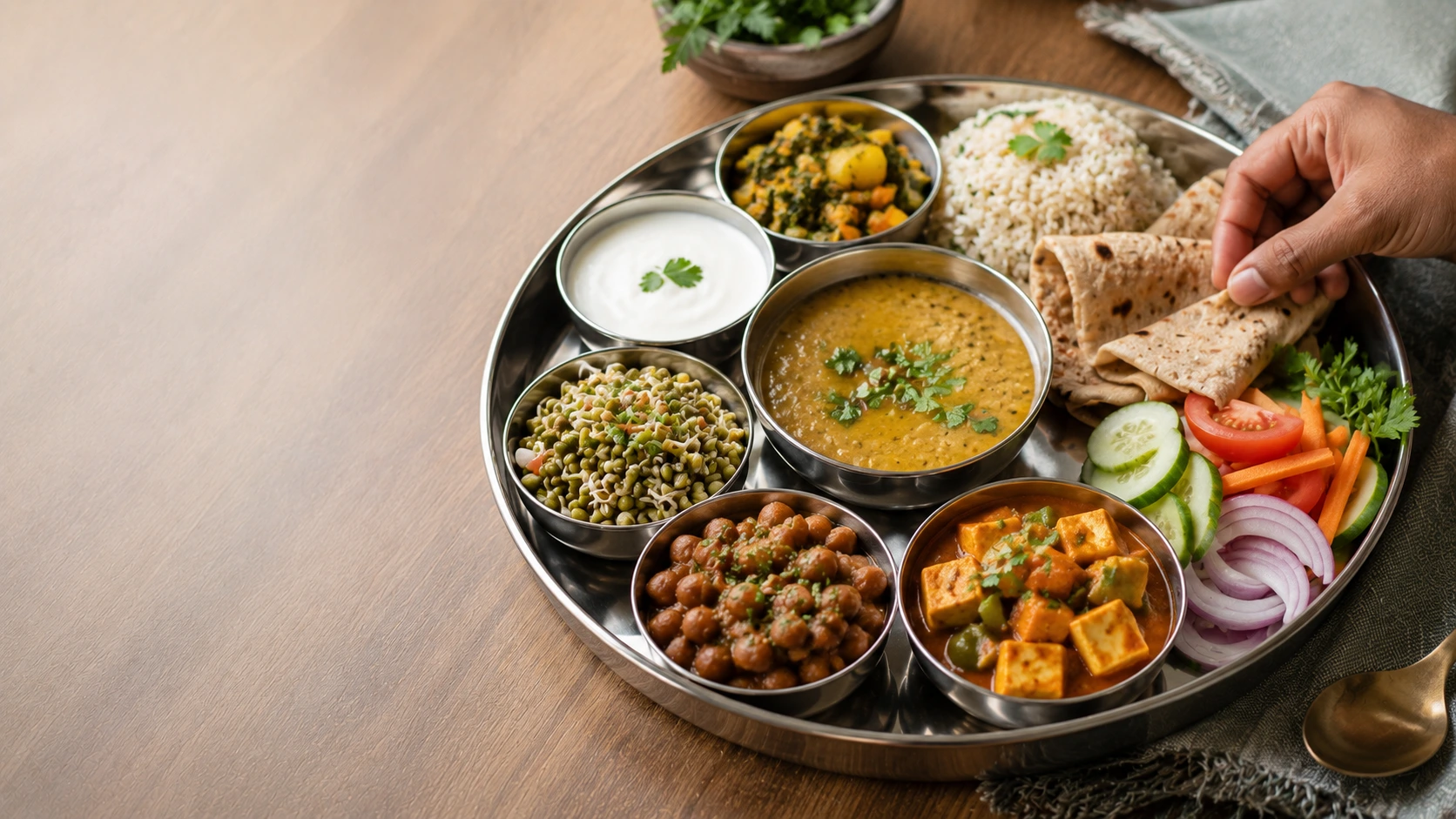
For many Indian vegetarians, getting enough protein can sound more complicated than it actually is. The solution does not require replacing familiar meals with protein shakes or imported “superfoods.”
A traditional thali can already provide a useful foundation. Dal, curd, paneer, sprouts, legumes and other familiar foods can be combined to create a more protein-focused meal.
For people looking at protein for indian vegetarians, the better question is not “What single food has the most protein?” It is “How can I build ordinary Indian meals so protein appears consistently throughout the day?”
The Indian Food Composition Tables 2017 provide nutrient information for hundreds of Indian foods and can be useful when evaluating the nutritional composition of familiar ingredients.
Why the Traditional Thali Is a Great Starting Point for Protein
The traditional thali already has an important advantage: variety.
A typical plate may include:
- Dal or another pulse preparation
- Roti or rice
- Sabzi
- Curd
- Salad
- Sometimes paneer, sprouts or another pulse-based preparation
The problem is that protein can become an afterthought.
A large serving of rice or several rotis may occupy most of the plate, while the dal is served in a relatively small bowl. A little curd may be added on the side, but there may not be another meaningful protein source.
This is one reason the protein in average indian meal can vary considerably depending on portions and food combinations.
A better approach is to build the thali around a clear protein anchor.
Think “add” before you think “remove”
Instead of removing familiar foods, start by asking:
What can I add to this meal to make it more protein-focused?
For example:
| Regular meal | Simple protein upgrade |
| Roti + sabzi | Add dal + curd |
| Rice + sambar | Increase the pulse portion |
| Roti + aloo sabzi | Add paneer or curd |
| Poha | Add sprouts or curd alongside |
| Khichdi | Add curd and a pulse-rich preparation |
| Vegetable pulao | Add dal, rajma or curd |
This makes healthy Indian eating habits easier to maintain because the meal still looks and feels familiar.
Small Swaps That Meaningfully Increase Protein
Small changes often work better than completely redesigning a diet.
1. Give dal a bigger role
Dal is one of the simplest ways to improve protein intake in an Indian vegetarian meal.
Instead of treating dal as a small side dish, make it one of the main components of the plate.
Moong dal, masoor dal, toor dal, chana dal and other pulses can all contribute protein while fitting naturally into Indian meals.
2. Add curd regularly
Curd is convenient because it requires little preparation and works with roti, rice, khichdi or a thali.
For households already consuming dairy, it can be an easy addition to meals.
3. Use paneer strategically
Paneer can make a vegetarian meal more protein-dense, although its overall calorie and fat contribution also matters.
The Indian Food Composition Tables list paneer at approximately 18.9 g protein per 100 g, illustrating why it can be a useful protein-containing food.
4. Add sprouts
Sprouts can work particularly well for breakfast, snacks or as part of a meal.
Try adding moong sprouts to:
- Chaat
- Salads
- Poha
- Upma
- Sandwiches
- Homemade wraps
5. Consider millets as part of a balanced meal
Millets can add variety and nutrients to an Indian diet. However, replacing rice or wheat with a millet does not automatically turn a meal into a high-protein meal.
The protein component still needs attention.
A Sample High-Protein Thali Breakdown
A practical high protein Indian meal does not need to look dramatically different from a traditional thali.
Consider this combination:
1. Dal: A generous serving of dal or another pulse-based preparation
2. Roti: One or two rotis depending on individual energy needs
3. Sabzi: A vegetable preparation
4. Paneer: A modest serving where appropriate
5. Curd: A bowl of curd
6. Salad: Cucumber, tomato, carrot or other available vegetables
The key is distribution.
Instead of expecting one food to supply all the protein, the meal brings together several contributing sources.
What about rice?
Rice does not need to be treated as the enemy.
The familiar roti rice weight gain myth often turns nutrition into a simple “good food versus bad food” discussion. In reality, the overall meal, portions, preparation, activity level and individual nutritional needs matter.
A vegetarian can include rice while still building a protein-conscious plate.
Budget-Friendly Protein Additions
Eating more protein does not automatically mean buying expensive products.
Some practical Indian options include:
| Food | Easy use |
| Dal | Main dish with lunch or dinner |
| Chana | Chaat, curry or salad |
| Rajma | Curry with rice or roti |
| Moong | Dal or sprouts |
| Curd | Side with lunch or dinner |
| Soya | Curry, bhurji or mixed preparations |
| Peanuts | Chutney or snack component |
| Paneer | Sabzi, bhurji or filling |
The most sustainable option is usually the one that fits the household budget, cooking habits and preferences.
For protein for indian vegetarians, consistency matters more than finding one perfect ingredient.
This is especially relevant for busy professionals. When meals become too complicated, adherence tends to fall. Familiar ingredients reduce the friction between knowing what to eat and actually eating it.
Mistakes That Quietly Undo a High-Protein Plate
Even a meal containing several protein sources can become unbalanced if the overall structure is overlooked.
Mistake 1: Treating one ingredient as the solution
Adding a small amount of paneer to an otherwise low-protein meal does not automatically make the entire diet protein-rich.
Look at the day’s meals together.
Mistake 2: Increasing protein but ignoring portions
More protein does not mean unlimited portions.
The overall nutritional needs of the individual still matter, particularly for people managing weight, metabolic conditions or other health concerns.
Mistake 3: Confusing protein-rich foods with protein-only foods
A balanced meal also needs vegetables, appropriate carbohydrate sources, healthy fats and adequate micronutrients.
Mistake 4: Focusing on a perfect single day
One exceptionally high-protein meal is less useful than a pattern that can be repeated.
This is why sustainable health habits matter more than short-term dietary perfection.
Mistake 5: Not knowing what your meals actually contain
Indian meals are often mixed dishes. The amount of dal, paneer, curd or other ingredients can change from one household to another.
Tracking a few meals across a week can therefore be more informative than trying to estimate one “perfect” thali.
A simple meal tracking routine can reveal which meals are already protein-strong and which ones consistently need a small upgrade.
A Thali-Building Checklist
Before eating, use this simple checklist:
- Is there a clear protein source?
- Is dal, chana, rajma, soya, paneer, curd or another protein-containing food present?
- Is there a vegetable component?
- Is the carbohydrate portion appropriate for the individual?
- Can sprouts, curd or another familiar protein source be added easily?
- Is the meal realistic for the household to repeat?
- Am I looking at my overall day’s intake rather than one meal?
- Have I avoided making the meal unnecessarily restrictive?
For people trying to understand their real eating patterns, Nutrimate can make this process simpler by helping users track everyday Indian meals rather than relying entirely on memory or manual calculations.
The goal is not to turn every thali into a mathematical exercise. It is to build enough awareness to make small, repeatable improvements.
That is the practical foundation of healthy eating, particularly for Indian vegetarians who want more protein without abandoning the foods they already enjoy.
References
- ICMR-National Institute of Nutrition, Indian Food Composition Tables 2017
- ICMR-National Institute of Nutrition, Dietary Guidelines for Indians
FAQs
Start with a clear protein source such as dal, chana, rajma, soya, paneer, curd or sprouts. Rather than removing roti or rice, build the meal around a stronger protein component and include vegetables and appropriate portions of other foods.
Dal, chana, rajma, moong, sprouts, curd, soya and peanuts can be practical options. They can be incorporated into familiar Indian meals without requiring expensive specialty products.
Dal is an important protein source, but relying on only one food is not necessary. A varied vegetarian diet can combine pulses, dairy, soya, legumes, nuts and seeds across different meals. Individual protein requirements vary, so people with specific health or dietary needs should seek advice from a qualified professional.
Read Nutrimate Wellness first on Google