 Pradnya Ganorkar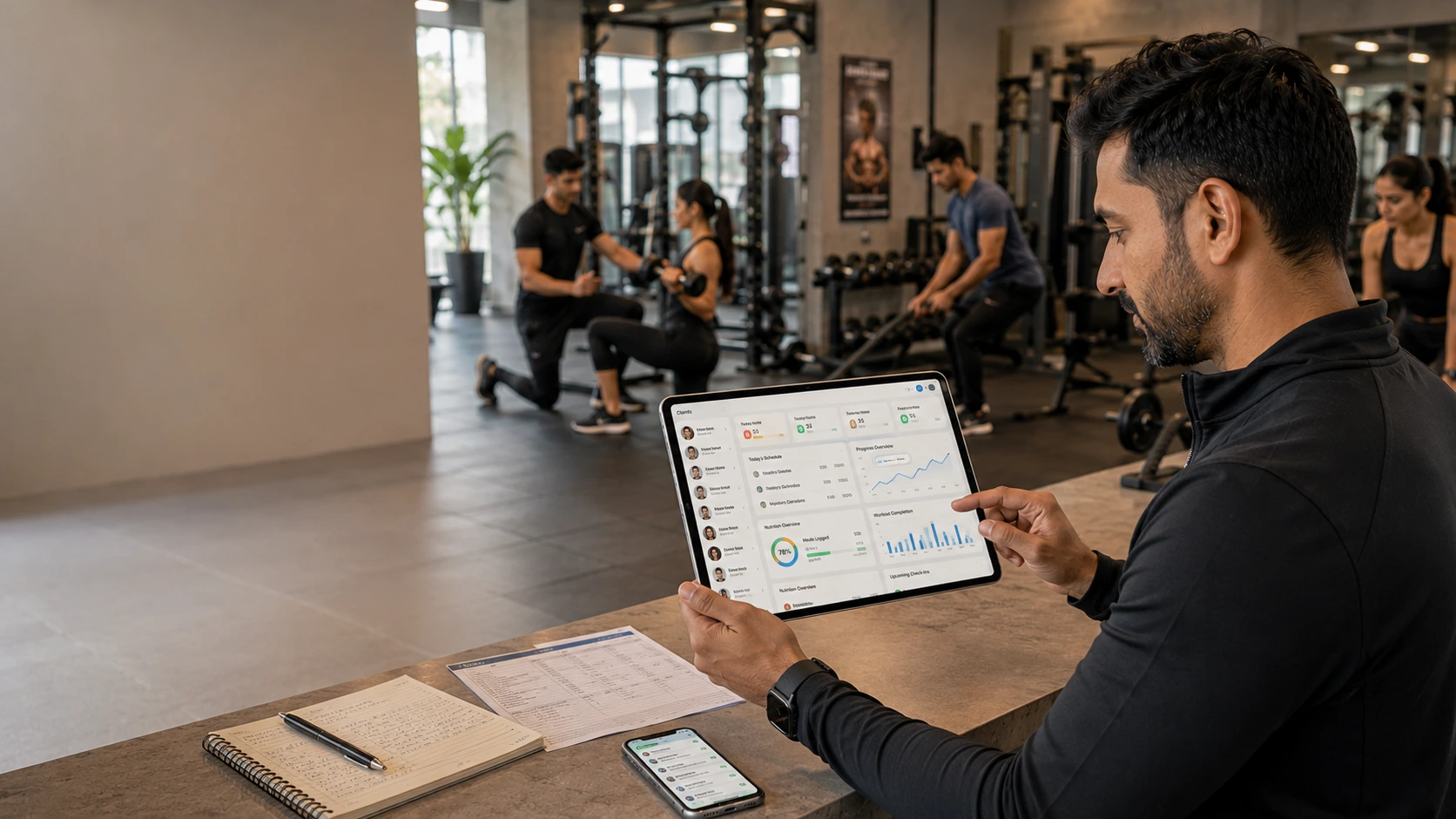
A trainer may begin with a notebook, Google Sheets and WhatsApp. But once clients have different workout plans, meal requirements, progress targets and schedules, keeping everything updated manually becomes difficult.
The best SAAS for fitness trainer india is therefore not simply the platform with the most features. It is the system that removes repetitive work while helping the trainer deliver a better coaching experience.
For Indian trainers, an important consideration is whether software handles both training and nutrition. A platform that manages workouts beautifully but leaves client meal tracking for trainers dependent on screenshots and WhatsApp messages may solve only half the problem.
Why Trainers Eventually Outgrow Spreadsheets and WhatsApp
The first few clients are easy to manage manually.
A trainer might send a workout through WhatsApp, collect progress photos, answer nutrition questions and schedule the next session. With five clients, this can work.
With 20 or 30 clients, the same process becomes fragmented.
A typical trainer may have:
- Workout plans in spreadsheets
- Client conversations in WhatsApp
- Progress photos in phone galleries
- Payments in UPI records
- Nutrition updates in chat messages
- Measurements in notebooks
- Appointment details in a calendar
The problem is not simply organisation. It affects coaching quality.
A client may ask for their previous workout while the trainer is searching through an old conversation. Another client may send a meal photo that gets buried under dozens of messages.
This is where personal trainer software becomes valuable. The objective is to create one structured place for client information, plans, communication and progress.
For trainers building an online or hybrid model, this also creates a foundation for client scaling without requiring every additional client to consume the same amount of administrative time.
Core Features Every Trainer Software Should Offer
The right fitness coach client management software should support the complete coaching workflow rather than only exercise programming.
Client management
A central client profile should make it easy to view goals, training history, measurements, plans and relevant notes.
This becomes especially useful when a trainer manages clients with different objectives, such as fat loss, strength development, general fitness or sports preparation.
Workout programming
Workout creation and scheduling remain essential.
Trainers should be able to create reusable templates while still adjusting exercises, sets, repetitions and progression for individual clients.
Progress tracking
A good system should make changes visible over time.
Useful metrics may include body measurements, strength progression, workout completion, adherence and other trainer-defined goals.
The purpose is not to collect every possible number. It is to help the trainer identify whether the client is progressing.
Nutrition tracking
This is one of the most important areas to evaluate.
Many trainers provide nutrition guidance through PDFs, spreadsheets or WhatsApp messages. That can work initially, but it becomes difficult to monitor consistently.
A diet tracking tool for fitness coaches should make it easier to review meals, identify patterns and provide feedback.
For Indian clients, this becomes even more relevant because meals frequently include mixed dishes such as dal, sabzi, roti, rice, poha, dosa or regional preparations that do not fit neatly into generic food databases.
Communication
In-app messaging, reminders and client updates can reduce dependence on scattered conversations.
The goal is not necessarily to eliminate WhatsApp. It is to ensure important coaching information does not disappear inside a busy chat thread.
Scheduling and payments
For independent trainers, administrative features can be just as valuable as fitness features.
Session scheduling, package tracking, payment records and renewal reminders help turn training from a collection of sessions into a more organised business.
Features That Sound Useful but Add Little Value
A common mistake is choosing software based on the feature list rather than actual workflow.
A platform may offer dozens of dashboards, analytics and integrations, but if the trainer still spends an hour every evening manually checking client messages, the core problem remains.
Be cautious about features that:
- Require extensive setup
- Clients rarely use
- Duplicate existing tools
- Produce data without actionable insights
- Make simple tasks unnecessarily complicated
For example, a sophisticated analytics dashboard may be less useful than a simple view showing which clients missed workouts, stopped logging meals or have not updated progress recently.
The same principle applies to nutrition.
A platform does not become a strong nutrition solution simply because it has a calorie database. Trainers should examine whether clients can realistically log Indian meals and whether the resulting information helps the trainer coach better.
The best system is the one that fits the trainer’s actual routine.
Typical Pricing Models for Solo Trainers vs Small Teams
Trainer app pricing can vary significantly depending on the number of active clients, included features, branding, automation and whether the platform supports multiple coaches.
Common models include:
Client-based pricing
The subscription increases as the trainer manages more active clients.
This can work well for independent trainers because software costs can scale alongside revenue.
Fixed-tier pricing
The trainer selects a package based on a client limit or feature set.
This is easier to budget for, but trainers should check what happens when they cross the client limit.
Feature-based pricing
Basic workout management may be included, while advanced nutrition, automation, branding or business tools require a higher plan.
This is particularly important when comparing Best SAAS for fitness Trainer India options.
Team or business pricing
Small coaching teams may need multiple trainers, shared dashboards and centralised client management.
Before buying, calculate the actual monthly cost at your expected client volume, not only the advertised entry-level price.
The cheapest plan may become expensive once essential nutrition, branding or automation features are added.
Must-Have vs Nice-to-Have Comparison Table
| Feature | Must-Have | Nice-to-Have |
| Client profiles | ✓ | |
| Workout programming | ✓ | |
| Progress tracking | ✓ | |
| Client messaging | ✓ | |
| Scheduling | ✓ | |
| Payment or package tracking | ✓ | |
| Nutrition tracking | ✓ | |
| client meal tracking for trainers | ✓ | |
| Habit tracking | ✓ | |
| Trainer analytics | ✓ | |
| trainer nutrition tracking dashboard | ✓ | |
| Automated reminders | ✓ | |
| White-label branded app | ✓ | |
| Advanced reporting | ✓ | |
| Wearable integrations | ✓ | |
| Business automation | ✓ |
For a trainer who only needs workout delivery, the essential list may be enough.
For someone building a scalable coaching business, nutrition, engagement and automation can become much more valuable.
A Buying Checklist for Independent Trainers
Before choosing best SAAS for fitness trainer india, ask these questions:
1. How many clients do I manage today?
Choose software based on current needs, but check the pricing structure at your expected future client count.
2. How much time do I spend on administration?
Track one normal week.
If you spend significant time copying workouts, searching WhatsApp messages, calculating nutrition or chasing progress updates, those are the processes software should improve.
3. Can clients actually use it?
A trainer may love a dashboard that clients find confusing.
Ask whether clients can easily access workouts, record progress, communicate and complete basic tracking from their phones.
4. Does nutrition work for Indian clients?
This deserves special attention.
Look for nutrition tracking, meal logging and food databases that accommodate Indian eating patterns rather than forcing clients into unnecessarily complicated manual entries.
5. Can the system support your coaching model?
Online coaching, in-person training and hybrid models require different workflows.
A trainer managing 15 premium clients may need depth and personalisation. A trainer managing 50 or more online clients may prioritise automation and reusable systems.
6. Does it help you build a business, not just deliver workouts?
Software should eventually help reduce administrative work, improve client engagement and create a more consistent coaching experience.
FitVia, a B2B platform from Nutrimate Wellness, is one example of this broader approach. It combines trainer dashboards, a branded member app, workout delivery, Indian food support, WhatsApp nutrition tracking, meal planning, progress reports and engagement tools for fitness professionals.
For trainers who want nutrition to be a first-class part of coaching rather than an afterthought, that distinction can matter.
The right software should ultimately make the trainer more efficient without making the coaching experience feel less personal.
FAQs
Personal trainers use different types of software depending on their business model. Common capabilities include workout programming, client management, progress tracking, scheduling, messaging, nutrition tracking and payments. Independent trainers should choose based on their client volume and coaching workflow rather than simply selecting the platform with the longest feature list.
Pricing varies according to active clients, features and plan structure. Some platforms use client-based pricing, while others use fixed tiers or charge separately for advanced features such as nutrition tracking, branding and automation. Trainers should compare the total cost at their expected client volume.
Some do, while others focus primarily on workout delivery. Trainers should specifically check whether the platform supports meal logging, nutrition plans, habit tracking and useful client nutrition insights. For Indian coaching businesses, it is also worth checking how well the system handles Indian meals and everyday eating patterns.