 Pradnya Ganorkar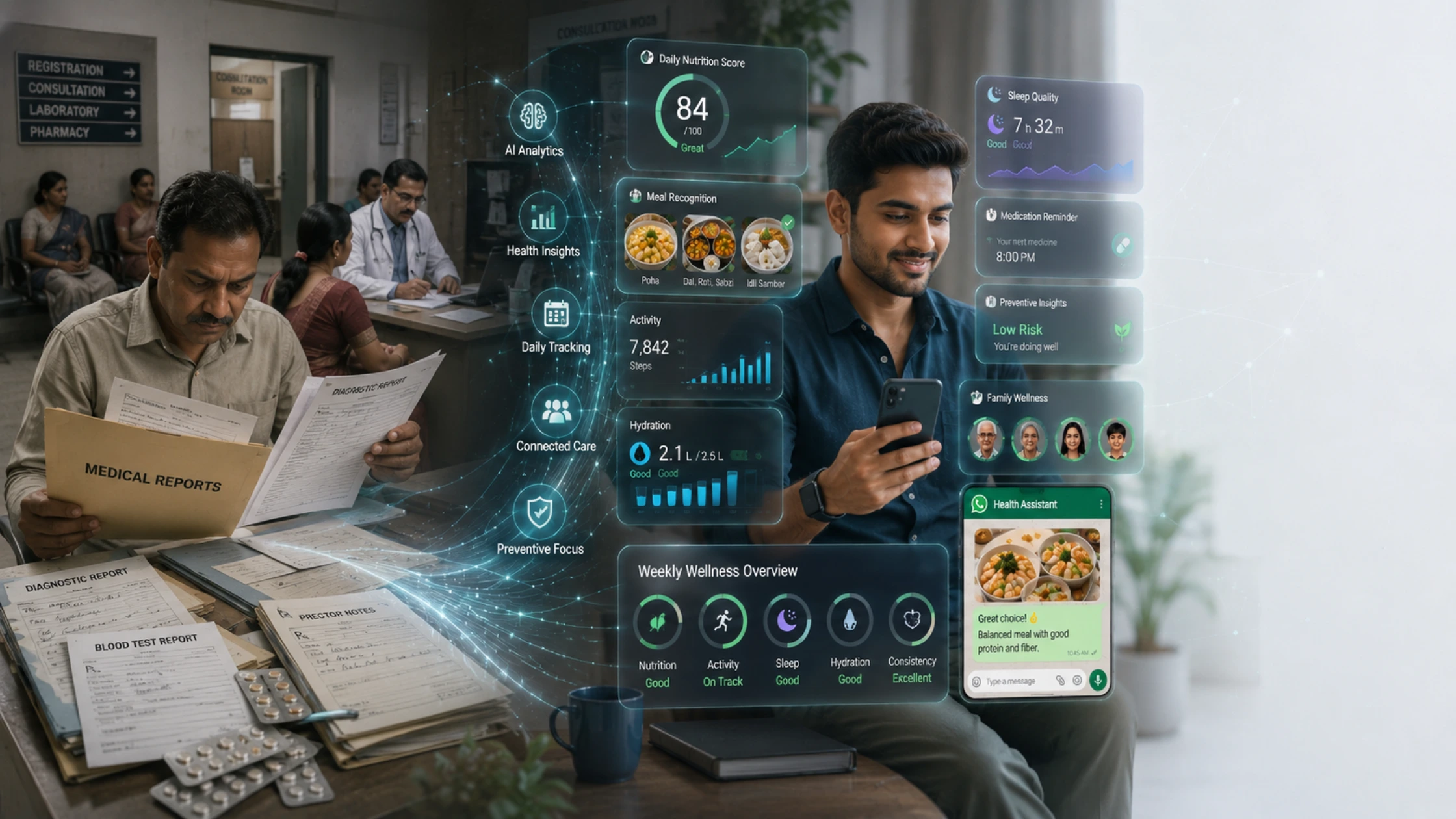
India’s healthcare system is entering a new phase.
For decades, healthcare has largely been reactive. Most people seek medical attention after symptoms appear, diseases progress, or health issues begin affecting daily life.
However, the future of digital health infrastructure India is unlikely to be built around hospitals alone.
Instead, it will increasingly depend on daily visibility, preventive care, AI-driven insights, and simple systems that help individuals take action before problems become serious.
This shift is particularly important in a country facing rising diabetes, obesity, cardiovascular disease, PCOS, hypertension, and stress-related health conditions.
The challenge is not a lack of healthcare professionals.
The challenge is the lack of continuous health awareness between consultations.
This is where AI wellness India, preventive health tech India, and scalable digital systems are beginning to transform how healthcare is delivered.
Why Current Health Systems Are Fragmented
One of the biggest challenges facing Indian healthcare today is fragmentation.
A person’s health data often exists in multiple disconnected locations:
- Hospital records
- Diagnostic reports
- Prescription files
- Fitness apps
- Nutrition trackers
- Wearable devices
- Personal notes
Very few systems bring these signals together into a usable health picture.
The Visibility Gap
A doctor may see a patient every few months.
A dietitian may review nutrition logs once per week.
An HR wellness manager may only receive participation reports.
The reality is that health happens every day.
Food choices, sleep quality, movement patterns, stress levels, medication compliance, and routine habits collectively determine long-term outcomes.
Without continuous visibility, intervention becomes reactive.
This is one reason many organizations are investing in employee health tracking solutions, preventive health monitoring tools, and digital wellness platform India initiatives.
Healthcare Is Still Event-Based
Current healthcare systems often focus on:
- Consultations
- Tests
- Diagnoses
- Treatments
Future healthcare will increasingly focus on:
- Monitoring
- Awareness
- Prevention
- Daily engagement
The organizations that build this capability will shape the future of digital health infrastructure India.
The Simplicity Problem
Many health technologies fail for one reason.
They are too complicated.
People Do Not Want More Apps
Most users already struggle with:
- Multiple passwords
- Several health applications
- Complex dashboards
- Manual data entry
This creates friction.
And friction reduces adherence.
Whether it is a patient, employee, gym member, or coaching client, the easiest system is usually the one people actually use.
Simplicity Drives Participation
Successful healthcare technology often shares three characteristics:
- Low effort
- Daily usability
- Immediate relevance
This is why WhatsApp-based workflows are becoming increasingly important in India.
Users are already comfortable using WhatsApp every day.
The future may belong less to complicated software and more to invisible technology that fits naturally into existing routines.
The Healthcare Adoption Challenge
Many healthcare businesses invest heavily in technology.
Few invest enough in behavior design.
Technology adoption improves when:
- Logging takes seconds
- Data collection feels natural
- Feedback is understandable
- Users see clear value
The most scalable preventive health software India solutions will likely prioritize simplicity over feature overload.
Daily Data as Infrastructure
When people hear “health infrastructure,” they usually imagine hospitals, clinics, medical equipment, or healthcare networks.
However, future healthcare infrastructure may increasingly include daily health data.
What Is Daily Health Data?
Examples include:
- Meal patterns
- Sleep duration
- Activity levels
- Medication adherence
- Stress indicators
- Energy levels
- Body composition changes
These signals often reveal problems long before laboratory results do.
Why Daily Visibility Matters
Consider diabetes.
Most patients understand what they should do.
The challenge is following recommendations consistently.
Daily visibility enables:
- Faster intervention
- Better adherence
- Improved coaching
- Personalized recommendations
This is why diabetes tracking software India, clinic nutrition software India, and advanced employee health dashboard India platforms are becoming increasingly relevant.
Daily Data Creates Better Decisions
Healthcare providers can identify:
- Missed medication patterns
- Poor nutrition habits
- Reduced engagement
- Early risk indicators
before conditions worsen.
This transforms healthcare from reactive treatment into proactive management.
AI + Indian Lifestyle Advantage
Artificial intelligence becomes valuable when it understands context.
Historically, many wellness platforms were built using Western assumptions.
That approach often struggles in India.
The Indian Food Challenge
India’s dietary diversity creates unique complexity.
Meals vary by:
- Region
- Culture
- Religion
- Language
- Household practices
A system that understands quinoa but not poha, rajma chawal, misal pav, khichdi, or ragi is unlikely to create meaningful engagement.
This is where AI wellness India has a unique opportunity.
Context Matters
Effective health systems should understand:
- Indian meal patterns
- Local food databases
- Family eating habits
- Regional dietary preferences
This improves accuracy and user trust.
Simplicity + AI
The future is not AI replacing healthcare professionals.
The future is AI reducing manual effort.
Examples include:
- Automated nutrition insights
- Smart adherence reminders
- Personalized risk identification
- Health pattern detection
This supports healthcare providers rather than replacing them.
Use Cases Across B2B Segments
The future of digital health infrastructure India extends far beyond hospitals.
Corporate Wellness
Organizations increasingly recognize that wellness participation alone is not enough.
Modern corporate wellness platform India solutions are shifting toward:
- Outcome measurement
- Habit visibility
- Engagement tracking
- Nutrition awareness
This improves ROI while supporting employee well-being.
Clinics & Healthcare Providers
Healthcare providers need continuity between consultations.
Solutions incorporating:
- patient diet tracking tool
- nutrition tracking for clinics
- diabetes diet tracking India
- remote monitoring
help improve adherence and retention.
Trainers & Coaches
Fitness professionals increasingly require:
- fitness coach client management software
- trainer nutrition tracking dashboard
- client meal tracking for trainers
- diet tracking tool for fitness coaches
to scale services effectively.
Gyms & Fitness Businesses
Many gym owners are transitioning from facility operators to wellness businesses.
This is where platforms like FitVia represent a broader industry trend.
Instead of relying only on memberships, modern fitness businesses are building complete digital ecosystems through:
- White-label member apps
- Nutrition tracking
- Workout delivery
- Community engagement
- Trainer dashboards
This supports gym member retention tools, fitness client engagement platform capabilities, and long-term gym business growth India opportunities.
FitVia’s model demonstrates how a white label fitness app India can help gyms, trainers, and dietitians create ongoing value rather than relying solely on physical attendance.
Future Outlook
India’s healthcare future will likely be defined by three shifts.
1. Preventive Healthcare Will Become Mainstream
Healthcare systems cannot sustainably manage rising lifestyle disease burdens through treatment alone.
Prevention will become essential.
2. Daily Visibility Will Matter More Than Annual Checkups
People generate health signals every day.
Organizations capable of interpreting those signals responsibly will create better outcomes.
3. Simplicity Will Win
The most successful health platforms may not be the most sophisticated.
They may be the easiest to use consistently.
Systems built around:
- Daily engagement
- Low-friction tracking
- Indian context
- Meaningful insights
will likely form the foundation of future healthcare delivery.
Low-friction systems may become foundational for scalable health ecosystems.
Nutrimate’s AI-powered approach reflects this broader shift by focusing on practical health visibility rather than complicated tracking. Through Indian meal intelligence, WhatsApp-first convenience, and India’s #1 whatsapp meal logging feature and Unique Caregiver feature, the platform supports individuals, families, healthcare providers, and wellness businesses seeking sustainable engagement and long-term preventive care.
References
1. National Digital Health Mission (Government of India)
2. World Health Organization – Digital Health
https://www.who.int/health-topics/digital-health
FAQs
Digital health infrastructure refers to the systems, platforms, technologies, and data networks that enable healthcare delivery, monitoring, communication, and preventive care through digital tools. It includes health records, wellness platforms, remote monitoring systems, nutrition tracking, and AI-powered health management solutions.
AI is helping preventive healthcare by identifying patterns in daily health data, improving adherence, personalizing recommendations, automating monitoring, and enabling earlier intervention before health issues become serious. When combined with simple user experiences and local health context, AI can improve engagement and long-term health outcomes.
Read Nutrimate Wellness first on Google