 Pradnya Ganorkar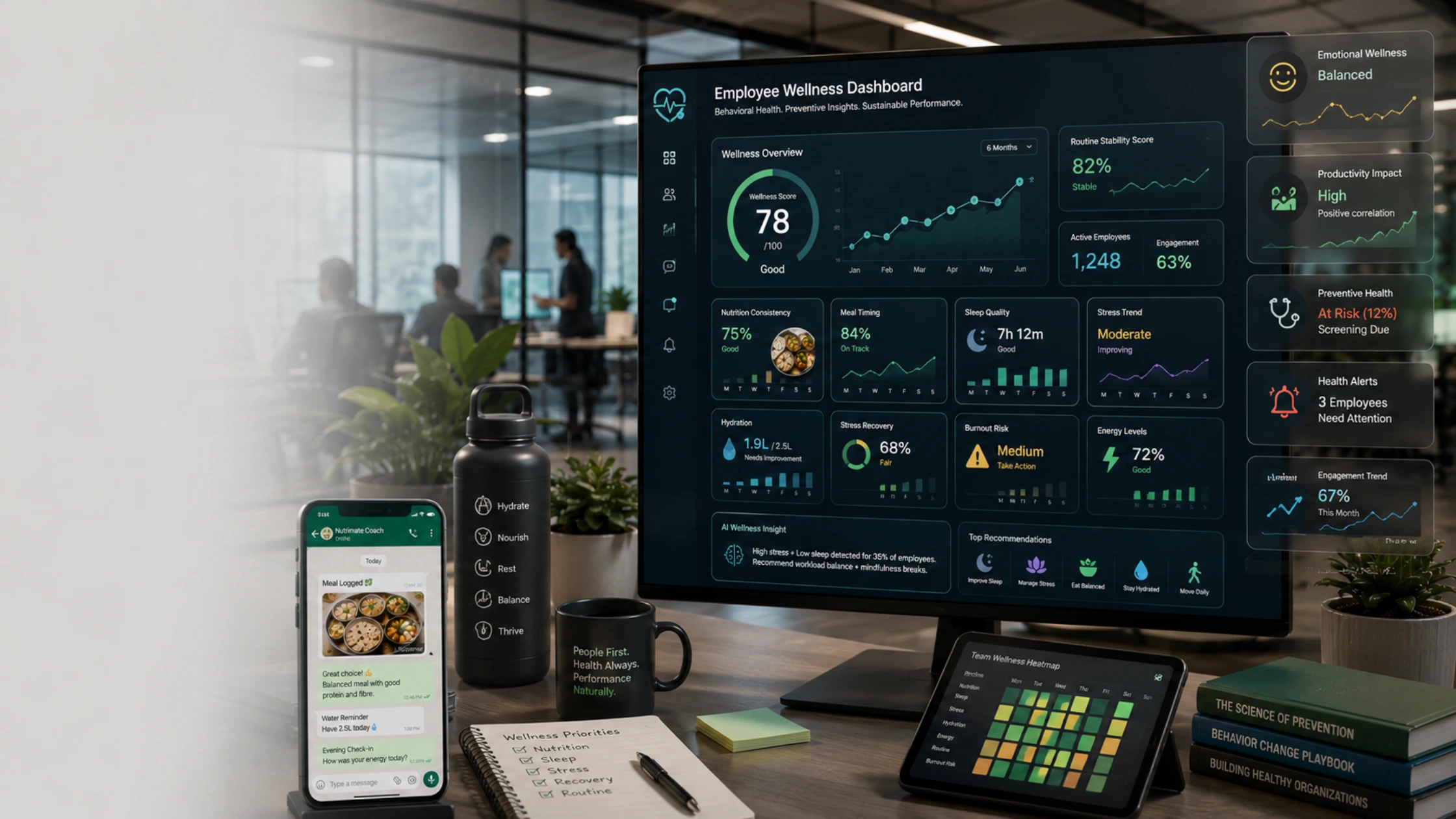
Most workplace wellness dashboards fail for one simple reason.
They track participation.
Not behavior change.
Many companies proudly measure:
- Step counts
- Challenge participation
- App downloads
- Attendance rates
- Webinar registrations
But none of these automatically improve employee health.
An employee may:
- Attend a wellness webinar
- Complete 10,000 steps once
- Join a monthly challenge
…and still struggle with:
- Stress eating
- Poor sleep
- High sugar intake
- Burnout
- Irregular meals
- Fatigue
- Rising blood sugar markers
This is why many organizations investing in corporate wellness still fail to see meaningful long-term outcomes.
A modern employee health dashboard India must move beyond vanity metrics and focus on daily behavioral consistency.
That means tracking:
- Nutrition habits
- Stress patterns
- Sleep consistency
- Routine stability
- Meal quality
- Engagement trends
- Preventive health signals
Today’s workforce health challenges are no longer limited to inactivity.
Indian employees increasingly face:
- Long sitting hours
- Stress-driven eating
- Hybrid work fatigue
- Diabetes risk
- Poor sleep cycles
- Emotional burnout
- Screen exhaustion
According to the World Health Organization, noncommunicable diseases including diabetes, cardiovascular disease, and obesity are strongly linked to daily lifestyle behaviors.
Meanwhile, India continues to see rising metabolic health risks across working-age populations, especially in urban environments.
This is where intelligent employee health tracking solutions become strategically important.
The future of workplace wellness is not about counting activity alone.
It is about understanding daily behavioral patterns before they become long-term health risks.
Why Surface-Level Metrics Fail
Most wellness dashboards are built around visible activity.
But visible activity is not the same as sustainable health behavior.
For example:
- An employee can hit a step goal while sleeping poorly.
- Someone may attend yoga sessions but still stress eat daily.
- Participation numbers may rise while burnout quietly increases.
This is one of the biggest weaknesses in traditional workplace wellness engagement tools.
They measure activity participation instead of consistency signals.
Common surface-level metrics include:
- Challenge completions
- Login frequency
- Event participation
- Webinar attendance
- Fitness challenge rankings
These create short-term excitement.
But they rarely predict long-term health outcomes.
A smarter employee health dashboard India should prioritize:
- Behavioral consistency
- Habit stability
- Daily routine patterns
- Nutrition quality
- Stress indicators
- Recovery markers
This creates more actionable insights for HR teams.
For example:
- Are employees skipping meals regularly?
- Are stress-snacking patterns increasing?
- Are sleep routines collapsing during project deadlines?
- Are energy crashes affecting productivity?
These are real preventive indicators.
Not vanity metrics.
This shift is becoming increasingly important for organizations investing in:
- corporate wellness platform India
- digital wellness platform India
- preventive health software India
- digital health infrastructure India
Behavior vs Biometrics
Many companies focus only on biometrics:
- Weight
- BMI
- Blood sugar
- Blood pressure
These are important.
But they are lagging indicators.
Behavior is what predicts those outcomes earlier.
For example:
- Irregular eating patterns often appear before blood sugar issues.
- Chronic sleep disruption often precedes burnout.
- Daily stress eating patterns may emerge long before visible weight gain.
This is why modern preventive health monitoring tools focus heavily on behavior tracking.
Especially in India, where:
- Work stress is increasing
- Eating schedules are irregular
- Processed food consumption is rising
- Hybrid work has blurred routine boundaries
A useful dashboard should combine:
- Biometrics
- Habit data
- Nutrition visibility
- Stress trends
- Behavioral patterns
This creates proactive wellness management instead of reactive healthcare.
For example:
| Weak Dashboard | Strong Dashboard |
| Steps only | Nutrition + sleep + stress + routines |
| Attendance tracking | Consistency tracking |
| One-time assessments | Daily behavioral signals |
| Generic wellness scores | Personalized health patterns |
| Activity participation | Lifestyle stability insights |
This approach improves:
- Employee engagement
- Early intervention
- Wellness ROI
- Long-term preventive health
- Workplace productivity
What HR Should Track Daily
A practical wellness dashboard should focus on signals employees can realistically maintain.
Not overwhelming data collection.
The best dashboards simplify visibility.
Key categories include:
1. Nutrition Consistency
Track:
- Meal timing
- Skipped meals
- Processed food frequency
- Sugar-heavy snacking
- Hydration consistency
This is especially important for:
- Corporate employees
- Shift workers
- Hybrid teams
- IT professionals
Simple meal visibility often reveals hidden burnout patterns.
This is where AI-powered Indian meal intelligence becomes useful.
Nutrimate’s India’s #1 whatsapp meal logging feature and Unique Caregiver feature simplify food awareness through WhatsApp-based logging designed for Indian routines and Indian meals.
2. Stress Signals
Instead of complicated psychological tracking, dashboards can monitor:
- Self-reported energy
- Mood trends
- Workload spikes
- Burnout indicators
- Sleep consistency
Small behavioral patterns matter more than occasional surveys.
3. Routine Stability
Routine consistency strongly influences:
- Productivity
- Emotional stability
- Metabolic health
- Sleep quality
Useful signals include:
- Sleep timing
- Work-break balance
- Weekend recovery patterns
- Meal regularity
4. Engagement Quality
Not just app opens.
Instead track:
- Habit consistency
- Program completion
- Sustained participation
- Behavior improvements
This creates more meaningful HR insights.
Nutrition, Stress, Routine Indicators
The most effective employee health metrics are often simple.
The problem is not lack of health knowledge.
It is behavioral inconsistency.
Especially in India, workplace health challenges are deeply connected to:
- Long commute times
- Late-night work culture
- Emotional eating
- High caffeine intake
- Festival eating
- Weekend binge cycles
- Sedentary routines
A strong dashboard identifies patterns such as:
- Increased late-night eating during project deadlines
- Reduced hydration during office-heavy weeks
- Weekend recovery instability
- Increased sugar intake during stress periods
These insights are far more valuable than step competitions alone.
Modern HR analytics wellness systems should identify:
- Risk trends
- Burnout patterns
- Engagement drops
- Habit instability
- Preventive intervention opportunities
This is where behavioral health intelligence becomes important.
Some organizations are now adopting systems inspired by platforms like FitVia, where gyms, trainers, and wellness providers use centralized dashboards combining:
- Nutrition tracking
- Habit visibility
- Engagement analytics
- Workout consistency
- Retention tracking
The same logic applies inside corporate wellness ecosystems.
Daily consistency signals matter more than isolated health events.
Dashboard Design Framework
A successful employee health dashboard India should feel supportive, not invasive.
Overcomplicated systems reduce adoption quickly.
A practical framework includes:
Layer 1: Daily Simplicity
Employees should easily log:
- Meals
- Energy
- Sleep
- Mood
- Hydration
Without friction.
This is why WhatsApp-first systems are increasingly effective in India.
Employees already use WhatsApp daily.
Reducing behavioral friction improves consistency dramatically.
Layer 2: Team-Level Insights
HR should see:
- Wellness trends
- Stress spikes
- Engagement changes
- Habit stability patterns
Without exposing unnecessary personal data.
Layer 3: Preventive Alerts
The dashboard should identify:
- Burnout risks
- Routine instability
- Sleep decline
- Emotional eating patterns
- Engagement collapse
Before serious health issues emerge.
Layer 4: Actionable Recommendations
Not generic wellness quotes.
Instead:
- Meal consistency suggestions
- Stress management prompts
- Recovery reminders
- Routine improvement guidance
This makes wellness operational instead of symbolic.
Organizations investing in:
- employee health tracking solutions
- workplace wellness engagement tools
- digital health infrastructure India
must prioritize usability over complexity.
Do vs Don’t
| Do | Don’t |
| Track daily habits | Track only steps |
| Focus on consistency | Depend on one-time challenges |
| Measure behavioral trends | Obsess over vanity metrics |
| Simplify logging | Create complicated dashboards |
| Use preventive indicators | Wait for visible health decline |
| Build habit visibility | Overwhelm employees with data |
| Encourage sustainable routines | Push unrealistic wellness goals |
Content Direction
Pain:
“Companies track participation, not outcomes”
Many organizations mistake wellness activity for wellness improvement.
But real workplace health outcomes come from:
- Consistency
- Behavioral visibility
- Early intervention
- Sustainable routines
Modern wellness systems should focus on understanding everyday employee behavior instead of simply counting attendance or challenge participation.
Product Integration
“Modern dashboards focus on consistency signals, not vanity metrics…”
Some modern wellness systems now combine:
- AI-powered nutrition visibility
- WhatsApp-based engagement
- Routine tracking
- Habit monitoring
- Preventive wellness analytics
Nutrimate applies this through simple Indian-first tracking designed for real employee lifestyles rather than unrealistic fitness expectations.
The same operational thinking also powers FitVia, Nutrimate’s platform supporting gyms, trainers, dietitians, and wellness businesses with:
- White-label wellness systems
- Trainer dashboards
- Habit tracking
- Nutrition visibility
- Client engagement analytics
- Indian food intelligence
- Retention-focused wellness workflows
This reflects a broader shift toward scalable, behavior-driven wellness infrastructure.
References
FAQs
HR should track behavioral consistency indicators such as nutrition habits, stress patterns, sleep quality, hydration, routine stability, and engagement trends instead of only activity participation metrics.
No. Step counts alone do not reflect overall employee health. Wellness outcomes are influenced by sleep, stress, nutrition, emotional health, routine consistency, and long-term behavioral patterns.
Read Nutrimate Wellness first on Google