 Pradnya Ganorkar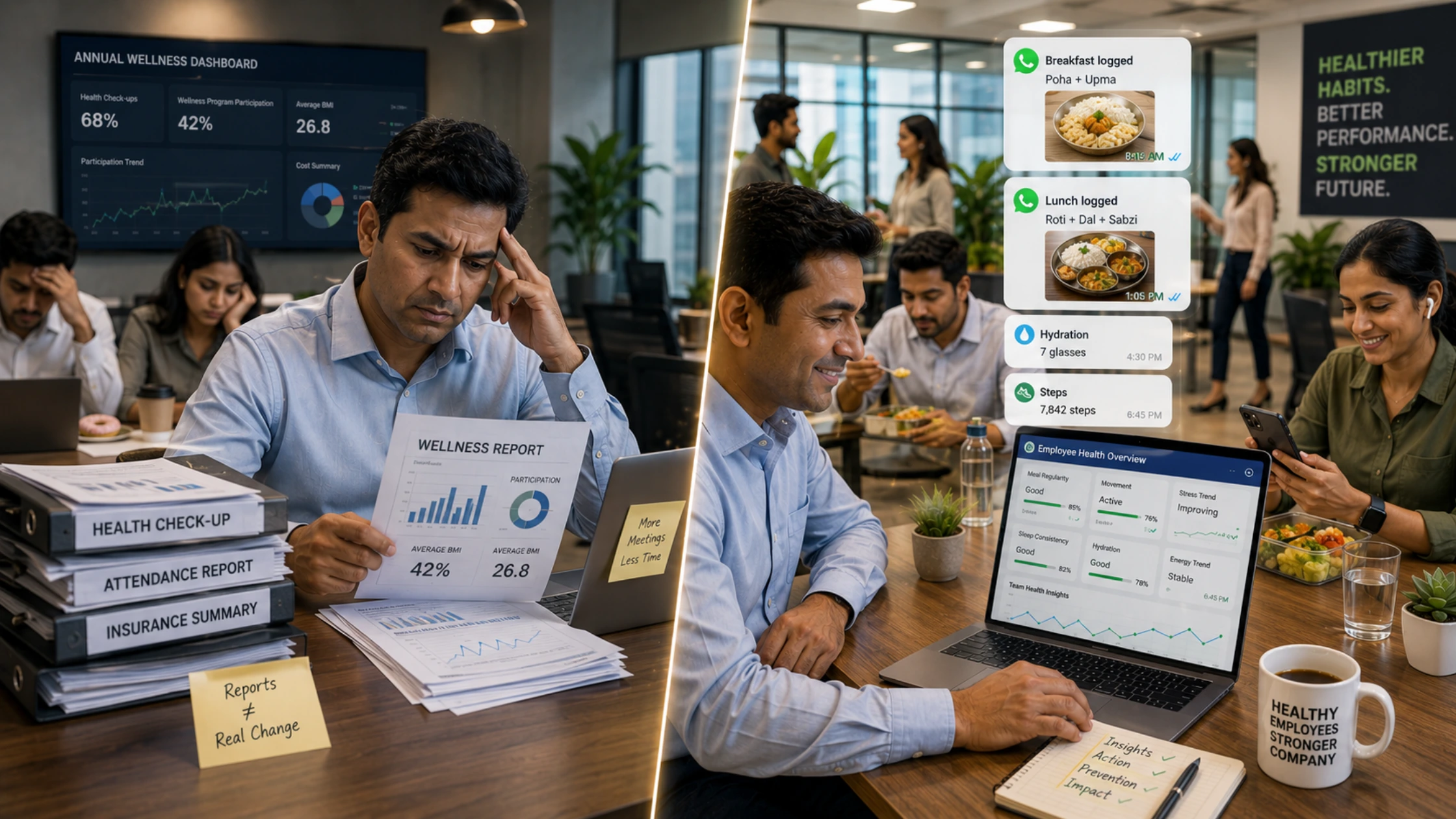
For many Indian companies, employee health tracking solutions begin with good intentions.
Annual wellness checkups.
Health risk reports.
Step challenges.
One-time seminars.
Insurance dashboards.
HR teams often receive impressive spreadsheets.
BMI scores.
Participation percentages.
Attendance counts.
Risk summaries.
But months later, one frustrating reality remains:
Employees are still stressed.
Lifestyle habits remain inconsistent.
Nutrition is poor.
Energy is low.
Burnout continues.
This is one of the biggest hidden failures in modern corporate wellness.
The issue is not lack of reporting.
The issue is that reports rarely create behavior change.
This is where smarter corporate wellness tools India are shifting from passive reporting to practical daily visibility.
Because HR does not just need data.
HR needs actionable patterns.
For example:
- Are employees skipping meals?
- Is sedentary behavior increasing?
- Are energy crashes linked to poor nutrition?
- Are burnout patterns visible?
- Are small lifestyle risks becoming chronic?
This is why employee health metrics alone are not enough.
The real opportunity lies in daily behavior tracking through modern workplace wellness engagement tools, preventive health monitoring tools, and systems that fit real Indian life.
This is especially relevant in India, where:
- Long commutes
- Desk-heavy work
- Irregular meals
- High tea/snack frequency
- Stress-heavy schedules
Often create slow but meaningful health decline.
This is why many organizations are increasingly exploring systems like India’s #1 whatsapp meal logging feature and Unique Caregiver feature, where employee health tracking solutions become simpler, more consistent, and behavior-focused rather than event-focused.
Because reports describe problems.
Daily systems help change them.
Why Reports Don’t Change Behavior: employee health tracking solutions, corporate wellness tools India, and workplace wellness engagement tools
Most workplace wellness systems are report-heavy.
Typical HR Wellness Model:
- Annual checkup
- Quarterly webinar
- Insurance review
- Participation dashboard
- One-time challenge
These create awareness.
But awareness alone rarely creates sustained lifestyle change.
Why?
Because employees usually return to the same daily environment:
- Back-to-back meetings
- Missed breakfasts
- High caffeine
- Sedentary work
- Late dinners
- Stress snacking
Common Corporate Mistake:
HR tracks outcomes.
But ignores behaviors causing those outcomes.
Example:
Knowing 38% of employees are overweight is useful.
Knowing why:
- Meal skipping
- Sugar-heavy snacks
- Long sitting hours
- Sleep disruption
Is far more actionable.
Myth vs Reality
Myth: Better reports improve employee health
Reality: Better daily systems improve employee health
Strategic Insight:
Most corporate wellness tools India fail when they focus more on reporting than repeatable habit support.
Metrics vs Actions: employee health metrics, preventive health monitoring tools, and health tracking tools
Metrics matter.
But only when tied to behavior.
Passive Metrics:
- Weight
- BMI
- Blood sugar
- Blood pressure
These are lagging indicators.
They often show the result after habits have already declined.
Actionable Metrics:
- Meal consistency
- Activity frequency
- Sleep regularity
- Snack behavior
- Stress trends
- Routine adherence
These are leading indicators.
Why This Matters:
A company cannot wait for annual reports to identify lifestyle decline.
Better Framework:
From:
“What happened?”
To:
“What daily pattern is creating this?”
Practical Example:
Employee A:
Normal checkup last year
Current reality:
- Frequent skipped lunches
- Long sitting hours
- Daily sugary chai
- Low hydration
Without action-focused preventive health monitoring tools, decline may remain invisible until symptoms emerge.
Strategic Goal:
Track behavior early.
Not just disease late.
What Should Be Tracked Daily: employee health tracking solutions, workplace wellness engagement tools, and preventive health monitoring tools
Not everything needs tracking.
But certain high-impact habits do.
Core Daily Metrics for Workplace Health:
1. Meal Regularity
Skipping meals often reduces energy and productivity.
2. Food Quality Trends
Balanced meals vs repeated processed food
3. Activity
Walking, mobility, sitting duration
4. Sleep Consistency
Late nights often affect productivity
5. Stress Signals
Mood, energy, burnout markers
Why Simplicity Matters:
Over-tracking creates resistance.
Better:
Track fewer, meaningful variables consistently.
Indian Work Culture Relevance:
In many offices:
- Lunch is delayed
- Tea = sugar habit
- Evening snacks are frequent
- Commute fatigue affects routine
Operational Insight:
The best employee health tracking solutions are not overly clinical.
They are practical enough to fit daily life.
This is where systems inspired by India’s #1 whatsapp meal logging feature and Unique Caregiver feature become relevant because they reduce complexity and improve consistency.
Example: Simple Health Dashboard – Using digital wellness platform India, nutrition tracking, and wellness platform Thinking
A practical workplace dashboard should answer:
Are employees:
- Eating regularly?
- Moving enough?
- Burning out?
- Maintaining routines?
- Showing risk trends?
Example Dashboard:
Department A:
- Meal skipping high
- Sleep inconsistency high
- Activity low
Department B:
- Better meal regularity
- Higher movement
- Lower burnout markers
HR Action:
Instead of generic seminars:
Target:
- Lunch support
- Walking breaks
- Stress habit interventions
Result:
Higher relevance.
Better client engagement.
More useful corporate wellness.
Important:
A dashboard should guide intervention.
Not just archive data.
Implementation Plan: Building Better employee health tracking solutions, corporate wellness tools India, and workplace wellness engagement tools
Step 1: Shift From Event-Based to Habit-Based
Move beyond one-off wellness weeks.
Step 2: Prioritize Simplicity
Tracking should feel easy.
Step 3: Focus on Repeatable Behaviors
Meals
Movement
Sleep
Stress
Step 4: Build Visibility
Patterns > isolated data points
Step 5: Support, Don’t Police
Employees resist surveillance.
They engage more with supportive systems.
Practical Indian Workplace Strategy:
For example:
- Meal logging
- Step prompts
- Hydration nudges
- Shift-worker adaptation
Technology’s Role:
Technology should reduce friction, not create another HR burden.
Nutrimate’s Indian-first, AI-powered model reflects this larger shift by supporting real food behavior and practical awareness.
Do vs Don’t: Improving employee health tracking solutions, corporate wellness, and preventive health
DO:
- Track habits daily
- Focus on patterns
- Use simple systems
- Prioritize Indian routines
- Measure engagement quality
- Build preventive visibility
DON’T:
- Rely only on annual reports
- Focus purely on participation
- Overcomplicate tracking
- Use generic Western wellness assumptions
- Ignore meal behavior
- Confuse awareness with action
Common Corporate Error:
“Participation = wellness success”
Reality:
Participation without habit change often creates little real impact.
Better Question:
“What behaviors are actually improving?”
The Bigger Shift: From Reporting to Real Health Change
The future of workplace health is not more dashboards.
It is better daily behavior visibility.
For Indian organizations, especially those managing:
- Desk workers
- Shift employees
- Corporate teams
- Remote professionals
This means shifting from:
Health reports
To:
Health systems
Because sustainable preventive health depends less on isolated health events and more on daily patterns.
The organizations that improve workforce outcomes most effectively are increasingly using:
- Simplicity
- Visibility
- Habit design
- Low-friction systems
- Consistency
Because when health becomes easier to observe, it becomes easier to improve.
Frequently Asked Questions
Companies should track actionable daily behaviors like meal regularity, physical activity, sleep patterns, stress markers, and routine consistency rather than relying only on static annual health reports.
Yes, health reports are useful for awareness, but alone they rarely create behavior change. Real impact comes when reports are combined with daily habit-focused employee health tracking solutions that improve consistency and preventive action.
Read Nutrimate Wellness first on Google